Showing posts with label Retreat. Show all posts

Friday, 21 February 2020

'A Very Dangerous and Anxious Sitation': European Refugees and the Retreat Hospital, 1938-1945


By Dr. Nicholas Melia, Archives Assistant, Borthwick Institute for Archives
_________________________________________________________________________________

In spring 1939, John W. Harvey, professor of philosophy at Leeds University and a prominent Quaker, wrote to Dr. Arthur Pool, Medical Superintendent at the Retreat Hospital, requesting help in finding work and hospitality for a ‘very distinguished’ émigré psychoanalyst who had fled Vienna in the aftermath of the Anschluss. The letter, preserved in a file of correspondence and papers in the Retreat Archive at the Borthwick institute relating to applications for posts by European refugees before and during the war (RET/5/6/16), explains that not only had Dr. Maxim Steiner ‘heard of the Retreat’, but came ‘with very strong recommendations from Prof. Freud’, to whom Steiner acted as physician and dermatologist in Vienna.
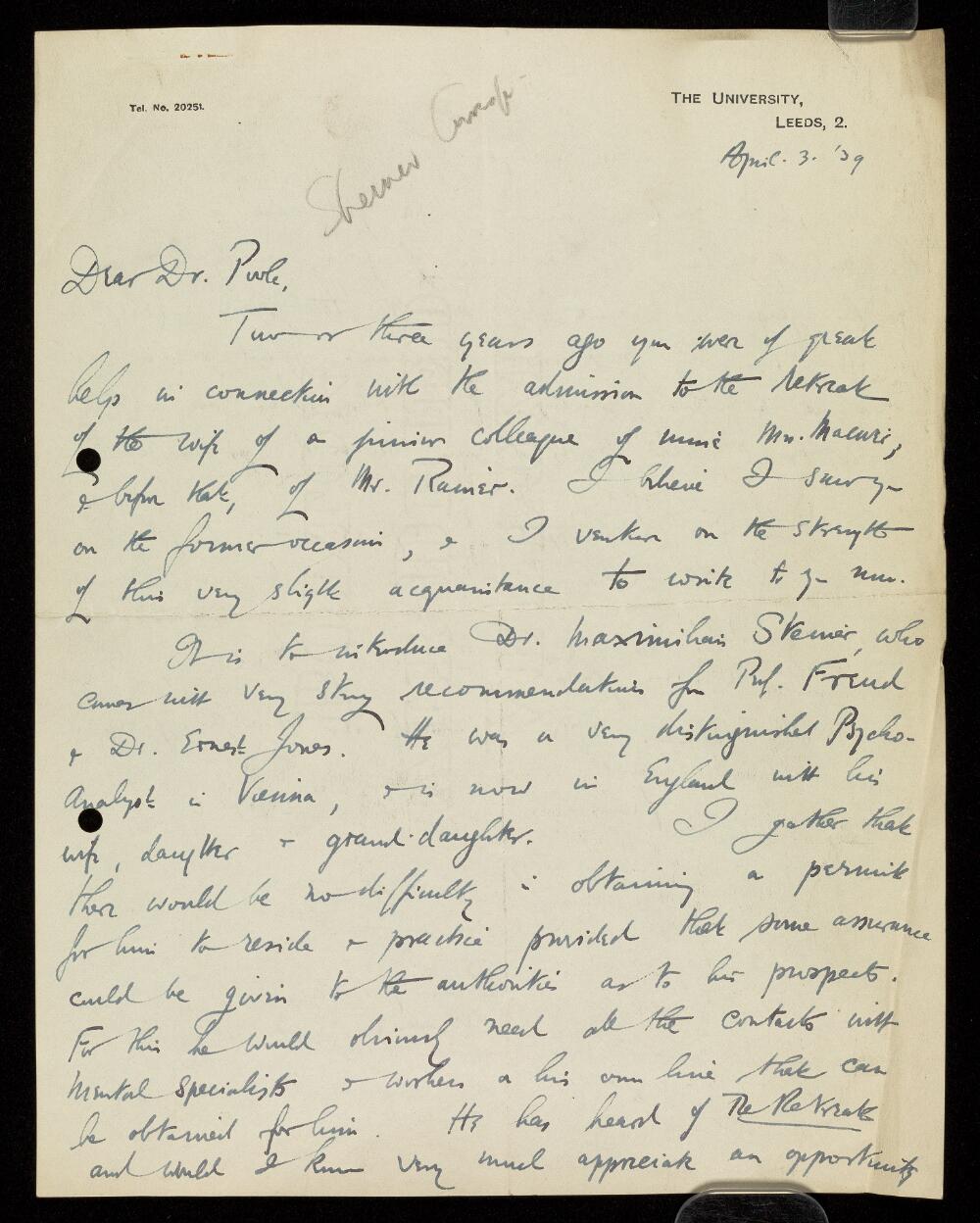
Letter from John W. Harvey, University of Leeds to Dr. Arthur Pool concerning Dr. Maxim Steiner, April 1939.
Twelve months earlier, Freud had written to Ernest Jones, president of both the International Psychoanalytical Association and the British Psycho-Analytical Society, begging him to aid Steiner’s passage to England: ‘I cannot claim that he is important as an analyst’, wrote Freud, ‘but […] he is a special friend of mine’.(1) Jones appears to have shown the letter to Harvey some time later, and, despite the personal, rather than professional tenor of Freud’s recommendation, Pool nonetheless met the 62 year old Steiner over tea in York. In his response to Harvey, he described Steiner as ‘very alert intellectually and younger than his years’, despite suffering with a self-confessed depression resulting from the ‘terrible things’ afflicting Europe.

While Steiner was not ultimately able to secure work at the Retreat, he was in no sense the only physician to seek refuge from Nazi persecution in the UK or, indeed, at the Retreat. A Quaker poverty relief unit had been active in Vienna for some years, and Freud himself had dined at the Friends Society there, likely through acquaintance with British Quaker psychoanalyst John Rickman. Rickman had moved to Vienna in 1920 and, with his wife Lydia, spent much time working with the unit to alleviate poverty. In fact, the Friends War Victims’ Relief Committee (later the Friends Relief Service) had acted to organize aid and hospitality for Europeans affected by poverty, war and political instability since the Franco-Prussian war in 1870, and was ultimately awarded the Nobel peace prize in 1947 for its wartime work.
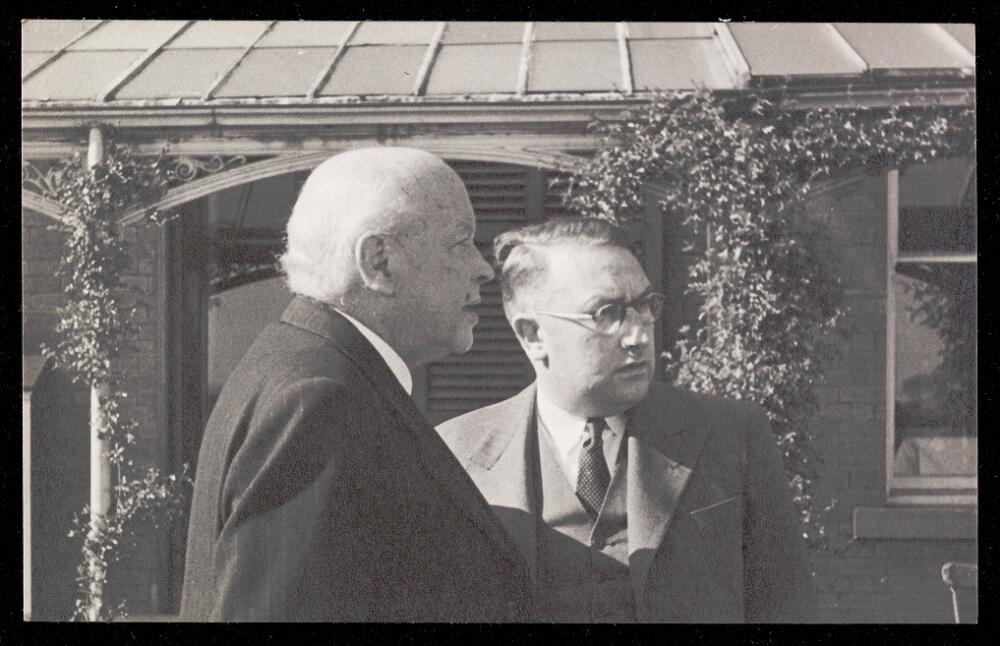
Photograph of Arnold S. Rowntree with Dr Arthur Pool, Retreat Physician Superintendent, 1946.
It is no surprise, therefore, that Quaker responses to the rise of fascism in Europe were coordinated early. The German Emergency Committee (later Friends Committee for Refugees), which played a vital role in the 1938 Kindertransport, was established in 1933, and within months of the Anschluss and annexation of Sudetenland, the Retreat became the recipient of the first of many applications for work and hospitality, mostly via the mediation of Quaker agencies and networks. The Retreat Management Committee ‘felt it was right to offer what hospitality it could to refugees from central Europe’ and had, in fact, signaled that it was ‘anxious to help in any way’ possible a matter of days after Kristallnacht. A few weeks later, the Committee responded to a request from the Vienna Society asking for help in ‘getting non-Aryans to England’, and by January 1939, had ‘committed [itself] to trying to get two doctors into the country – a Dr. Koch from Vienna and a Dr. Kiewe from Germany’. It was also working to provide hospitality for a third - Dr. Fritz Kraupl - already in London, and had already hosted Dr. Gretl Hitschmann earlier in 1938, who wished to gain ‘insight into the work of an English Mental Hospital’, and had, Management Committee minutes reveal, been ‘forced to leave Austria because she is a Jewess’. Shortly thereafter, the Committee would also agree to provide work running the Male Nurses Hostel for Manfred and Ilse Tallert, who had landed in Whitby while fleeing Europe for Shanghai.

Little correspondence survives regarding the successful arrival in April 1939 of Dr. Siegfried Kiewe, but Management Committee minutes tell us that he had been forced to leave Berlin ‘on account of his being a Jew’. The Committee offered hospitality ‘for an indefinite period’, and psychiatrist and family were lodged with Retreat secretary Mr. Burgess at Garrow Bank. Kiewe initially undertook laboratory, dispensary and massage work at the hospital, but in 1941, the Committee and Board of Control approved his undertaking of locum duties, and he continued thereafter as a salaried Assistant Physician until retirement in January 1959. Upon receipt of the Alfred and Margaret Torrie award, given to staff making an outstanding contribution to the wellbeing of patients, Kiewe payed tribute to the ‘kindness, understanding and tolerance’ he had received from the moment of his arrival in York. He died in 1986 at the age of 105.(2)

Dr. Fritz Kraupl, a medical dietician from Sudetenland exiled in London with experience of treating nervous disorders, was initially invited to the Retreat as a guest of the Committee with the intention of undertaking a kitchen traineeship. However, the committee felt that it would be inappropriate to place a male physician into a kitchen in which the ‘staff are wholly female’, and having taken up residence on 31st July 1939, Kraupl was found work in the Retreat laboratory, before obtaining a Clinical Assistant post at the Crichton Royal, Dumfries, in May 1940.

Securing safe passage for Dr. Rudolph Koch, however, proved more difficult. The Vienna Society of Friends approached Pool in November 1938 seeking hospitality and work for a physician ‘just been released from the concentration camp’. In correspondence, Koch declared himself ‘compleatly [sic] healthy and willing to work’, but stressed the need to escape from Vienna with the ‘utmost urgency’. Given the prohibitive implementation of the UK’s immigration legislation under the 1919 Aliens Restriction Act and Aliens Order 1920, which severely limited the possibility of refugees gaining employment, Pool was unwilling to try to engage Koch as a physician. Instead, he submitted a formal request to the Home Office for permission to employ a ‘foreigner who has left or wishes to leave Germany or Austria on political, racial or religious grounds’ as a laboratory technician. The combination of an intensifying climate of Home Office suspicion and the delay in processing applications due to a huge increase in numbers of applicants, however, took its toll on the Koch family. This is most clearly felt in the series of increasingly desperate letters from Koch’s mother preserved in the correspondence file, who wrote directly to Pool to express ‘the greatest worry about my son’.

Despite Pool’s desire to help and, if necessary, take Koch in ‘on no official basis’, the Germany Emergency Committee received correspondence from the Home Office on February 15th 1939, rejecting the application and stating that ‘we are unable to agree to foreigners, especially foreign doctors, coming to the United Kingdom to settle in employment as laboratory assistants’. Two weeks later, Pool reported to the Retreat Committee that ‘arrangements for admitting Dr. Koch […] had fallen through’.
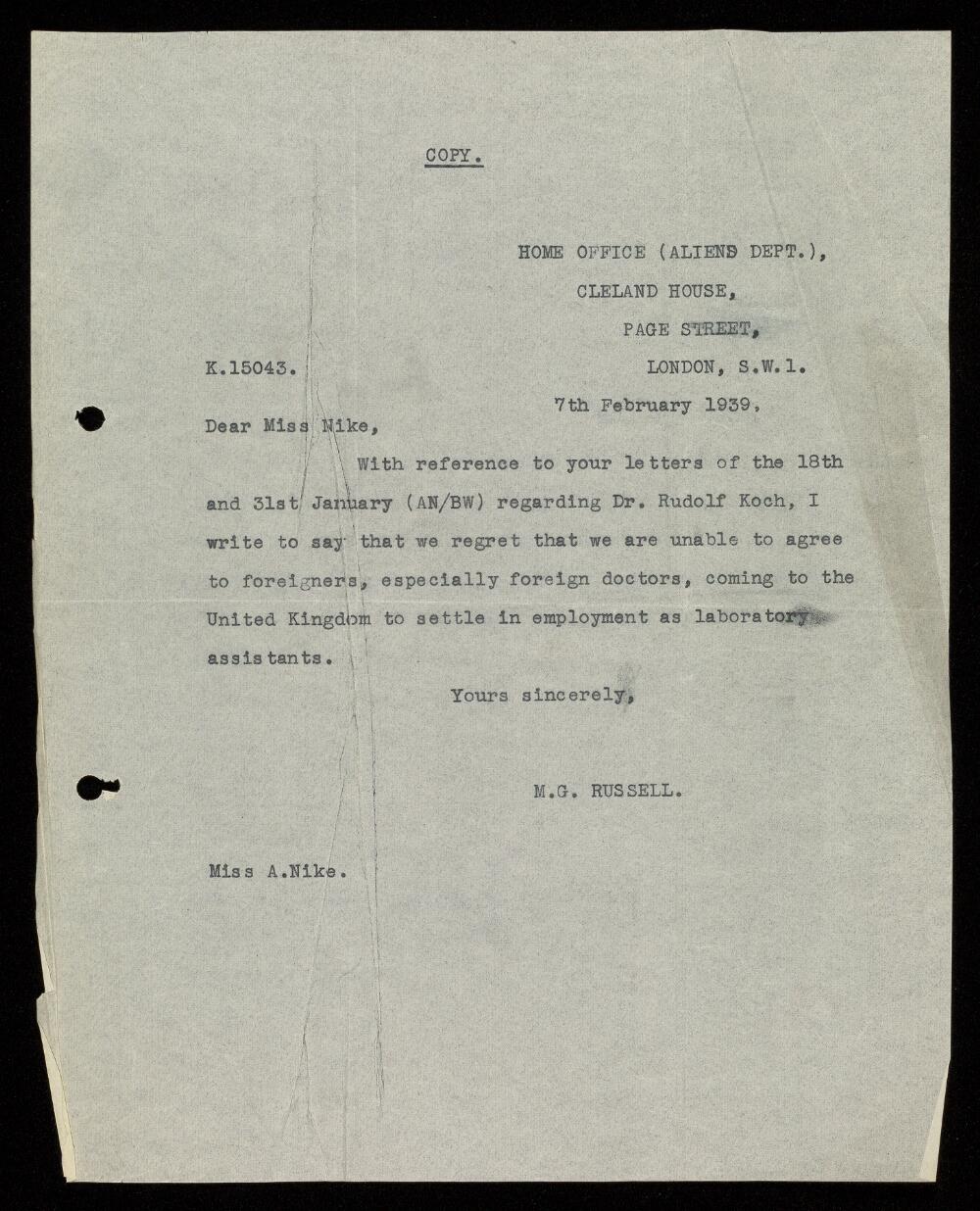
Letter from M.G. Russell, Home Office (Aliens Dept.) to Miss Nike, Society of Friends' Germany Emergency Committee, concerning Dr. Rudolph Koch, February 1939.
Letter from M.G. Russell, Home Office (Aliens Dept.) to Miss Nike, Society of Friends' Germany Emergency Committee, concerning Dr. Rudolph Koch, February 1939. 
The sincere efforts and commitment of the Committee notwithstanding, many aspects of the correspondence file make for uncomfortable reading. The Retreat had agreed in 1938 to take ‘our quota of refugee girls permitted by the home office to train as nurses’, and the Annual Report of 1941 tells us that by the end of that year, ten refugees were to be counted among a total nursing staff of 72. However, women who had gained success in their field and sought to utilise professional medical expertise received a significantly shorter shrift than did their male counterparts. Psychologist Rose Rand, the only registered female member of the Vienna Circle, which included Rudolf Carnap and Kurt Gödel amongst its numbers, and Ludwig Wittgenstein and Karl Popper amongst its advocates, was described by her peers as ‘a specially gifted philosopher with high promise’.(3) She had worked and studied psychology at the University of Vienna Psychiatric Clinic, where her work with women suffering with mental and nervous disorders led the director of the clinic to describe her as ‘uncommonly gifted for the right treatment of insane patients’. Upon fleeing Vienna, Rand had obtained a post in an ‘epileptic colony’, but had become ill with exhaustion and was, in January 1940, ‘living in London alone on £1 per week’.

Pool was dismissive of Rand’s appeal. In a letter to the Nursing and Midwifery Department of the Central Office for Refugees dated 22nd January 1940, he described Rand pejoratively as a ‘blue-stocking type’: ‘I feel […] suspicious of the very intellectual type who finds it difficult to engage in ordinary domestic pursuits. I prefer the type who can get down to washing dishes and if necessary scrubbing a floor’. ‘If you feel that you would like me to see her’ Pool concluded, ‘well and good, but from your description, I am not at all impressed’. Rand was forced to look elsewhere for hospitality.
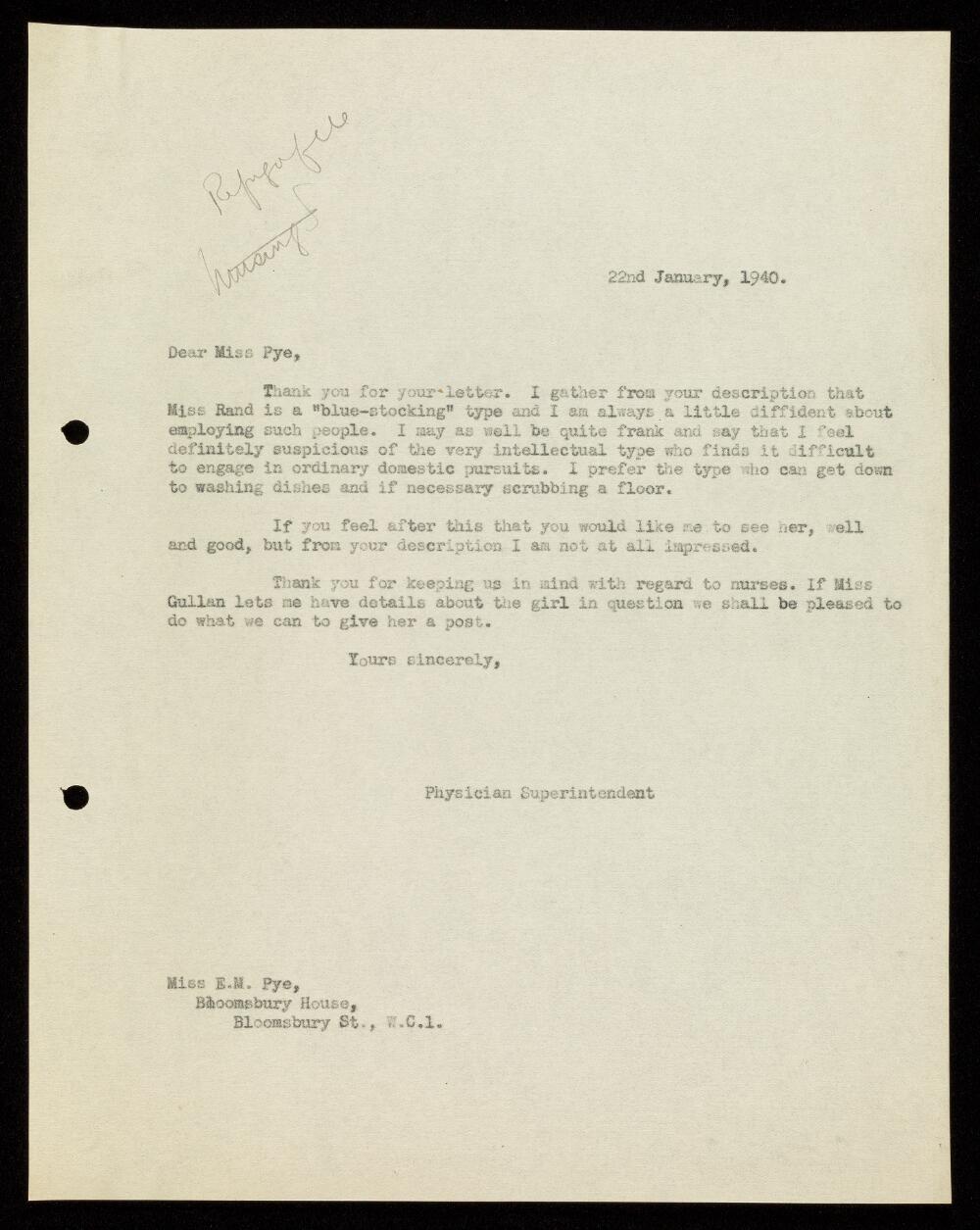
Letter from Dr. Arthur Pool to Miss Pye, Nursing and Midwifery Department of the Central Office for Refugees, concerning Rose Rand, January 1940.
The Committee continued to receive and assess applications throughout the war. In the two years following October 1938, it had considered applications from 62 European refugees, and by mid-1939, with applicants at once increasingly desperate and numerous, requests for work were being routinely refused. Probationary Nurse Ilse Gunszt, for example, a ‘non-Aryan Christian [opposed] to the new German ideas’, was required to leave Gt. Yarmouth Hospital when it was requisitioned by the military in 1940, and all ‘aliens had to move 20 miles inland’. She was the first of many to receive a standardized, albeit apologetic, response from Pool: ’[u]ntil the Government make more definite plans, it is unwise to take on our nursing staff [any more] applicants’.

The following year, a Special Meeting of the German Emergency Committee heard with some perturbation accounts of ‘the amount of mental breakdown among refugees’. In a report in the correspondence file, we read that ‘it is quite clear that there is a growing need for special care for refugees who have not been able to overcome the strains and stresses through which they have lived in recent years’. The report raises concern over the increased risk of attempted suicides, and the need for provision of institutional treatment for European refugees. It is an image much in evidence in the latter half of the correspondence file, which increasingly couples applications for work with appeals for treatment.

While the file largely leaves the fate of its supplicants unresolved, many had either already managed to escape from mainland Europe, or would find safe haven elsewhere in the UK. This was not the case for all, however, and this is no more apparent than in an unanswered letter from December 1938, in which we hear from the brother of Johannes Braun, a ‘very successful actor’. Johannes, ‘tall and broad, good looking’ was prohibited from working in Germany, had retrained as a masseur and, we are assured, ‘could become after some instruction a male nurse’. Dr. Konrad Braun described his brother’s situation as ‘very dangerous and anxious’: a third brother, also a doctor, had already been ‘arrested without any reason but that he is of Jewish extraction’. While ‘Johannes is still free’, Konrad warns us, ‘there is actual danger for his life and existence’.

The Braun family archive, held at the Bodleian Library, reveals that Johannes was arrested by the Gestapo in spring 1942 and taken to the Majdanek concentration camp near Lublin, where he contracted tuberculosis. Within four months, he was dead.

Notes

(1) Letter from Sigmund Freud to Ernest Jones, 23 April 1938. Paskauskas, R. Andrew (ed.). The Complete Correspondence of Sigmund Freud and Ernest Jones, 1908-1939. London: The Belknap Press of Harvard University Press, 1995, pp. 761-762.

(2) AJR (Association of Jewish Refugees) Information, Volume XLI No. 12; December 1986, p. 7.

(3) Rentetzi, Mari, ‘”I Want to Look Like a Lady, Not Lie a Factory Worker” Rose Rand, a Woman Philosopher of the Vienna Circle’. In Suárez, Mauricio; Dorato, Mauro; and Rédei; Miklós (eds.), EPSA Epistemology and Methodology of Science: Launch of the European Philosophy of Science Association, Dordrecht, Heidelberg, London and New York: Springer, 2010, p.240

Bibliography

Paskauskas, R. Andrew (ed.). The Complete Correspondence of Sigmund Freud and Ernest Jones, 1908-1939. London: The Belknap Press of Harvard University Press, 1995.

Rentetzi, Mari, ‘”I Want to Look Like a Lady, Not Lie a Factory Worker” Rose Rand, a Woman Philosopher of the Vienna Circle’. In Suárez, Mauricio; Dorato, Mauro; and Rédei; Miklós (eds.), EPSA Epistemology and Methodology of Science: Launch of the European Philosophy of Science Association, Dordrecht, Heidelberg, London and New York: Springer, 2010.

Steiner, Riccardo, ‘It is a New Kind of Diaspora’: Explorations in the Sociopolitical and Cultural Contexts of Psychoanalysis, London and New York: Karnac Books, 2000.

Wednesday, 31 May 2017

Spotlight on the Retreat archive: An unexpected find

This is the fifth in a series of blog posts celebrating the Retreat archive and our digitisation project as it nears completion. The Retreat is one of the most important institutions in the care and treatment of mental health patients. Over the last two and half years, staff at the Borthwick have been working through the archive, preparing the documents for digitisation, carrying out conservation treatments where appropriate and photographing each item page by page.


This has been a huge task. Over 650,000 images have been created in total and the focus has been on handling each item with care and capturing a high quality image efficiently and effectively. Of course there have been many items that have caught our eye along the way. In this series of blog posts project staff pick out some of the interesting items that they have encountered.


Here Tracy Wilcockson, Conservator for the project discusses an image of York sculptor G.W. Milburn and links with other archives in our holdings.


**************************************************

I have had the pleasure of seeing many interesting documents pass through the studio as part of the Retreat Digitisation project and as a conservator it is not often that my interest in the image or text overshadows that of the physical makeup or condition of an item. But during my work on part of the Retreat archive, I was intrigued and excited to come across this.


Reference: RET/1/8/6/7/8

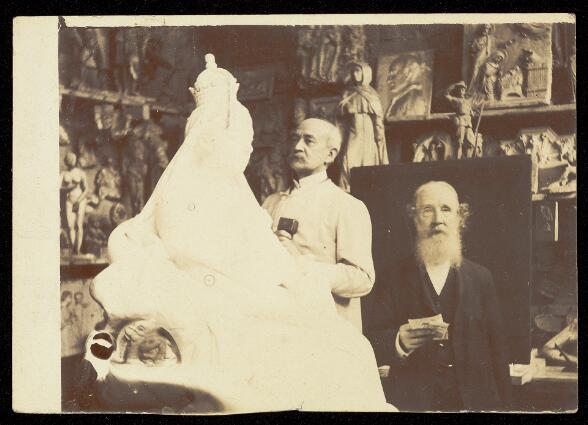
In the modestly sized silver based print on a paper support, I recognised a familiar face. Not of the York sculptor G.W. Milburn, as this was the first photograph I had seen of the famous sculptor, or of the patient Frederick Pryor Balkwill, whose records I had yet to assess and conserve. It was the statue of Queen Victoria that first caught my attention, having passed by this actual statue many times while walking in West Bank Park, Acomb, York, and knowing its sculptor to be G. W. Milburn.


The image shows the eminent sculptor working on the Queen Victoria commission in his studio, whilst his friend Frederick Pryor Balkwill looks on. The work was originally commissioned and sited in the Guildhall, but was moved to a number of locations before its final installation in West Bank Park.


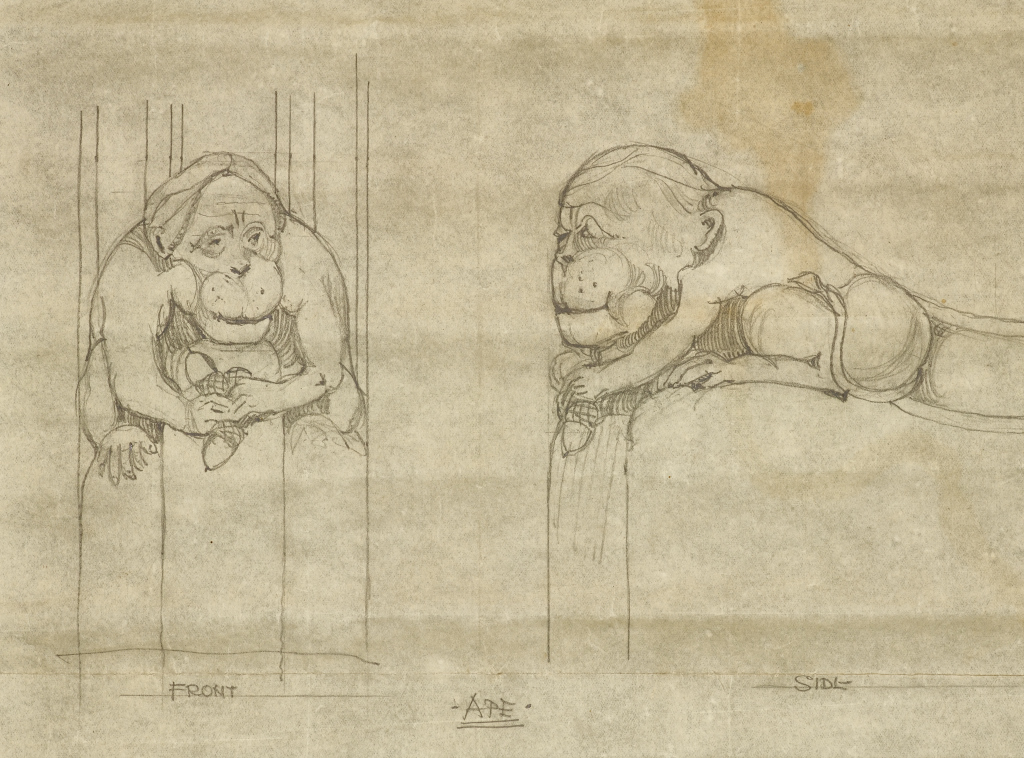
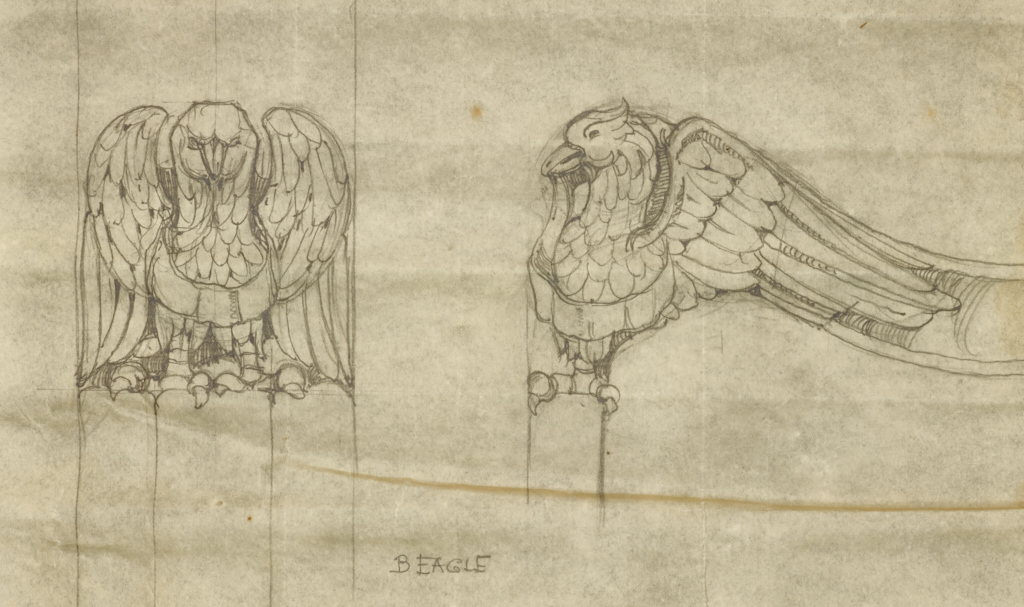
I had a keen and personal interest in Milburn as prior to seeing this photograph, I had been fortunate to view Milburn’s Day book in a private collection, which documented many commissions for carvings in buildings throughout Yorkshire of architectural or ecclesiastical significance. Within this intriguing and fragile volume I had observed many of Milburn’s commissions but was delighted to recognise both concept drawings and photographs of final pieces from plans in the Atkinson Brierley Architectural Archive held at the Borthwick and recently conserved by our conservation volunteers, linking Milburn to another of our holdings. These carvings from Sherburn Church (possibly -in-Elmet), are just one occasion that we have speculated that Milburn’s work appears.

Reference: ATKB/6/98


Reference: ATKB/6/98


There is also evidence of his York firm in the 1930 additions and alterations to Harewood House (correspondence file ATKB/8/155) and estimates from his firm for the Canon Guy Memorial Stone in Fulford (correspondence file ATKB/8/156/7).


This is just a short example of where a single item within the Retreat Archive can provide unexpected avenues of personal interest and connection beyond the expected parameters of a mental health archive. The Retreat archive might not have been the first place (or even the tenth place) a researcher might look for an elusive picture of Milburn, but it displays quite eloquently the breadth of material now available and searchable for free online thanks to the Wellcome Trust funded project and how further research leading from the Retreat archive is supported by the wider holdings of the Borthwick.


More information about the Wellcome Library funded project to digitise the Retreat archive can be found on the project pages of our website. Digital surrogates from the Retreat archive project are available via the Wellcome Library.

Tuesday, 14 February 2017

Spotlight on the Retreat archive: A splendid time is guaranteed for all!

This is the second in a series of blog posts celebrating the Retreat archive and our digitisation project as it nears completion. The Retreat is one of the most important institutions in the care and treatment of mental health patients. Over the last two and half years, staff at the Borthwick have been working through the archive, preparing the documents for digitisation, carrying out conservation treatments where appropriate and photographing each item page by page.


This has been a huge task. Over 600,000 images have been created so far and the focus has been on handling each item with care and capturing a high quality image efficiently and effectively. Of course there have been many items that have caught our eye along the way. In this series of blog posts project staff pick out some of the interesting items that they have encountered.


Here David Pilcher, one of our digitisation assistants introduces The Kirks.


**************************************************

It would be true to say that the Retreat archive contains a lot more than mental health records, correspondence and monthly accounts. Folders can be found that include artwork and poetry, landscaping and planting details in the gardens, various sporting activities, in fact a whole plethora of subjects.

One of the cornerstones of the Retreat's care of the mentally ill was to provide educating and stimulating entertainments which were enjoyed in a shared environment by patients and staff alike and, by the beginning of the twentieth century, most calendar months had a programme of entertainment events ranging from lectures, puppet theatre, magic lantern shows, musical evenings and variety acts. Over time the information and correspondence collected for reference by the Retreat on these mainly travelling acts grew to a considerable amount and in itself has become a valuable potential resource for anyone looking at the history of variety and light entertainment.

Due to considerations of space here it would be impossible to write about all the many acts that aspired to make a living by travelling the length and breadth of the country with their often amusing and eccentric shows so I have chosen one such act to try and put across a flavour of what was on offer during the first half of the twentieth century.

I present, for your delectation and enjoyment ………… The Kirks!  


Publicity photo of The Kirks circa. 1924-28 (Ref: RET/1/5/5/7/9)


The Kirks were a double act comprised of Mr. M Wingate Kirk and his wife, who was referred to by her stage name of Madame. Both of them hailed from Scotland. Mr. Kirk performed the majority of the show combining such skills as magic and conjuring, illusions and even some ventriloquism using a kilt clad dummy called, at various times, either “Brown” or “Scottie”.   He had devised several sketches for himself and the dummy, one curiously entitled “A Cigarette and a Kiss”, possibly not the best of combinations by anyone’s standards!       

Madame usually made her appearance after the interval when the couple attempted a routine called “ Transference of Thought” sometimes named “Two Minds with but a Single Thought”. She was seated and blindfolded while her husband moved around the stage with items given to him by members of the audience which then Madame immediately and correctly described without any word spoken by her partner! Coins were named and even dated, rings were identified by size and colour and she would continue to amaze despite some of the articles being wrapped before presentation. It was, as the publicity material announced, A Baffling Exhibition of Instantaneous Telepathy!

The Kirks did their show at the Retreat on Friday, 24th November 1922, and for a show lasting 90 minutes were paid four guineas.  (Ref: RET/1/5/5/7/4)  

It also has to be noted that earlier in that year the same show was performed for HRH Prince Henry and the repertoire included The Cake in the Hat and My Stick.

The Retreat records reveal that the duo were booked several times during the years that followed and were obviously very reliable in providing quality entertainment for all.

In 1928 M. Wingate Kirk notified the Retreat that he would be in the area around October and would the Retreat like his services once more? The reply from the Retreat is strangely obscure in part

“if you can assure us that your programme will be somewhat changed from what you gave us two years ago we are willing to book you”. (Ref: RET/1/5/5/7/9)

Kirk wrote back with that assurance and suggested he include The Living Marionettes (new for the 1928-29 season!) and also “all the latest novelties which are suitably adapted to Hospital Entertainments”. (Ref: RET/1/5/5/7/9)

RET/1/5/5/7/9

The Kirks performed once more at the Retreat on Tuesday, 2nd October 1928 and as well as the aforementioned Living Marionettes the act included The Library Problem (?) and The Organ Pipes. The show was traditionally closed with a stirring rendition of God save the King.

The last recorded mention I have been able to trace of the Kirks is towards the end of 1946 when M. Wingate Kirk sent the Retreat his latest programme with an accompanying letter asking about possible dates. (Ref: RET/1/5/5/7/15)


The ventriloquist`s dummy now went under the name of Sandy and the tricks and sketches included The Plume Illusion and the bizarrely titled A Seaside Experience (Pulling a Lady through a Keyhole). Sadly there was no mention of his wife or Madame in either the publicity or the related correspondence so one does wonder if she had passed away by then and Mr. Kirk was bravely soldiering on with the act. Interestingly the headed notepaper used at that time just names M. Wingate Kirk. (Ref: RET/1/5/5/7/15)

To conclude this particular thread The Retreat in their reply thanked Mr. Kirk for his offer of entertainment but unfortunately was unable to secure him a fixture at the present time.
Obviously, as the years rolled on variety acts in general were on the demise mainly due to the rising popularity of the cinema and then later, television. The Retreat had already acquired a cine projector and were hiring major titles for the entertainment of their residents so to coin a phrase …“variety was (unfortunately) dead”.  

In some ways the Kirks were unique in the style of entertainment that they provided. The material was accessible to children and also suited to an adult audience while the content was deemed to be “safe” for the residents of mental hospitals, of which they included many in their nationwide tours.

Never vulgar or crude in their delivery but possibly with a jocular element of cheek they amused and amazed audiences over almost three decades and certainly had a shared passion in their wonderful gift to entertain.   

More information about the Wellcome Library funded project to digitise the Retreat archive can be found on the project pages of our website. Digital surrogates from the Retreat archive project are available via the Wellcome Library.

Wednesday, 25 January 2017

Spotlight on the Retreat archives: A Window on the 19th Century Pharmacist

This is the first in a series of blog posts celebrating the Retreat digitisation project as it nears completion. Over the last two and half years, staff at the Borthwick have been working through the Retreat archive, updating the catalogue, preparing the documents for digitisation, carrying out conservation treatments where appropriate and photographing each item page by page. This has been a huge task. Over 600,000 images have been created so far and the focus has been on handling each item with care and capturing a high quality image in the most time efficient and effective way we could. Of course there have been many items that have caught our eye along the way. In this series of blog posts project staff pick out some of the interesting items that they have encountered. First Jane Rowling, one of our digitisation assistants introduces the Papers Relating to Alfred Jones from 1880 (RET 6/19/1/85A). 
**************************************************


 As a Victorian, where could you turn to find information on curing a nosebleed, making medicines for dogs, entertaining your children, restoring your hair, polishing soldiers’ buttons, concocting salad dressings, soothing a black eye, extracting teeth, and building a cheap aquarium? Your first port of call would probably have been your local pharmacist. One volume in the Archives of The Retreat offers a fascinating insight into the world of the Victorian pharmacist, and his customers. This volume, Medical and Domestic Formulae by a Pharmaceutical Chemist, is a notebook handwritten by a Retreat patient, Alfred Jones, and dedicated to the Medical Superintendent Dr Baker.

RET/6/19/1/85A


 Mr Jones clearly felt an affinity with Dr Baker, inscribing the first page of of his book with the words “Experientia Docet” - meaning ‘experience teaches’ - and:

‘Poets are born - not made And so are true Physicians.’ 

 These lines express a sense of a shared calling and a certain kind of equality between patient and doctor. The book also serves to show the pride a Pharmaceutical Chemist might take in his work and status in the late nineteenth century.


 Until 1842, chemists and druggists did not have to have a formal qualification. Anyone with sufficient funds could set up a shop and sell potentially lethal concoctions of drugs. Accidents with mis sold or wrongly made-up medicines gave the profession a bad name, leading to the formation of a group of pharmacists who wanted to protect their trade. Jacob Bell, the son of a Quaker pharmacist, quickly emerged as the spokesman for this group. Their greatest successes were the granting of the Royal Charter of Incorporation to the Pharmaceutical Society of Great Britain in 1843, and the 1868 Pharmacy Act, which meant that anyone making up medicines had to have taken the Society’s examination, and had to be registered with the Society. For pharmacists like Alfred Jones, registration with the Society was a mark of status as a trusted individual within a local community, and as a privileged member of a wider medical community which would also include the Medical Superintendent of a Mental Hospital like The Retreat. Thus he writes that his book contains:

 ‘Tried and Reliable Remedies & Family Recipes Etc. in Chemistry Pharmacy & Domestic Medicine & Veterinary Practise by a Registered Chemist by Examinations (classical & technical) of the Pharmaceutical Society of Great Britain’ 

 Alfred Jones’ notebook gives us an overview of the kinds of products people required from a pharmacist in the later nineteenth century, and how dangerous some of them might have been! A ‘Carmmative for Infants’ included a large dose of laudanum, while a ‘Mixture for Excited Brain’ (recommended for children as well as adults) contained bromide and chloral hydrate, a sedative. Just as unappealing is an ‘Indigestion Mixture’ containing dilute nitro hydrochloric acid - a substance which can be highly corrosive if not sufficiently diluted.


Another page recommends “Chloroform just short of anasthesia [sic] is best treatment of Hydrophobia” in cases of diseases such as rabies. This would be another risky procedure, but probably safer than the alternative, which was to perform a tracheotomy. The Victorian pharmacist walked a fine line indeed!

Some of the less harmful recipes in the book give us an insight into the realities of life beyond the pharmacist’s shop, for example:

 ‘The Herb called Solomon’s Seal is a reputed cure for Black Eye Geber saith: “It removeth any black or blew spots which occurreth to any woman on falling on her hastie husband’s fists.”


 In the nineteenth century, the local pharmacist would also provide cures and tonics for animals, reflecting a world in which working animals were a much greater part of the general public’s everyday lives than they are today. Alfred Jones offers recipes for a ‘Cleansing Drink for Newly Calved Cow,’ consisting of juniper berries, sulphur, aniseed, ginger, cumin seeds, Glaubers salt (sodium sulphate - used as a laxative in crystal form), and Epsom salts. He notes that, ‘some add 1/2 pt Linseed Oil. A different page gives ‘Alterative and Restorative Powder for Horses’ and ‘Cough Balls for Horses,’ reminding us of the ubiquity of the horse for transport at this time.


The recipes also show a lighter side of life, however. For example, this idea for a children’s entertainment:

‘Magic Designs on a White Sheet Stretch a sheet & draw a design such as the Prince Wales’s Feathers &c with a piece of Chalk & dust thereon lightly a penny packet of Aniline dye Red, Blue, or Any Colour. This is invisible at a distance but on spraying Methylated Spirit onto the sheet with a spray apparatus - it is instantly developed to the amusement of the youngsters.’


The pharmacist also held a wealth of knowledge about food and drink, for which ingredients could be supplied. Alfred Jones offered recipes for ‘Sea Side Sauce’, ‘American Cock Tail Bitters’, Doncaster Butter Scotch, Ginger Wine, ‘Currie Powder’ and Salad Dressing, as well as various jams and marmalades. In this book, some of these recipes sit rather incongruously beside much less appetising concoctions, for example ‘Currie Powder’ (nutmeg, turmeric, “cummin seed,” cayenne, coriander, black pepper, ginger and mustard) is followed by ‘Cement for Glass, China &c’ and ‘Insoluble Liquid Glue.”


This volume, handwritten by a Retreat patient, is just one of the thousands of documents in the hospital’s archive which can tell us about life outside the walls of the Retreat, as well as within. While there are some unusual additions (a poem entitled ‘Lines addressed to a Kitten’ tucked into a page describing furniture polish and cold cream, for example), this book is a fascinating insight into the world of the Victorian pharmacist, and just one of the documents in the Retreat’s archives which brings a lost world to life.

More information about the Wellcome Library funded project to digitise the Retreat archive can be found on the project pages of our website. Digital surrogates from the Retreat archive project are available via the Wellcome Library.

Wednesday, 3 August 2016

Archives on Loan

This is a guest post by Catherine Dand, a Conservator at the Borthwick Institute.

Our Conservation department is pleased to report that we have a number of archives and special collections that will be going on loan this year. Loaning archival material, especially for the purpose of display, is an exciting way to increase access to the archives. It is an excellent opportunity to raise awareness of our collections, and to build up context and associations for our archives, giving them greater depth.

Our largest loan request this year was from Fairfax House in York. Fairfax House has asked to borrow 4 books and 1 pamphlet from the University of York Special Collections and 4 objects from the Retreat Archive at the Borthwick Institute, to be displayed in their exhibition In Pursuit of Pleasure: The Polite and Impolite World of Georgian Entertainment, which runs from Friday 29th July to Saturday 31st December 2016.

The conservator’s role in the loans process is to reduce the risks that the archives might face while away from home. This can take various forms.

Fig. 1 Sample page from UKRG Facilities Report
  • Initially we need to gather details about the loan that could impact on the safety of the archives. We want to ensure that security has been fully considered at all stages of the loan, including transport, storage, access and display. We would request information about the environment that the archives will be stored and/or displayed in, which would take into account aspects such as temperature and humidity, light levels and exposure, and fluctuations in these environmental factors. We would also want to know what materials the display cases, mounts or supports will be made from, to check that they are appropriate and there will not be anything that might damage the archival materials.

Often facilities reports will be filled in and returned to us, which provide most of the information outlined above (fig.1). Fairfax House sent us a facility report along with 2 supplementary reports – one on security and one on display cases – which addressed almost all of our questions very quickly. Any extra enquiries can then be easily answered.

  • If there are any concerns with the information that we have gathered, our first response is to look for solutions to problems and ways to work around any issues. If we can be helpful, we are keen to provide advice and support to the people and/or organisation that will be responsible for the archives while they are on loan.
There were no obstacles to the Fairfax House loan, but as they will be providing their own mounts and supports we were able to offer advice and suggestions on these aspects from our condition reports (see below). Previous loans to other organisations have included the additional loan of equipment such as display cases, book rests or weights, as well as environmental monitoring equipment such as data loggers to record temperature and humidity, blue wool samples to monitor light exposure or simple Oddy testing materials to check for off-gassing.

Fig.2 Photographic documentation
  • Each item requested for loan is condition assessed to confirm that it is in adequate condition for the purpose of the loan. We will undertake written and photographic documentation of each item, which should effectively communicate the structure and materials of the item and the condition of these different aspects (fig.2).
Accurately recording the condition of items before they leave the building is also the only way in which we can monitor any changes that may occur while they are away. The vast majority of loans are made to people who are careful with the archives, but there have been occasions where carelessness or lack of knowledge has led to damage. If we are aware of what has happened then we can prepare for it better next time.

Assessment also gives us the opportunity to highlight any specific advice or cautions with regard to individual items and the purpose of the loan. If a volume requested for exhibition is very large or has a restricted opening and extra thought will be needed regarding a book rest, this can be passed on. If the item has been requested for access but the materials are too unstable to be handled, we can discuss what the options are.

As Fairfax House had decided to provide their own book supports, our condition reports allowed us to make recommendations as to the maximum angle of safe opening for display on books that have a restricted opening or damaged joints. It also gave us the opportunity to highlight any particular damage or weaknesses – forewarned is forearmed!

Fig.3 Page requested for display is detached
  • Once we have assessed the items conservators can also undertake any treatments to ensure that the items are as stable as possible for the loan.
One of the volumes requested for the Fairfax House exhibition had several detached pages, one of which was the page selected for display (fig.3). The volume does not open freely, and straps will be required to keep the book open at this page; therefore the loose, protruding pages could be at risk of damage from both handling and the straps. All detached pages were reattached to the volume.

This book also had a detached back board. It was decided that it was not necessary to reattach the board for the exhibition. As long as the board is carefully positioned on the book support, it will still be able to provide the necessary support for the textblock while the volume is on display. The damage has been noted, and this information will be stored on our Work Required database, to be addressed in the future.

Fig.4 Packaging objects for loan
  • Finally, conservators package loan items to ensure that they are transported safely. Usually this will include: individual packaging for each item; a box for easy transfer; padding within the box to stop the items moving around and to provide an environmental buffer for the items; and a plastic covering for the box in case it rains! 
Sometimes packaging for loans needs to be more extensive. Fairfax House has requested a number of un-accessioned objects from the Retreat archives, including various manacles and restraints. It was necessary to rethink their packaging, to ensure that the items were secure during transit. Layers of Plastazote were built up to create a mould for each item, and these slotted together in a box (fig.4). The mould for each item is still separate, and so items can be stored in individual boxes on their return to the archive.

The exhibition at Fairfax House opens on Friday 29th July, and we are excited to see the items on display. If you get a chance to attend, see if you can spot the items that have come from the Borthwick and the University Special Collections!

For more information on the Fairfax House exhibition In Pursuit of Pleasure: The Polite and Impolite World of Georgian Entertainment, please see our news page.

Thursday, 14 July 2016

Just what the Doctor ordered?

A new blog today on medicinal alcohol, courtesy of our Summer Intern (and York history student) Gaby Davies.

Whilst looking through the York Medical Society records, it was interesting to find the York County Hospital ‘Wines and Spirits book’ 1861-1865.  The pages contain lists of names of doctors, rooms and incidents, and the corresponding number of servings of port, sherry, brandy or gin that was needed.  Doctors seem to be doling out spirits and wines on a daily basis to their patients, and giving more for particularly bad events; September 29th 1861 required 20 servings of brandy due to the ‘Lendal Bridge accident yesterday’, and on 9th January 1861 8 servings of port were needed due to a ‘railway accident’.  This seems to make it clear that this is medicinal alcohol, rather than that beverages ordered by patients (and not doctors getting through a particularly difficult shift).

BI, YMS/5/1/2

This reliance on alcohol seems startling from a contemporary viewpoint, but in the early- to mid-19th century, Victorian doctors relied on alcohol heavily for quite general medical purposes, although towards the late 19th century medical opinion did start to turn against alcohol as a catch-all solution to ailments, and it started to be seen harmful and addictive.  Before this point, however, alcohol was prescribed liberally both as a stimulant and a sedative.  Brandy was used to ‘stimulate circulation’, to resuscitate the unconscious much like smelling salts, and in emergencies, especially outdoor pursuits such as hiking and skiing.  In hospitals it was often given intravenously or even (wince) rectally.  Even in 1920, physician William Hale White espoused its virtues, primarily as ‘A pleasant depressant, peculiarly efficacious in inhibiting peripheral impulses, such as pain here, and discomfort there, that it diminishes those trivial worries which bother the sick.  In larger doses it has the advantage of inducing sleep.’  This rather unscientific viewpoint may have been the reason the alcohol in this book seems to have been given to patients so regularly; for lack of other drugs it was a quick solution to mild pain or lack of sleep, and was an easy way to improve a patient’s comfort.  It was even used for children when teething or colicky, and many ‘tonics’ sold by unlicensed practitioners for babies could be up to 50% alcohol.  The fact that it was ‘opium free’ was often enough to convince mothers that the tonic was safe.

Victorian doctors also used alcohol enthusiastically as a painkiller for the dying, along with ether and opium.  Combinations of ether, brandy and port wine were often used as a stimulant for a weak heart and to promote circulation, and brandy was additionally favoured for its aid to the digestive process. Doctor William Munk recommended that for those with a terminal illness, small quantities of alcohol should be given frequently, favouring port and sherry over champagne as the latter tended to wear off quickly.  

Choosing the right alcohol for the right patients.
BI, YMS/5/1/2

It was not just in England that this culture of medicinal alcohol was prevalent; in America during Prohibition, doctors could prescribe spirits to their patients and there was even a medical beer campaign, which congress had shut down by 1921 for fear that, as the New York Times put it, ‘druggists become bartenders and the drug store a saloon.’

Looking through The Retreat documents we find similar evidence of this general use of alcohol by doctors.  One 1860s circular advertising ‘cheap light wines’ has two full pages of doctors’ recommendations, published in the Medical Times, of how wine can be used as an aid to breastfeeding (unless you are working class, in which case beer will do), a cure for acidity which would ‘add ten years to your patient’s life’, a drink to ‘fill the veins with pure healthy blood’ and as a healthier substitute to tea.  

BI, RET/4/8/2/134

Pure clean claret for nursing mothers?
BI, RET/4/8/2/134

Several articles also recommend that wines are ‘admirably adapted for children’, and that for children ‘puncheons of cod-liver oil might be spared at the age of 16-20, if, at the age of 7-10…the physician had said, ‘give her some kind of light, clean tasting, sub-acid wine…so that it might tempt her to relish her mutton’.  The document is an advertisement so these articles have clearly been cherry-picked, but the fact that they were published at all despite medical opinion beginning to turn at this point is an insight into the respect given to various quasi-scientific opinions of individual doctors, and the resulting effect that this had on patients.

‘Medical alcohol’ would clearly have worked, to a certain extent, in dulling pain and making patients fall asleep. It can only have been a relief for mothers when, after hours of crying, their teething babies would finally drift off thanks to some ‘medicinal’ tonic which was basically the equivalent of giving them a shot of vodka.  However, developments in the mid-to-late-19th century led to medicinal alcohol slowly declining as a cure.  A better understanding of the pharmacology of alcohol came about, improved alternative treatments were developed, anaesthetics such as chloroform and nitrous oxide became more widespread, alcoholism and its dangers to the human body became better understood and the temperance movement became more prominent.  Brandy was still occasionally recommended even in the 1930s as a general sedative, a food for those finding it hard to take in physical nutrition and up until the 1940s there were still debates as to whether it could help in cases of pneumonia.  This ‘wine and spirits’ book is a fascinating relic of a time where the virtues of alcohol were widely accepted and recommended by doctors, and can give us an insight into the lack of alternative, effective medicines at this time.  

And on a purely curious note, it leaves us wondering why the laundry maid regularly checked out 3 servings of port!


Port for the laundry maid?
BI, YMS/5/1/2


The Retreat Archive is currently being digitised.  More details are available at the Wellcome Library website.

Bibliography

Beverly Gage, 'Just What the Doctor Ordered' in Smithsonian Magazine (http://www.smithsonianmag.com/history/just-what-the-doctor-ordered-80480921/?page=2&no-ist)

Henry Guly, 'Medicinal Brandy' in Resuscitation (July, 2011).

Patricia Jalland, Death in the Victorian Family (Oxford, 1996).

R. H. Kinsey, 'An Address on Alcohol and on Drainage' in The British Medical Journal (1883).

The Rose Melnick Medical Museum, 'Medicinal alcohol and Prohibition' (https://melnickmedicalmuseum.com/2010/04/07/medicinal-alcohol-and-prohibition/)

William Hale White, 'Discussion on the value of alcohol as a therapeutic agent,' Proc R Soc Med. 1920.

Friday, 29 May 2015

Who came to see the Retreat? A look through the Retreat Visitors’ Books

Queen Victoria and the Duke of Wellington didn’t visit the Retreat!
The monarch would never have signed herself “Queen Victoria” in 1856, and the signature of the Iron Duke in 1821 fails to match up with authenticated examples. Mischievous or deluded patients from the democratic Retreat “family” were probably responsible for these entries.
Queen Victoria’s name appears in the visitor’s book RET 1/4/4/2 but we don’t think it is a genuine signature
But many well-known people, from all over the country and from abroad, really did come to see the Retreat in its early days and they signed their names in the Retreat General Visitors’ Books: three volumes covering the years 1798-1822 (RET 1/4/4/1), 1822-1835 (RET 1/4/4/2) and 1837-1861 (RET 1/4/4/3).
Genuine royal visitors included the Grand Duke Nicholas, brother to the Emperor Alexander of Russia, who visited with a party of Russian notables on 12 December 1816. Important Russian visitors seem to have been a feature of the Retreat’s early years: in August 1814, the Emperor’s physician came, as did a Russian princess, and in July 1818 Grand Duke Michael, another brother of the Emperor, arrived with his suite.
On 25 August 1822, “Augustus Frederick, Kensington Palace”, signed his name in the Visitors’ Book. This was Prince Augustus Frederick, Duke of Sussex (1773-1843), the sixth son of George III. The Duke was very interested in the arts and sciences, was involved in many charities, and had progressive political views, being a supporter of the abolition of the slave trade and of Catholic emancipation.


Augustus Frederick’s signature
Such an interest in reform characterised many Retreat visitors. The Utopian idealist Robert Owen, who developed the socially enlightened and pioneering model village of New Lanark (like the Retreat, this was a place of pilgrimage for all who were interested in progressive social ideas) visited the Retreat on 6 May 1815, remarking that “on visiting houses of this kind his feelings had been harrowed up but at this house he was not so affected”. Another well-known social reformer, who visited the Retreat several times, was the Quaker prison reformer Elizabeth Fry.

The three Retreat General Visitors’ Books have long been well-known to Retreat historians, and they repay close study. Yet there has been no thorough analysis of them to examine the appeal of the Retreat and to tease out the meaning of its fame among different social groupings. There is not even a complete index of the visitors’ names. But clearly, visitors flocked as a result of the publicity generated by Samuel Tuke’s Description of the Retreat, (1813). As William Brereton Grime, a visitor from Manchester, remarked on 4 July 1816, he “was confirmed in the good opinion he had formed of it by reading Mr Tuke’s book”. The model care offered by the Retreat not surprisingly attracted those who were also involved in the management of the insane.  Thomas Maynard Knight from Finsbury Square, London, for example, came on 16 and 17 April 1817 “on purpose to gain information respecting treatment etc being about immediately to open a house called The London Retreat for the reception of about 12 Persons mentally disordered”.
Looking through the names of visitors, they clearly fall into a number of often overlapping categories: the famous visitors, who came largely in the earliest years when the Retreat was such a novelty; doctors from Britain, Europe and  the USA, coming to see the Retreat regime for themselves; Quakers, coming to see the Retreat of which they must have heard so much (and perhaps because a family or friend was a patient); ordinary people, often whole families or larger parties, visiting the Retreat because it was famous (sometimes one can clearly see local people bringing their guests to see the Retreat because it was one of the tourist sights of York), and some visitors who defy these categorisations, such as the seven Seneca Red Indian warriors, who signed the visitors book on 8 May 1818 with their names in pictures: Long Horns, Beaver, Black Squirrel, etc. They had been brought to England to be toured around theatres, and they were then appearing at the York Theatre Royal. In this case, it was not the Retreat that was being shown off but the visitors themselves who were the object of interest: a number of local Quakers came up to the Retreat to meet them.
So what names in the visitors’ books have caught my eye?
Amelia Opie (1769-1853) visited on 9 December 1834. She was a novelist, poet, radical and philanthropist, the wife of the painter John Opie and the friend of the writer and feminist Mary Wollstonecraft. She had become a Quaker in 1825 and must have been interested to see the famous Quaker Retreat.
Ignatius Bonomi (1787-1870) visited on 14 September 1815. He was a Durham based architect, who gained a considerable architectural practice in the north east of England. He is sometimes called “the first railway architect”, because in 1824 he designed the first railway bridge, over the River Skerne at Darlington, for the Stockton and Darlington Railway. Bonomi later had a family connection with York: his sister Mary Anne married Dr George Goldie (1784-1853), who became York’s premier physician and was also a very frequent visitor to the Retreat, often bringing guests with him.
Having studied nineteenth century doctors for my doctoral thesis, I was interested to see some old friends visiting the Retreat. On 9 September 1819 the young, recently qualified, Manchester surgeons Thomas Fawdington and John Boutflower visited the Retreat together: at that time they were junior resident doctors at the Manchester Infirmary, which was given as their address. They went on to have successful careers in Manchester and Salford respectively, and were both active as teachers in the Manchester medical schools. In June 1819, Joseph Atkinson Ransome, Honorary Surgeon to the Manchester Royal Infirmary, came to the Retreat, and in September 1822 Edward Carbutt MD, Honorary Physician to the Manchester Royal Infirmary, was a visitor. Both of these doctors were Quakers. It is not known what other connections, if any, Carbutt had with the Retreat, but in the Retreat archive (RET 8/8/2) is a copy of a handbill which was issued by Carbutt in 1815 to support his cause during a dispute he was then having with a doctor competitor for the post of physician to the Manchester Infirmary.
As my son now lives in Copenhagen, I was interested to see two Copenhagen doctors signing the visitors’ books. Dr Franz Gothard Howitz of Copenhagen came on 9 August 1818 and Dr Carl Otto, came on 9 April 1822. These men were successively Professors of Forensic Medicine at the University of Copenhagen, and Otto also succeeded Howitz as physician to the Copenhagen prison. Howitz had argued that many of the criminals in the prison were in fact mentally disordered and could thus not be responsible for their crimes. Both he and, to an even greater extent, Dr Otto, were phrenologists (phrenologists believed that the size and shape of the skull indicated mental faculties and character traits). A closer reading of the Retreat visitors’ books shows that other phrenologists visited the Retreat. On 17 March 1817, for example,“B. Donkin  London, Craniologist, Disciple of Dr Spurzheim” came. Johann Spurzheim (1776-1832), a German physician, is famous as one of the chief proponents of phrenology. And in fact he himself had visited the Retreat only two months earlier, on 30 January 1817; recorded in the visitors’ book as “Dr Spursheim (Craniologist)”.

This is one of a series of blog posts published as material from the Retreat archive is digitised and made available online. More information about the Wellcome Library funded project to digitise the Retreat archive can be found on the project pages of our website. Digital surrogates from the Retreat archive project so far are available via the Wellcome Library.
Kath Webb
Borthwick Institute
May 2015