Showing posts with label World War 1. Show all posts

Thursday, 20 December 2018

Lawrence Rowntree – A Life in Letters (Part Two): ‘I have health & strength & can probably find some way of making myself useful at last, if I look for it.’

Written by Rosie Denton and Sally-Anne Shearn

Part one can be read here

‘I want to run over & have a talk with you sometime. I have been feeling more and more lately that I oughtn’t to be here.’ So began the letter that was to change the lives of Lawrence and his mother forever. It was January 1916 and Lawrence had been on active service with the Friends’ Ambulance Unit since the outbreak of war two years earlier. The FAU, a civilian volunteer ambulance service established by Quakers, provided vital medical support to the armed forces in extremely dangerous conditions and Laurie’s famous journal from this time, entitled ‘A Nightmare in Three Acts’, attests to the horrors he and his companions faced from their arrival in Dunkirk in October 1914. 

However by early 1915 Laurie was already beginning to have doubts about his vocation. In August 1914 he had written that he would do all he could, and offer himself ‘to what ever relief works are going,’ flatly rejecting the absolutist pacifism of some Quakers who refused to refused to play any part whatsoever in the war effort. ‘Although the horrors it entails are too great to be imagined, & one realises the wickedness of it all, still I consider it would be criminal to stand out & say “you have brought this war on your selves, I will do nothing.” For a medical student the FAU offered an honorable way to make a contribution to the war effort without engaging directly in armed conflict.


In January 1916, with military conscription looming and the war no closer to being won, he admitted to his mother that he was in the FAU rather than in the Army ‘because it was the only place that offered me the work I wanted, not because of my conscience, & I couldn’t go before a tribunal & say I was a conscientious objector.’ He goes on ‘I suppose everyone gets a call of some sort some time. I’ve been getting it for about nine months. I think it started when I met some men coming out of the trenches & I was in the car, but it’s been much stronger lately.’ He had waited ‘because I never felt before that I was really wanted, but now I am sure that I am more wanted there than here… Here am I, healthy & strong, doing work that any woman could do, when there is man’s work waiting.’ 

The letter to his mother in January 1916 in which Laurie first broached the subject of joining up.

We do not have Constance’s reply, but evidently she was as supportive of her son as she could be because Lawrence’s letter the following day begins ‘You really are an absolute brick, & you understand things better than anybody I know.’ He clearly felt great guilt for his decision and its impact on her however, adding ‘I am different to what you want me to be I know. I’m frightfully sorry, because I know it is an awful disappointment to thee, & I have tried to fall in with what you would like, but the call is too strong. It doesn’t go against my conscience: I wish it did, for thy sake, & if it did I would sooner die than do it.’ 

  Lawrence left the FAU the same month and enlisted in the army, just one of hundreds of Quakers to join the armed forces. After training, he returned to France in August 1916, this time as part of ‘C’ company of what would later become known as the Tank Corps. A month later Laurie was part of the first ever deployment of tanks in battle at Flers-Courcelette, part of the Battle of the Somme. His unit’s tank, nicknamed Creme de Menthe (film of the tank can be viewed here), took part in a successful attack on a sugar factory but Laurie was wounded and returned briefly to Britain to convalesce at Edinburgh’s Royal Infirmary where his recent deployment aroused a great deal of curiosity; ‘The old tanks seem to be creating a lot of interest. Nobody knows anything detailed about them & it is amusing to hear some of the extraordinary things they say.’ It was during his time at Edinburgh that Laurie decided to apply for a commission, subsequently becoming a 2nd Lieutenant in the Royal Field Artillery. 


His letters from the Front between 1916 and 1917 are frequent and detailed, despite the occasional liberal application of the censor’s black ink. They show his characteristic sense of humour. Of his regular post from York he wrote in 1916: ‘The postal staff have got into the habit of expecting at least one for me every day & they weep bitter tears of disappointment if there isn’t. The record was sustained yesterday by one which arrived in a state of decomposition. In fact it looked as if it had been in a rather bad railway smash & arrived marked ‘died of wounds’. We gave it a decent burial, but no one present recognized the deceased. No inquest.’ In December that year he wrote that ‘Christmas day went off as well as we expected. Luckily we didn’t expect much because we didn’t get much.’ In a letter to his adventurous little sister Jean in early 1917 he simply added the postscript ‘P.S. Whatever you do, don’t.’ 

These flashes of humour belied the terrible strain of everyday life on the Western Front. Laurie writes of the discomfort of lice, trench foot and having to sleep in a gas mask during his stints in the trenches. After one such duty in August 1917 he wrote that it was ‘blessed peace coming back to a tent & green grass after rabbit warrens & mud & everlasting smell.’ In October he reported that he and his companions had got a gramophone going ‘to try & cheer us up’, expressing the hope that the war would not last out the winter. 

 However by November he seemed less optimistic, writing of poor weather and how everyone was ‘tired and ill’. On the 8th of that month, after another turn of duty on the front line, he wrote ‘it has been so bad that it was really impossible to write. I have practically done without sleep & altogether done without any sort of a wash.’ On his return to the wagon lines he was knocked down by a car and although it did no serious damage he found it very difficult to walk as a result. He wrote longingly of family Christmases, noting on the 22 December 1916 that ‘they (whoever they are) say that the third time is lucky. This will make the third Yule-tide that I have been absent from the family board so at that rate next year I ought to be there.’ 


It was not to be. On Friday 30 November 1917, Constance met up with her sister-in-law Isabella. She remarked that she had not heard from Laurie for nearly a week. At the point, Constance said, she did not mind if it was good news or bad news, just so long as there was news. The following morning, she received a telegram: Lawrence Rowntree had been killed during the 3rd Battle of Ypres (Passchendaele) on 25 November 1917, just three months before his 23rd birthday 

Over the following weeks Constance received nearly 130 condolence letters. She kept them all tied up in an old writing paper folder. Almost all of the letters commented on Laurie’s kindness and his caring nature. Many remarked on Laurie’s great love for his mother. His housemother from prep school who had recalled Laurie’s first reaction to hearing of his father’s death as being “But who will look after my mother?” imagined that he had had the same reaction upon finding himself in heaven. She was not the only writer to imagine Laurie in heaven. A prominent American Quaker who had known Laurie’s father wrote to Constance: ‘You raised Laurie alone for 12 years. Now it is John’s turn. And when you to ascend unto Heaven, they will be there waiting for you: the man you loved and the man you created together’. Constance’s best friend Winnie took a more practical approach, offering to have the then 12-year-old Jean to stay both immediately or over the upcoming Christmas holidays if it would help. Perhaps the most heartbreaking letter came from one of Constance’s childhood friends. She described Laurie as a kind and thoughtful young man, and she recalled her favourite memory of Laurie when, as a teenager, he had helped his mother host Christmas dinner. She offered her support and prayers. Then, at the bottom of the page, she simply wrote: ‘P.S. We have both now lost three apiece. Let’s not lose any more.’ 

A letter of condolence from Laurie's FAU comrades.

After receiving news of Laurie’s death his friend Roger Derby drove straight to Constance’s house to retrieve Laurie’s documents as he had promised. He subsequently wrote a series of four letters to Constance from different parts of the country explaining what he had done on Laurie’s behalf. This included selling Laurie’s Cambridge flat and furniture, collecting Tony from a friend’s house in Edinburgh, organising for Laurie’s bank account to be closed, and coordinating with the army for the return of Laurie’s belongings. In the final letter he writes that, with Dorothy’s permission, he has taken one of Laurie’s coats and a pair of gloves, as well as a photo of Laurie and Dorothy together that Laurie kept on his bedside table. He writes 'I will return them if you would like, but I would so like to have the photo to remember him by.'

Laurie and Dorothy

Constance wrote to Dorothy, Laurie’s fiancée, immediately after receiving the telegram, but she had already heard the news from Margaret, Laurie’s sister and Dorothy’s roommate. In her reply to Constance, whom she called her ‘other Mother’, she wrote that it was terrible news but not wholly unexpected. She was grateful for the time she and Laurie had had together and thanked Constance for ‘giving me your son, the most precious gift you could bestow,’ adding that she would aim to live a life worthy of Laurie so that when they met again in Heaven he would be proud of her. 

Three days letter, Dorothy wrote a second letter. This one read simply: 


Dear Other Mother,

This is far harder than I thought it would be, and I think I need my family around me. Could I come and stay?

Thy Other Daughter


A letter from Roger confirms that he drove to London to collect her the following morning.

Laurie’s other close friend, Richard, was serving in the trenches at the time and didn’t hear of his death until over a month later. It was only while on leave in Paris that he bumped into an old friend and was told the terrible news. He wrote to Constance immediately, apologising firstly for the delay and secondly for not knowing how to write a condolence letter, yet his letter is one of the most heartfelt that Constance received. He wrote that he frequently imagined life after the war. He daydreamed about returning to Cambridge and completing his medical degree, and envisioned his life beyond Cambridge. He had had many variations on this daydream, but in every single one of them Laurie was there with him. While Richard had considered that he personally might not survive the war, it had never even occurred to him that Laurie might not and he struggled to imagine a future without him. 

Richard did survive the war. He did indeed return to Cambridge and complete his studies. Roger also survived the war, despite returning briefly to France. He later invested in the railways, married and had a large family. Dorothy later married the brother of her another school roommate and went on to have two children. Margaret married only a month after Laurie’s death. It’s not clear if Laurie ever met her soon-to-be husband, but hopefully he would have approved of him! Tony also married in 1925. She continued to write through much of her life, and some of her scrapbooks and journals also survive in the Borthwick archives. True to Laurie’s word, they are funny and entertaining, and tell you precisely nothing about what she was actually doing on a day to day basis. 

It was Jean, however, who led perhaps the most adventurous life of the remaining siblings. After obtaining a history degree from Somerville College, Oxford, she briefly became a teacher but took a sabbatical in 1938 to help Jews and other vulnerable refugees fleeing the newly Nazi occupied Sudetenland.   This was, after all, the girl who had attempted to shoot down zeppelins from the roof of her house with an air rifle. Following her return to England in 1940 Jean joined the BBC. She served as a producer of educational programming for many years, retiring in the 1970s. A great advocate of education for all, she was instrumental in setting up the Open University and received an OBE in 1962.  Like Tony, she kept scrapbooks and journals throughout her life. She died in 2003, aged 97. 

Constance died in 1928 at the age of 56. True to her friend’s letter, her three remaining children all outlived her. 

But let’s not end with death. Instead, let’s end with and extract from my favourite of the letters Laurie wrote. On New Year’s Day 1917 Laurie wrote the following letter to the then 11 year old Jean: 


My Dear,

Happy New Year, and much good may it do you. I’m afraid I’ve been an awfully long time answering your letters and thanking you for the soap but I knew you wouldn’t mind my taking them in age order, and that way it takes some time to come round to you. When the only time one gets for writing is half an hour to an hour in the evening.


The soap was most acceptable. Thanks awfully. Also it was in a way a relief to get something that didn’t have to be eaten – at least I suppose some people might have eaten it, but I didn’t. I gave that up at the age of two in favour of more toothsome delicacies. 

You warned me not to eat too much turkey. Unnecessary, madam, for there was no turkey to eat. But you didn’t say anything about goose, so I ate too much of that. I got a lump of green stuff with it that I couldn’t make out until it struck me that it must be what they make pate de foie gras out of. Which as a luxury I consider to be overrated, besides entailing a certain amount of cruelty in its production. 

You haven’t told me if your heart is yearning particularly over anything in the shape of a Christmas present. If it is, acquaint me with the object. It will have to continue to yearn for a little while I’m afraid, but at the first possible opportunity it shall be procured if money can buy it. That last condition does not necessarily hold true. Don’t request an elephant or anything else of a ridiculous nature… 

Thy Loving Brother, 

Laurie

....

A catalogue for the Lawrence Rowntree Archive will be available in early 2019.


Lawrence Rowntree - A Life in Letters (Part One)

Written by Rosie Denton

Those of you based in York may have already heard of Lawrence Edmund Rowntree, the subject of a recent exhibit at York Castle Museum which was covered in the York Press. For those to whom the name is unfamiliar, Lawrence (or Laurie as he was always known) was the son of John Wilhelm and Constance Rowntree, and the grandson of the famous chocolate-maker and philanthropist, Joseph Rowntree. Until now he has been best known for the journal he wrote while serving with the Friends Ambulance Unit during the First World War.

It is this journal that serves as the basis of the Castle Museum exhibit as well as a play based on his early wartime experiences that was performed at the museum in the summer of 2017. However in late 2017 the Borthwick Institute received a gift of more than 600 letters written by Lawrence to his mother Constance Rowntree. These reveal, in his own words, the fascinating story of his upbringing as part of York’s most famous family and his fateful decision to leave the Friends’ Ambulance Unit for active military service which led to his death at Passchendaele at the age of just 22.

Laurie was born in 1895, the only son of John Wilhelm Rowntree, who would himself die young at the age of 37 leaving a widow, Constance, and Laurie and his four sisters Margaret, Antoinette (Tony), Violet (who died aged 3), and Jean. The earliest letter surviving letter from Laurie dates from 1901 when he was just six years old. His parents were away from home, and Laurie wrote to his father to let him know that all the children were safe and happy. 

Shortly after this, Laurie and his sister Margaret were sent to live with a local tutor. While Laurie was occasionally persuaded to write to his parents during this time, these letters give the very clear impression that Laurie was relying on Margaret to pass on any important news, although he does proudly report any time their hosts let him drive the horses. One letter to his father gives a glimpse of the kind of education he was receiving. ‘I wrote down all five conjugations in Latin all by myself! Then he [the teacher] told me there are six conjugations. I’m not sure.’

Laurie started at boarding school in 1904. Over the next thirteen years he wrote to his mother at least twice a week. Initially writing from prep school, Laurie continued to write during his years studying at Bootham School in York, his year studying at Haverford College in Pennsylvania, and his brief spell at Cambridge University as a medical student. 


Some things remained constant over the thirteen years’ worth of letters. For one, Laurie was forever an athlete. His letters from school relate endless results of football, rugby, cricket, and swimming matches. Each year at Bootham School, each dorm would compete against the other dorms in a variety of sports. Laurie took this competition very seriously and updated his mother on the score after every match. While in America, Laurie attempted to play American football, but quickly decided he would rather support than play. At Cambridge, he joined the rowing team. Even when writing later from the trenches of World War One, he tells Connie about impromptu football games between the men - always being very careful to mention exactly which goals he scored.

Laurie also loved to ‘fix’ things. While in the junior years at Bootham School, Laurie and his friends became fixated with the idea of creating a hydroplane. For over a year, Laurie wrote about this hydroplane in every single letter to his mother. As the letters go on, he continues to explain why it is taking so long and why they need more money for a new part. Finally, Laurie writes that the hydroplane is almost finished and that he and his friends are planning to launch it on the river. He promises to send Constance all the details of exactly what happens, but the hydroplane is never mentioned again. A quick search through the Bootham School Archive revealed that the hydroplane sank as soon as it was put on the water! 

While in sixth form, Laurie purchased a motorbike without telling his mother. Again, he decided to try and ‘improve’ the motorbike, with varying levels of success. Eventually he was forced to give up, although a much later letter hints that Constance was now using the motorbike herself, despite her initial disapproval of the machine! Thankfully all this early experience served Laurie well. While serving with the Friends Ambulance Unit, he was using his grandfather’s Daimler car as an ambulance. Unfortunately, the Daimler was not cut out to be driven on such poor or non-existent roads, nor was it used to being driven so regularly. It broke down often, and Laurie was forced to rely on all his earlier engineering experience to keep it going.

Reading these letters, it is also possible to watch Laurie grow up, and nowhere is this more evident than in his sign-off. The early letters are signed ‘Thy very loving little son’ with the word ‘very’ underlined multiple times. When he started secondary school, Laurie dropped the word ‘little’. By the time he had reached sixth form, the ‘very’ had also disappeared. While serving on the western front, Laurie’s letters became quite hurried, and the word ‘loving’ also disappears, leaving simply ‘Thy son.’ However, there is one letter written in early 1917 in which Laurie signs himself ‘Thy very loving little son.’ He then crosses out ‘little’ and adds underneath 'sorry – nostalgic habit!'


Laurie and his mother were clearly very close. In 1917 the housemother from Laurie’s school would recall that when he was told of his father’s death in March 1905, his first response was ‘But who will look after my mother?’ His letters from school show frequent concern for her health, in one he sends sympathy for her hay fever, adding with concern ‘Please don’t let him cut off your nose, as you said he was going to. I’m sure it will get better without that. And besides, it would hurt.’ 


Out of his three sisters, Laurie was especially close to his older sister Margaret. Margaret was at the Mount School in York, so as soon as Laurie started at Bootham Margaret arranged regular visits between the two of them. Laurie refers to the two of them visiting relatives together, going for walks around York, or attending social events at each other’s schools. When Margaret began to collect a series of beaus and fiancées, none of them quite met with his approval. In a letter from 1912, he wrote scathingly of Margaret’s latest romantic entanglement. In the next letter, he apologises profusely and takes back all earlier comments. However, on a separate sheet of paper with ‘DO NOT SHOW MARGARET’ written in capitals across the top, he writes that he will make enquiries about this mysterious fiancée (a missionary from Tasmania who none of the family had ever met) amongst other Quakers. 

Laurie's sisters Jean and Tony.

During the war, Margaret moved to London to help with the war effort. While at officer training camp, Laurie couldn’t often get home to Yorkshire, but he did make regular trips to London to visit Margaret. While in France, Laurie didn’t get much time to write letters, but when he did there was a strict order in which he wrote them. Margaret was third after his fiancée and his mother.


Tony photographed by Lawrence on a family holiday in  1914
Shortly after Margaret left the Mount School, Laurie’s younger sister Tony started there. Now it was Laurie’s turn to organise familial visits. He took Tony to tea in town, as well as to visit the full cohort of nearby relatives. He even put up with what he referred to as her ‘group of giggling girls.’ After Laurie left Bootham, the two siblings began to correspond regularly. The pair of them had seen Peter Pan together as young children, and it had clearly made an impression. They kept a close eye on the career of Pauline Chase (who had played Peter), and often make references to the play in their letters. Laurie wrote from America that he thoroughly enjoyed receiving Tony’s letters; they were funny, well-written, and entertaining, yet managed to tell the reader precisely nothing at all about what was going on in her life.


'Better a girl than none' - Laurie's verdict on
the birth of Jean.
Laurie’s youngest sister was born in 1905. Upon hearing of her birth, Laurie wrote to his mother ‘As I have had opportunity to say twice before – better a girl than none.’ He was clearly delighted at the idea of having another sibling, and suggested that she be called Cello. Perhaps understandably, Constance decided not to name her new baby after a musical instrument, but instead named the child Jean. As a teenager, Laurie complained about having to write to the young Jean, a decade his junior. ‘She’s just so little I don’t know what to say,’ he wrote. While Laurie was in America, the then seven-year-old Jean started to write back to him. Much like Tony’s letters, Laurie wrote that he enjoyed receiving them, but they only spoke of ‘childish nonsense’ and gave him no real news. However, by 1915 it’s clear the siblings were very fond of each other and perhaps the most similar of the four. For her tenth birthday, Jean requested a crossbow. She wanted to be able to shoot down the German zeppelins from the roof of their house. Laurie sent her an air rifle, explaining to his mother that it was simply the duty of older brothers to encourage their younger sisters.


Popular with his peers, two names feature frequently in Laurie’s letters to his mother: Roger Derby and Richard, whose surname is unfortunately not mentioned. Roger starts to appear in Laurie’s letters very shortly after Laurie arrived at Bootham School. He was a young lad of exactly Laurie’s age, who came from a prominent Quaker family in the south west. The two shared a dorm and were both determined to win the inter-house tournament. Later, when they no longer shared a room, often be entered for all the same events, but were quite happy so long as one of them won. They were clearly close and Roger was often invited to spend the shorter school holidays with Laurie. Aged eighteen, the two of them went on a motorcycling trip of the UK. Unfortunately, they did not get very far before Roger’s motorcycle broke beyond repair and the two were forced to return to Roger’s family in Bristol. The two lost contact for a couple of years after school, but were reunited when they joined the same section of the Friends’ Ambulance Service. It was a happy reunion, and once again news of Roger begins to fill Laurie’s letters. Roger did not join up when Laurie did, but returned to England as a Conscientious Objector. As such, Laurie made Roger the executor for his will, and asked Roger to take care of his family should anything happen to him.

Richard and Laurie became friends while both serving as prefects at Bootham School and became virtually inseparable. They shared both a bedroom and a prefect office. The two stayed close during Laurie’s studies at Haverford in the USA. Despite the 3000 miles between them, Laurie writes news of Richard in pretty much every letter to his mother. When Laurie arrived at Cambridge, Richard was already studying there. He had organised Laurie’s accommodation for him, and introduced him to the local Quaker community. Richard and Laurie were together when the outbreak of war was declared. Constance and Jean were on holiday in Austria at the time, and Laurie and Richard frantically worked with Laurie’s grandfather and Uncle Duncan to get them home safely. Richard stayed on with the family, and he and Laurie took the decision to join the Friends’ Ambulance Service together. Once again, they shared a bedroom. Richard joined the army shortly before Laurie and ended up serving in a different part of France, so the two were separated. However, whenever they were in the vicinity of each other, they always made sure to meet up, and Laurie always describes these meetings with joy.

Constance knew all of Laurie’s acquaintances at least by name. Unfortunately, this makes things rather tricky for the modern reader, as they often refer to people simply by initials. While at prep school, Laurie was forced to share a dorm with a boy named Pumphrey, who Laurie described as ‘quite the softest ass I have ever met.’ The two boys despised each other, and when Pumphrey enrolled at Bootham just a year after Laurie, he does little to hide his disgust. Fortunately, Bootham was a larger school than Colwall, and the two boys were able to largely avoid each other. Many year later, when Laurie joined the Friends’ Ambulance Unit, he was serving under a man known as P. J., who Laurie respected greatly. It in only on the Christmas dinner menu from 1914 signed by all the men of the unit that it becomes clear that P. J. is Pumphrey! It’s nice to know the two boys worked out their differences in the end.

Pumphrey's signature on the 1914 'War Dinner' menu


Lawrence and Dorothy
However the most important person in Laurie’s life during this time was Dorothy Cross; Tony’s old roommate and one of the ‘group of giggling girls.’ The two first started a romantic relationship when Laurie was eighteen and Dorothy was fourteen. Like Laurie, Dorothy was an athlete and her name appears on many of the Mount School sports awards from this time. She was also a committed Quaker like Laurie. Their relationship continued throughout Laurie’s time in America and Cambridge. In 1913 Laurie mentioned that Tony had written to him about a party held at the Mount School, noting that Dorothy looked very pretty – ‘As if I didn’t already know that!’ 

Dorothy moved to London during the war (she and Margaret shared a house for a while) and briefly assisted with the Red Cross in Belgium. She and Laurie were in constant contact and Dorothy was the first person Laurie wrote to whenever he had spare time. In 1916 he wrote to his mother to request she help him buy ‘an opal ring.’ She had it sent to him and he proposed to Dorothy shortly after while on leave in London. She accepted and the next letter Laurie wrote to Constance was brimming with joy and excitement. 


The two initially decided not to marry until after the war. However, many of their friends and acquaintances tried to talk them out of this, and the two wrestled with the idea of marrying while Laurie was on leave. In late 1917, Laurie wrote a letter to his mother while on leave in York. At the end, he briefly writes ‘Mrs L.E. Rowntree sends her love in buckets. Did I tell you we were married this morning?’ However, this is all that Laurie ever writes on the topic, and no marriage certificate has been found, so it remains a mystery!

Read part two here


Thursday, 18 January 2018

Eyewitnesses to History in the Retreat Archive

This is the sixth in a series of blog posts celebrating the Retreat archive as we publicise the availability of the digitised archive. As we have worked on this digitisation project there have been many items that have caught our eye along the way. In this blog post, one of our digitisation assistants, Jane Rowling highlights some of the interesting items she has encountered.

*************************************


One of the pleasures of digitising an archive like that of The Retreat, is the number of throwaway comments and random snippets which refer to bigger events in the history of Britain and the world. The correspondence files are particularly rich in this regard, and offer a fascinating insight into life during history’s “Big Events”, through the eyes of people who were there at the time. This blog will pick out a few of my favourite examples, although there are many more among the thousands of digitised documents from this archive which can be found online by browsing our catalogue.

The Tooley Street Fire


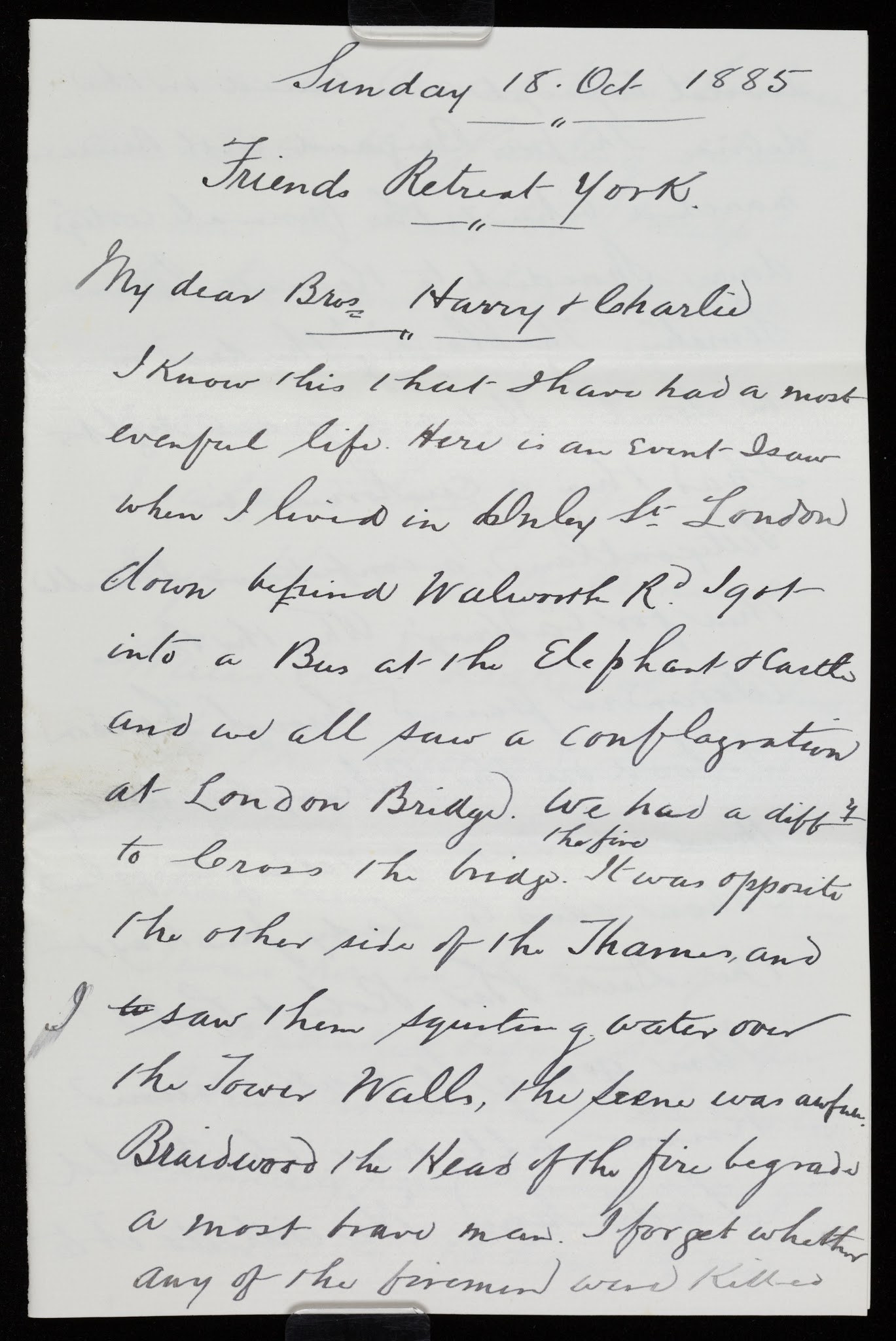
Writing in 1885, Mr Charles Cave Wilmott, a patient at The Retreat, recalled one of his experiences as a London resident earlier in his life:

RET/6/19/1


“I got into a Bus and at the Elephant & Castle and we all saw a conflagration at London Bridge. We had a diffy to Cross the bridge. The fire It was opposite the other side of the Thames, and I to saw them squirting water over the Tower Walls, the scene was awfull [sic]. Braidwood the Head of the fire begrade [sic] a most brave man. I forget whether any of the firemen were killed several bu people were buried in the debris. The fire Brigade with Braidwood marched behind the funeral cortege down Shoreditch to Kensall Green Semetry [sic], The playing the dead march in Saul. It was a grand sight.”

This memory has many parallels with the Tooley Street Fire of 1861, which was often referred to as the greatest fire since the Great Fire of London. This took place in the warehouses which lined the Thames close to London Bridge and took two weeks to extinguish. As with other disasters in the Victorian city, the Tooley Street Fire drew crowds of over 30,000 people, standing on the bridge and the opposite side of the river, bringing traffic to a standstill, and accounting for the difficulty which Mr Wilmott’s bus experienced in crossing. James Braidwood, the Superintendent of the London Fire Engine Establishment, was in fact killed during the effort to extinguish this conflagration, buried under a wall which collapsed on him as he was attempting to assist one of his firemen. A funeral cortege like the one Mr Wilmott remembered , a mile and a half long, carried Braidwood to his final resting place. This event was a major spur for the creation of the Metropolitan Fire Brigade in 1866.


The First World War


Day to day history is also captured in vivid detail in the Retreat Archive. The First World War had a greater impact on everyday life in Britain than any previous war. For the first time, war was on the doorstep, and it’s effects can be seen everywhere in correspondence dating from 1914 to 1918. This led to the issuing of new rules and regulations which would govern people’s lives, and a level of fear began to affect even the most mundane of interactions with strangers. 

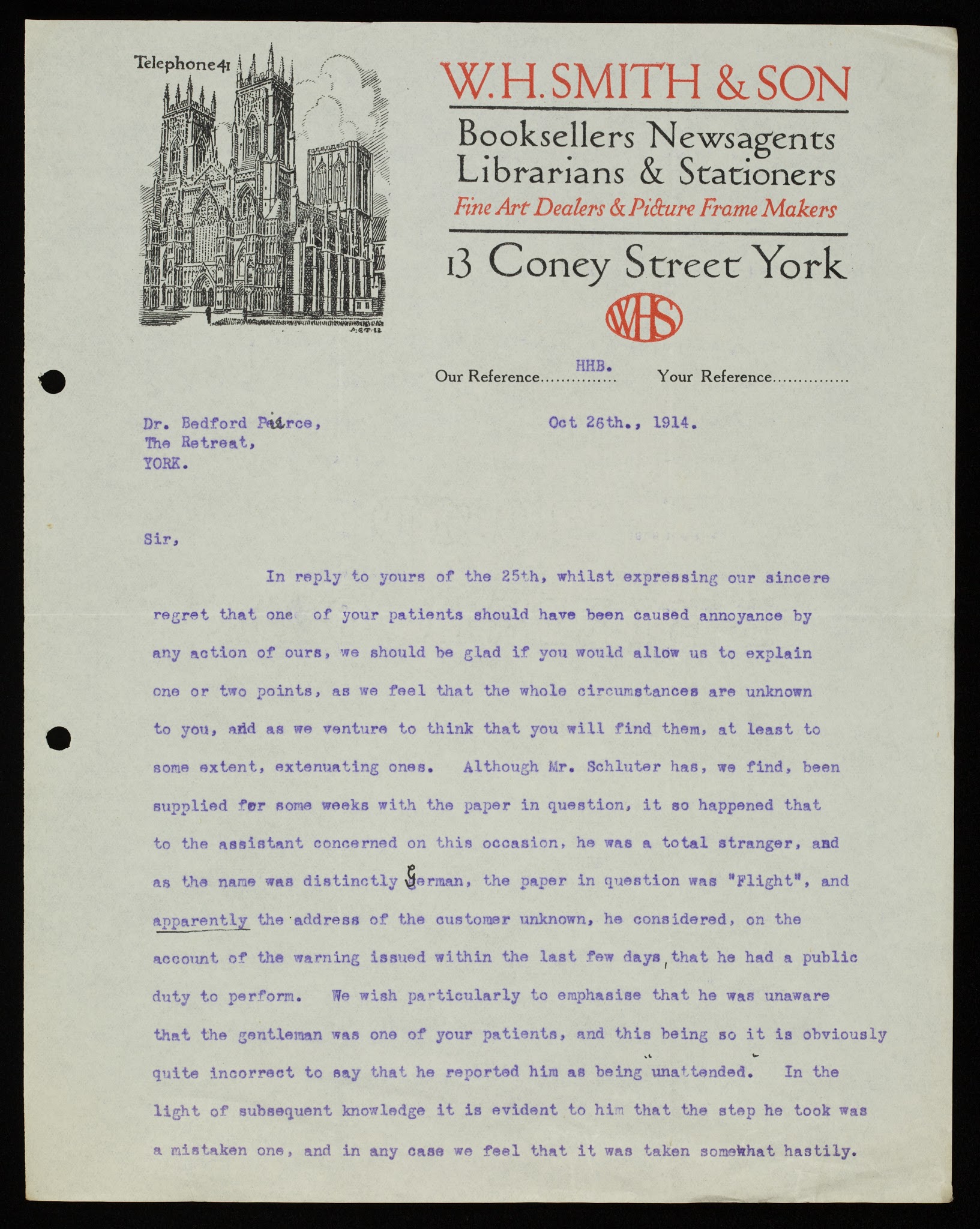
Take, for example, the case of Harold Schluter, a patient at The Retreat in 1914. While shopping in York, he entered a branch of WHSmith to order a book on flight, and was promptly reported to the police by the shop assistant on suspicion of being a German spy. 

A letter from WHSmith justifying the action of the assistant stated that "as the name was distinctly German, the paper in question was 'Flight' and apparently the address of the customer unknown, he considered on the account of the warning issued within the last few days, that he had a public duty to perform"

RET/6/20/1/18/12


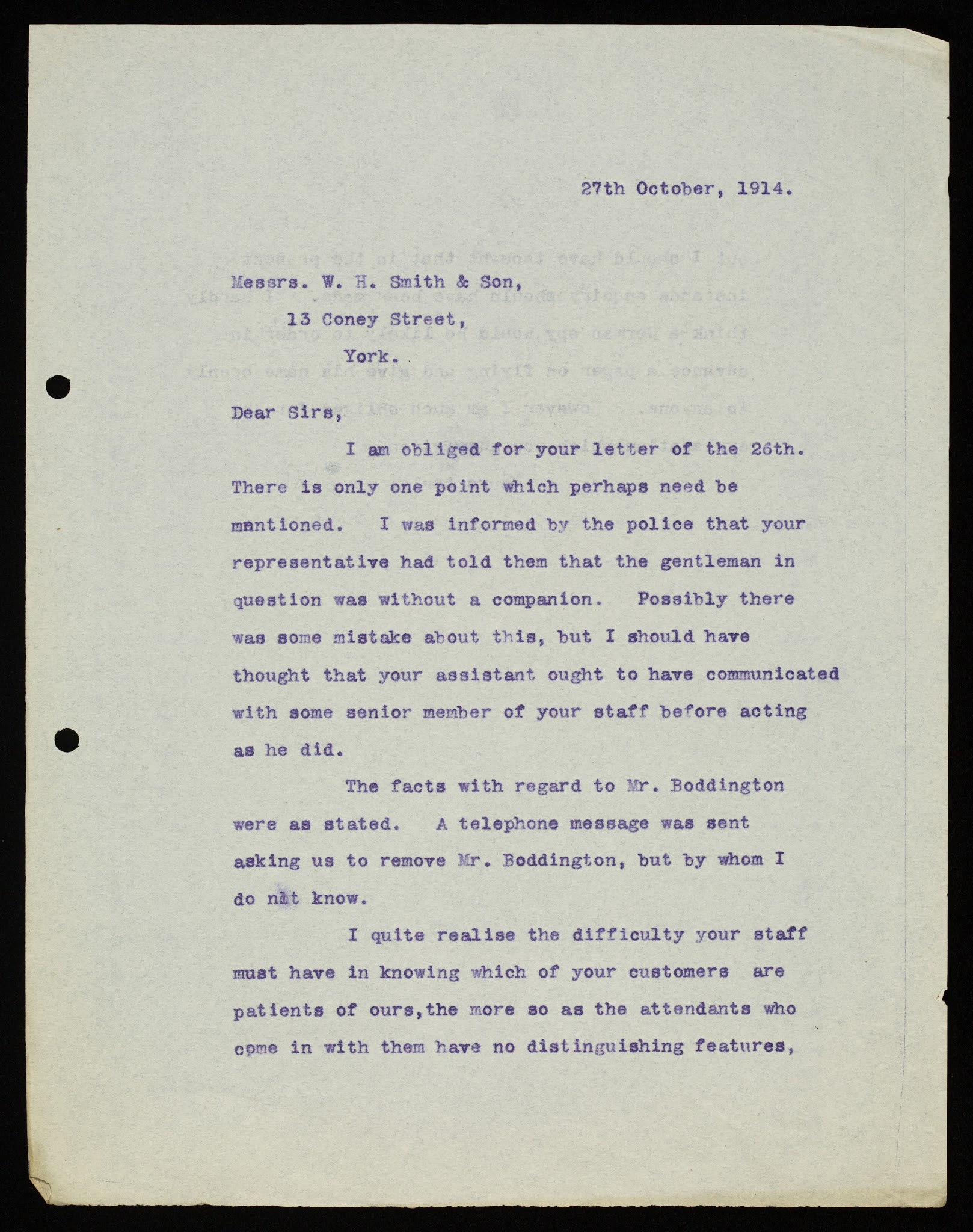
As was drily noted in the Retreat’s response to the shop’s apology: “I hardly think a German Spy would be likely to order in advance a paper on flying and give his name openly to anyone.”

RET/6/20/1/18/12


The First World War was a difficult issue for members of the Society of Friends, like Dr Bedford Pierce, the Superintendent of the Retreat. Correspondence from 1914-1918 is littered with references to the War, to conscription, and to the problems arising from being a committed pacifist, but also feeling a deep sense of loyalty towards Britain. 

In a letter to a friend, dated 27th February 1918, Dr Pierce wrote: "I am interested in hearing about your son going out. I fear it will be an anxious time for you. One cannot but feel that this year the promise of spring is hateful. It would be much more encouraging if there was a little prospect of an end to it, but if the settlement is by fighting it will be a long time before the conclusion is reached.” This links to the feelings of many members of the Society of Friends, who felt that Germany and her allies represented an evil which must be resisted, but that fighting was not the answer. 

Dr Pierce was often asked to allow patients to present themselves for medical inspection by the army doctors in order to see whether they could be judged fit to join up and fight. In some cases, this was allowed for the patient’s own peace of mind, despite the fact that they would almost certainly be judged unfit due to their mental or physical conditions; some patients suffered great distress at the thought that they had not volunteered to serve their country. As a result of this suffering, which could exacerbate existing mental illnesses like depression, or delusions of having committed a great sin by damaging self-esteem, Dr Pierce often arranged for patients to see army medical officers to be examined, producing a flurry of correspondence with family and friends.

Another document in this archive shows the calm before the storm of the First World War from a different perspective.

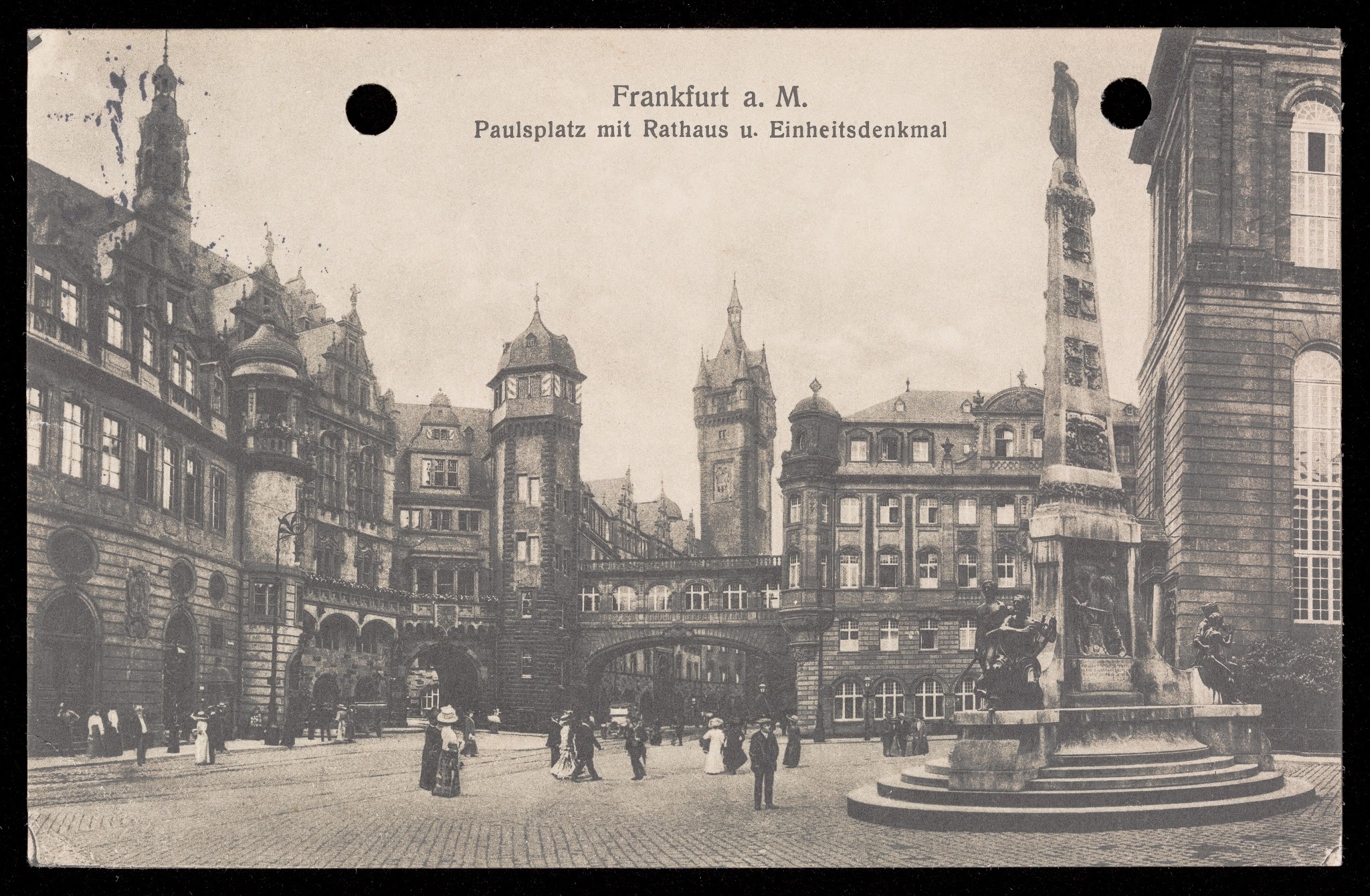
RET/6/20/1/7/35


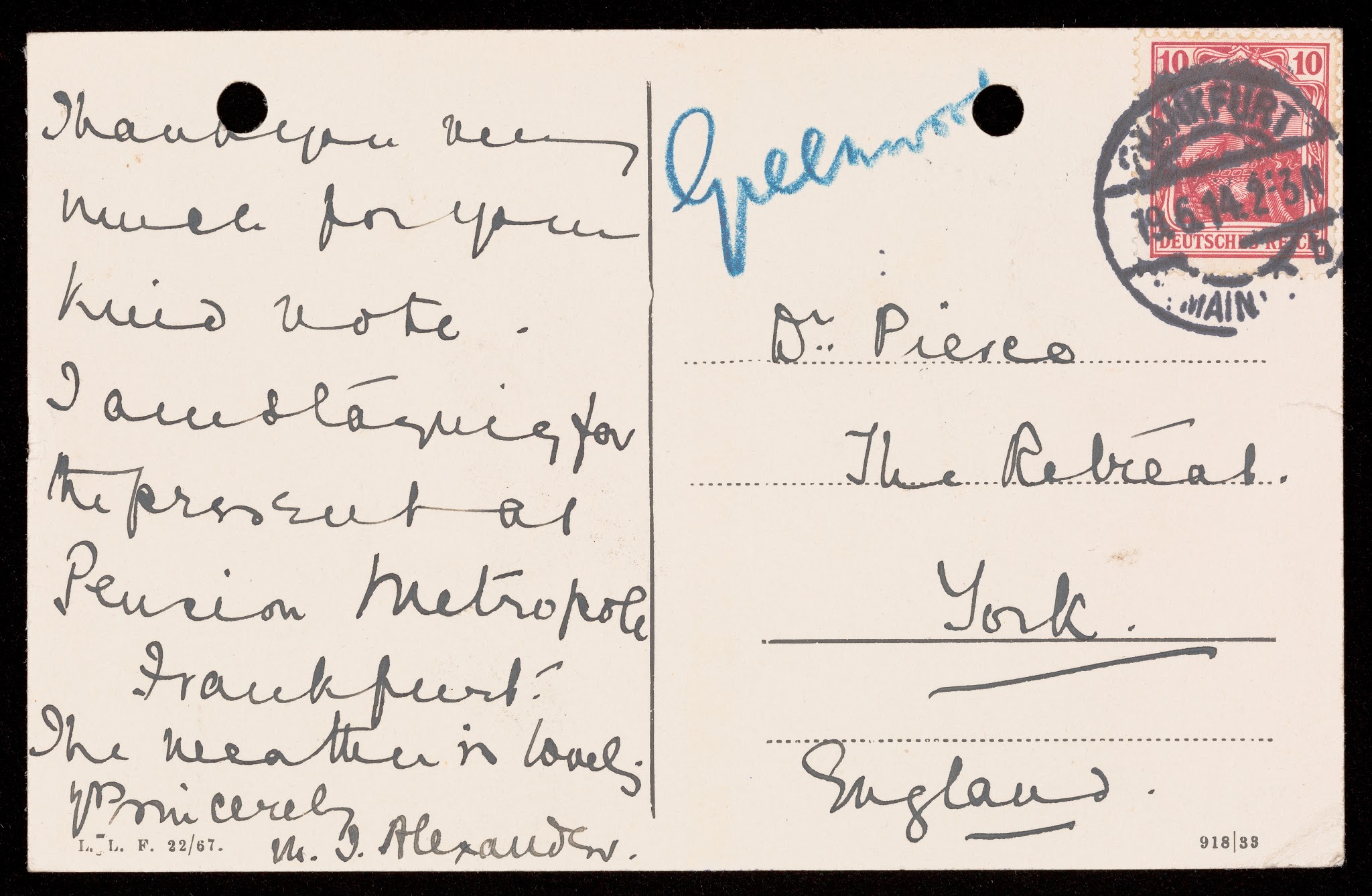
This postcard, dated just two weeks before the assassination of Archduke Franz Ferdinand, the event which is often described as the final spark to the tinderbox of conditions which existed before the First World War, was sent from Frankfurt. There is no sign in the sunny photograph of any dark clouds on the horizon. The postcard’s sender writes:

RET/6/20/1/7/35


“Thankyou very much for your kind note. I am staying for the present at Pension Metropole Frankfurt. The weather is lovely.”


Technology in the Home


The Retreat Archive also offers a view of a world of rapid technological advance, with recognisable innovations that we still use in some form today, as well as some which never quite caught on.

RET/3/3/2/16


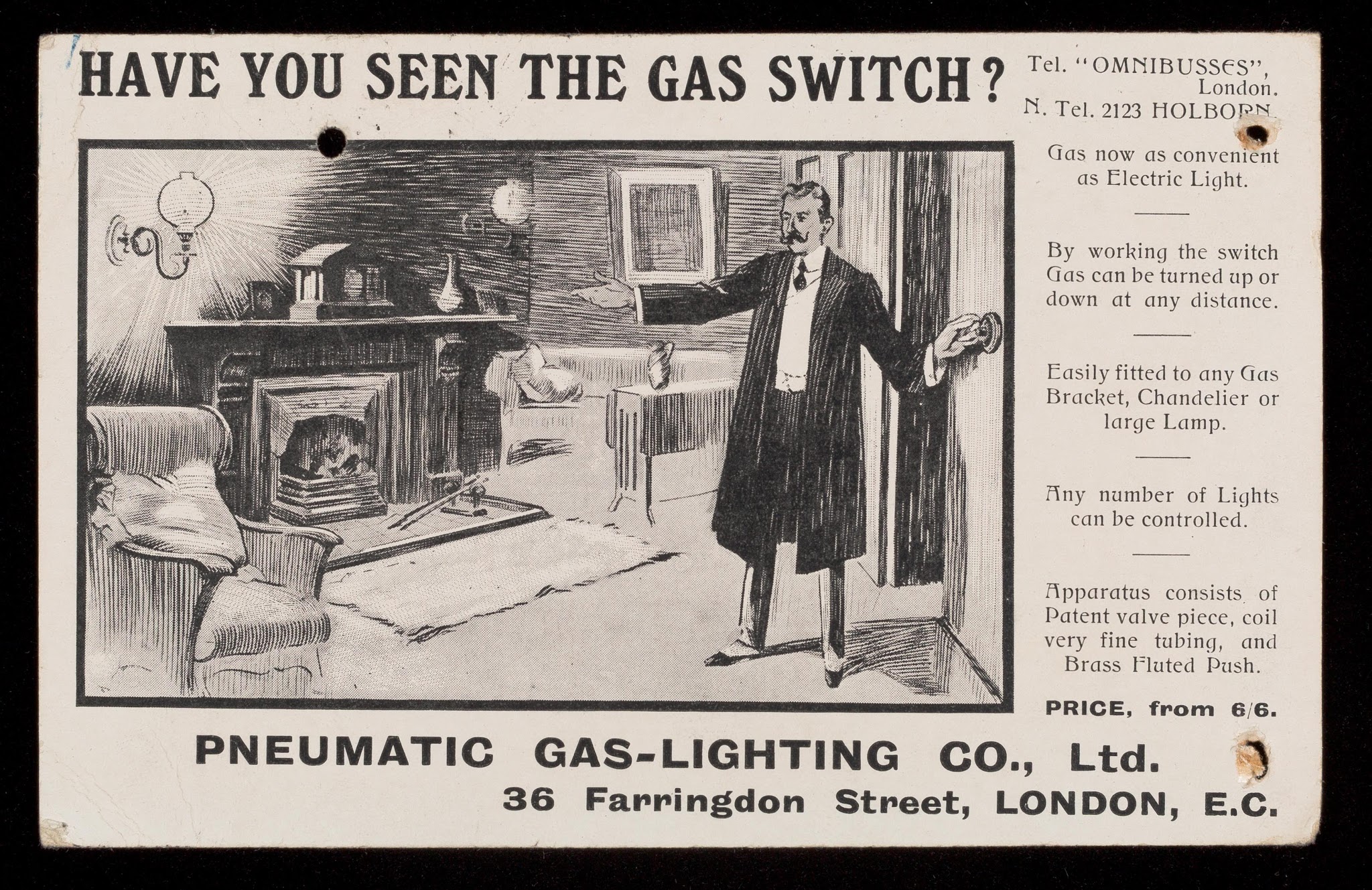
The competition between gas and electric lighting in the home is captured in this advertisement of 1906/7, which declares that gas was “now as convenient as Electric Light”. In the twenty-first century, with almost ubiquitous electric lighting, it seems odd to remember that this was by no means a foregone conclusion, and that the struggle between electricity and gas companies was fiercely competitive.

RET/4/3/1/1


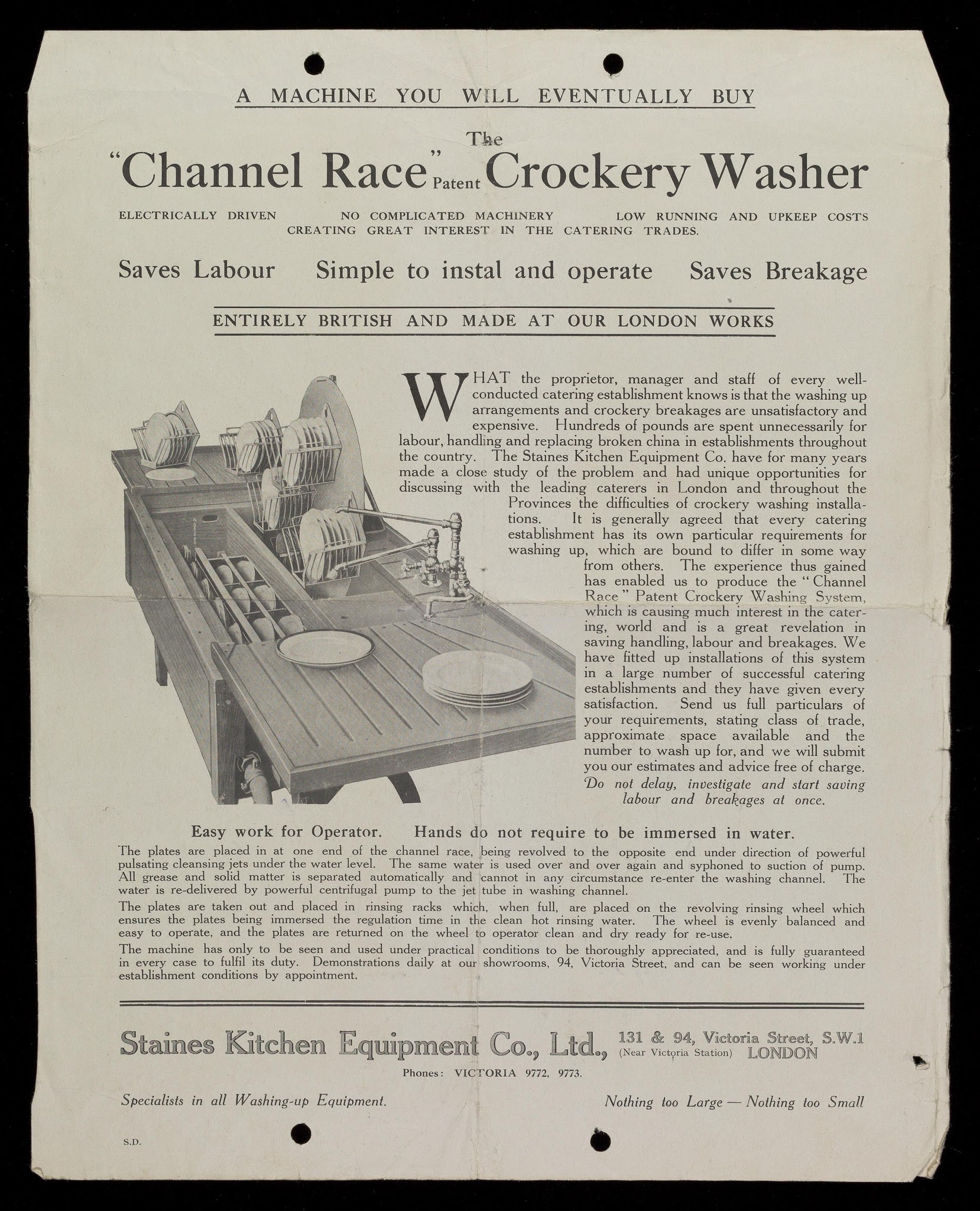
Another invention which we can recognise today is the dishwasher, but this one, advertised in 1921 seems very large and complex by today’s standards. The advert confidently declares that the “Channel Race” Patent Crockery Washer is “A machine you will eventually buy.” 

The early twentieth century produced a wealth of labour-saving devices for domestic use, as the era of the domestic servant came to a close. After the First World War, women who had taken on work which had previously been the preserve of men often wanted to continue working rather than return to domestic service. Although many women lost their wartime jobs in favour of men returning from the fighting, the world of work, and attitudes to female labour both inside and outside the home had changed forever. 

These are just a few of the topics, relating to wider themes in history, which can be accessed through the archives of The Retreat. 


More information about the Wellcome Library funded project to digitise the Retreat archive can be found on the project pages of our website. Digital surrogates from the Retreat archive project are available via the Wellcome Library and can also be found by following the links from the Retreat catalogue.

Thursday, 20 July 2017

An English Socialite in Paris: The Letters of Lady Victoria Stanley

‘Fun like sunshine, mixed with sense like salt’ was how an anonymous correspondent in The Times described Lady Victoria Bullock following her untimely death in November 1927, at the age of only 35.   This description is borne out in the lively bundle of letters by Lady Victoria which were deposited at the Borthwick as part of the Hickleton Papers, the extensive archive of the Earls of Halifax, which include the papers of Lady Victoria’s eldest daughter, Ruth, wife of the 2nd Earl.

The 19 letters span 28 years of Lady Victoria’s life in all, with the majority dated between 1918 and the mid 1920s.  They provide a fascinating glimpse into the world of an aristocratic socialite in the years after the First World War, when continental Europe was once again accessible to those who could afford it and the Roaring Twenties brought new fashions, music and attitudes.  


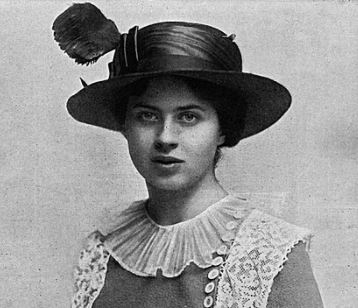
Lady Victoria Stanley. Copyright: Daily Sketch, 1915.


The only daughter of Edward Stanley, son and heir of the 16th Earl of Derby, and Lady Alice Montagu, daughter of the Duke and Duchess of Manchester, Lady Victoria was born into the privileged world of British high society in the closing years of the reign of Victoria.  

One of the earliest letters in the bundle, written to her ‘darling sweet Mamma’ in March 1902, describes a quiet country childhood at the family’s Coworth Park and Knowsley estates with her brothers Edward and Oliver, riding her pony Kruger, playing in the gardens and practicing the piano.


Lady Victoria to her mother, the Countess of Derby, in 1902
Borthwick Institute, Hickleton Papers


Wedding of Lady Victoria Stanley and Neil Primrose.
Copyright: Daily Mail Historical Archive, 1915


In 1915, at the age of 22, she married Liberal MP Neil Primrose, son of the 5th Earl of Rosebery, in a ceremony attended by Queen Alexandra and three of the royal Princesses, as well as David Lloyd George and a young Winston Churchill.  Their daughter Ruth was born in April 1916, but the marriage was cut tragically short by Primrose’s death in active service during the Sinai and Palestine Campaign in November 1917.


Thus at the age of only 25 Lady Victoria found herself a wealthy widow and when her father, to whom she was extremely close, was appointed Ambassador to France the following year, she went with him, arriving in Paris in the closing months of the war and at the very thick of the political and diplomatic action.  She found the city to be ‘the most wonderful place in the world’ and her 1918 letters are full of famous names and crowded social engagements as the great and the good began arriving in Paris for the post-war negotiations.  Sir Henry Wilson, Lloyd George and Admiral Hope attended her ‘England luncheon-party’ in late 1918. Sir Henry, she wrote, was so ‘terribly bored’ with his fellow politicians, or ‘frocks’ as he called them, that he ‘lunches, dines and comes to tea’ whenever he can. She played lawn tennis with Sir Eric Drummond, later the first Secretary-General of the League of Nations, and the Duc d’Albe invited her to go to Spain after the war. ‘As I have already made plans to go to Monte Carlo,’ she wrote, ‘I don’t believe I shall ever get back to England!’

She bought Parisian clothes and persuaded her friend Bee to do the same, admitting to her mother that she had ‘led her into temptation in the way of clothes,’ and that she herself had entirely lost her head in this direction and ‘bought masses’ of the new fashionable shorter skirts and thin silk stockings.

Her father’s post as Ambassador came to an end in 1920 but the surviving letters show that Lady Victoria was all too happy to remain, at least for long periods of time, in France.  In June 1919 she had married again, this time to Malcolm Bullock, a Captain of the Scots Guard and later Conservative MP for Waterloo.  The letters Lady Victoria wrote to him over the next 4-5 years, addressed always to ‘My own darling’ and signed from ‘ever your very loving wife, Victoria,’ reveal plenty of the fun and the salt described by The Times.  Her observations to him are often acerbic and rather funny. Writing from Paris in 1921 she describes the Duke of Marlborough and his bride as being ‘very much the young engaged couple, who have decided not to dance with each other but make googly eyes across the room instead.’  

Lady Victoria to her husband Malcolm Bullock, 1921
Borthwick Institute, Hickleton Papers

At another dinner she was made (as the only foreigner) to sit next to the King of Romania, who to her horror only wanted to talk about Bolshevism, meanwhile the Duchess de Guiche ‘evidently thought she should be next to him & sniffed round my place like a dog round a lamp post.’  On that occasion she seemed to rather admire her fellow guest Daisy Fellowes who managed to avoid having to stand all evening in the presence of royalty by immediately feigning a bad foot so she could retire to a chair in the corner and be left alone.  In a later letter, dated 1924, she wrote she was having ‘such a marvellous time that it is almost turning my head. I feel well dressed, I feel I am almost amusing, in fact all the things the Cadogans think they are & are not!’

Lady Victoria was evidently extremely popular, her letters chronicling a whirl of social engagements with numerous people, from lunches and dinners, to balls, plays, drives, dancing, golfing, horseriding and long evenings at the casino, sometimes until 4am.  ‘I am having a glorious time here & I feel quite mad,’ she told her husband in one letter of summer 1921, ‘I tremble to think what I shall be like with a mask on at the Bal de l’Opera on Saturday!’

Lady Victoria to her husband Malcolm Bullock, 1921
Borthwick Institute, Hickleton Papers

In a letter sent in April 1924 she sets out the numerous entertainments she has arranged for her husband’s imminent visit, including dinners out and trips to the theatre and the music hall.

Lady Victoria to her husband Malcolm Bullock, 1924
Borthwick Institute, Hickleton Papers


Her letters show that she continued to be a keen, though canny, shopper, writing to her husband that she had been ‘quite good about clothes,’ only buying an evening dress and skirt from Paton, an afternoon dress, two knitted skirts and some jerseys from the Russian ladies, which were ‘just like Chanel’s & quarter the price.’  In an unexpectedly modern anecdote, she also writes that she had her ‘nose done’ in January 1921, though it is not clear from the letter what exactly this entailed.  Rather startlingly, it involved her being given ‘a liberal application of cocaine’ to prevent her feeling anything during the procedure. ‘The doctor kept on warning me that I might feel faint or hysterical from the effects but I have a very odd constitution as I felt absolutely nothing!’ She concluded that the only remarkable thing it made her do was write some letters she had been avoiding.

Lady Victoria to her husband Malcolm Bullock, undated

Perhaps her most enduring interest however was horseracing.  This was perhaps hardly surprising given her ancestry.  The Epsom Derby was named for the 12th Earl of Derby and her father, the 17th Earl was a prominent owner-breeder, his horses winning the Epsom Derby, the Epsom Oaks, and the St Leger Stakes.  Lady Victoria’s 1902 letter to her mother references their horse Pellisson failing to win his race and the racing at Knowsley and even amidst the whirl of her new Paris life in 1918 she found time to ask her mother who she should back ‘for the Cambridgeshire’ and to wonder whether Cecily remembered to do her bets for her that week.  

Her 1920s letters are filled with further references to her own and her family’s horses chances at different races. Of the 1921 Prix de Diane she writes ‘It was rather a slap in the face to the French jockeys that the first three...yesterday were ridden respectively by Bullock, Donoghue & Childs. Maurice de Rothschild’s victory was received in stony silence.’ ‘I really think I must have seen thousands of horses,’ she writes in another undated letter from France, ‘I have been going around neighbouring stud farms in the mornings, then racing in the afternoon & yearling sales in the evening,’ adding that her expeditions had served to remind her just ‘how little I really know about horses.’  Only a year before she died she started a racing stable of her own in France with Major Dudley Gilroy.  

Lady Victoria to her husband Malcolm Bullock, undated [1920s]
Borthwick Institute, Hickleton Papers

Both of her daughters, Ruth Primrose and her child with Captain Bullock, Priscilla Victoria, shared their mother’s love of racing and would later become two of the first three women admitted by the Jockey Club in 1977. Priscilla’s grandchildren, Andrew and Clare Balding, are in turn well known today for their involvement with racing, as a trainer and an amateur jockey, journalist and television presenter respectively.  

Lady Victoria Bullock’s death in 1927 came as a devastating shock to her family.  Whilst hunting with the Quorn near Lowesby Hall, she struck her head on a low bridge and was thrown from her horse and found unconscious.  Her husband quickly arrived from London and her mother from Knowsley Park. An urgent message was sent to her father, who was on his way to Cannes, and he returned by aeroplane early the following morning, but to no avail.  Lady Victoria never regained consciousness and died at 3pm on the afternoon of the 26th November.  

The last two letters in the bundle were sent to Captain Bullock after her death. The first is a letter of condolence from fellow MP Winston Churchill, who sent his deepest sympathy to Bullock on the 10th December, ‘though well I know how useless words are, & how nothing but the passage of time mitigates gradually the pain & awful sense of deprivation.  You & Victoria were so suited to one another, so devoted to each other...that this separation & destruction of yr happiness seems doubly cruel.’  


Winston Churchill to Malcolm Bullock, December 1927
Borthwick Institute, Hickleton Papers

The second is from her father, written at the close of the year from France and accompanying ‘a photograph of our darling.’ ‘I can’t talk or write to you about her,’ the letter reads, ‘I am too great a coward, but I loved her - as no man has ever loved his daughter & with her has gone all joy from my life.’  Touchingly he adds that he wants Bullock to know that he will be to him ‘all that I tried to be to her’ and that he has in the earl ‘a friend to whom you can always turn & who would always try the best of his ability to help you.’ He ends by sending his son in law every good wish for 1928, knowing that ‘for you, as for me, no year in future can be a happy one - except the one in which I rejoin her.’

For her family and those who knew her, the words of the anonymous Times correspondent were all too true, ‘without her, the world was a duller and greyer place.’


The letters of Lady Victoria Bullock, nee Stanley, are part of the Hickleton Papers at the Borthwick Institute for Archives.

Friday, 11 November 2016

Remembering Private Thomas John Morgan


Well I far from home but you are not out of my mind.  I hope to be home by Christmas, if not before then.

These words were written by 18 year old Private Thomas John Morgan to his 7 year old brother Llewellyn in May 1916.  Two months later, Thomas would be dead, one of 4,000 Welsh soldiers killed in Mametz Wood during the Battle of the Somme.  The handful of letters he wrote home to his family in Llanfairfechan in North Wales survive as part of the Alfred Peacock Archive here at the Borthwick Institute, along with many other letters, postcards, diaries and photographs that tell of the terrible human cost of the First World War.

Thomas was born in early 1898, the eldest son of a Merionethshire quarry man and his wife.  By 1911 the family had settled in the small Welsh town of Llanfairfechan, just along the coast from Bangor.  Thomas was one of four surviving children, he had two younger sisters, Gladys and Margaret Ann, and his youngest brother Hugh Llewellyn, known as Llewellyn.  

We know from Thomas’ surviving army service record that he worked as a baker before he enlisted.  We also know that he lied about his age in order to join up.  In this he was far from unique. It has been estimated that some quarter of a million British soldiers in the First World War were underage.  Before the Military Service Act of 1916, recruits were supposed to be aged between 18 and 38, but they could not be sent abroad until they were 19.  Thomas enlisted in November 1915 at the age of 17, giving his age as 19 years and 14 days so he would be immediately eligible to be posted overseas.  He also barely met the height threshold of 5 feet 3 inches, coming in at only half an inch taller.

The ruse worked and Thomas was accepted into the 16th Battalion of the Royal Welsh Fusiliers and posted to France in March 1916, at the age of 18.  His letters home from France provide glimpses of his personality.  Despite his claims that he is ‘not a letter writer at all’ he promises to write and send field postcards at ‘every opertunity [sic] I get’ and requests paper and envelopes from home and letters as often as they can send them.  ‘You should see the smile on the lads’ faces when they get a parcel,’ he writes in May 1916, ‘It is the only thing to look forward to here.’

Looking forward to leave and parcels from home in this letter from May 1916.

The occasional odd phrasing and misspellings in the letters are a reminder that English was unlikely to have been Thomas’ first language, but that Welsh speaking soldiers were expected to use it regardless so that their letters could be more easily censored.

His letters are full of local concerns.  He mentions local men he has seen at the Front, telling his mother he has seen ‘Lloyd’s brother’ in the camp at Boulogne, and has spoken with ‘Tom Parry’ and asks to be remembered to everyone at Llanfairfechan ‘who I know.’  In May 1916 he writes to thank his mother for sending her ‘bara brith’ (a Welsh tea loaf) which was ‘very good indeed’ and asks if his father knows anyone from Manod Road as he had met a soldier from there by the name of Alun Jones.  He also worries about his mother receiving enough of his army pay, ‘I know you cannot spare the money and I think I can do without it here.’

Born and raised in a still largely rural area of Wales, he is critical of the more wasteful practices he sees.  In June he complains of skirmishing exercises taking place ‘in the middle of corn and potato fields which are to be seen for miles.  Now it is all spoiled, it is a great shame I think.  If the war happened to be there I wouldn’t say nothing but only for training it's a great shame we all think.’  


The most touching letter of all is the one to his little brother Llewellyn, enclosed with a letter to his mother in May.  ‘I received your kind little letter quite safe,’ Thomas writes. ‘Thanks very much for the song you sent me I am very glad of it.  I am sending you a handichief [sic] and one for Gladys & one for Margaret Ann. You can pick for yourself which you like best,’ adding ‘I must say that you are getting on well at school to be able to write letters like you are.’

He ends one of his final letters home with the hope that he might soon get leave, finishing ‘Well good bye now and God bless you all & please don’t worry.’  

The Battle of Mametz Wood began on the 7th July and Thomas was reported missing on the 11th, later confirmed as killed in action.  By some administrative error, his mother Margaret received notice only that he had been ‘discharged to duty’ and wrote to his regiment on the 21st July seeking further information, ‘Could you please let me know where he is, as I am so anxious to hear from him & trust you make enquiries for me, as it is a long time since I had a field post card, trusting it will not be troubling you too much.’

The letter informing Thomas' mother that he has been killed in action.

The terrible news was sent on the 28th and Margaret spent the next four years desperately searching for further news of the circumstances of her son’s death and his burial place, to no avail.  An army chaplain, replying to one of her letters in September 1916, wrote that ‘the probability is that he was buried where he fell with many of his comrades from the Battalion.  We did not have the opportunity of burying the brave fellows who fell in Mametz Wood, as immediately after the battle we moved elsewhere.’

Thomas’ resting place was never found and today he is commemorated on the Thiepval Memorial to the Missing of the Somme in France and at home in Llanfairfechan on the war memorial on Aber Road.  His letters, and those of his mother, are a testament to just one of the many individual and family tragedies that make up the First World War.  

On Armistice Day we remember them.


NB. This blog was written in 2016. In 2019 its author was able to locate the grave of Thomas Morgan's parents in a quiet corner of a cemetery in his home village of Llanfairfechan. Although Thomas' body was never brought home, his family had remembered him on the gravestone, which reads

'In loving memory of John Morgan, 3 Lewis Terrace, Llanfairfechan, who fell asleep September 29, 1929. Aged 63 years

Also Thomas John Morgan son of the above who was killed in action, France, July 11th 1916 aged 18 years. Rest in Peace

Also Margaret, wife of the above, who passed away August 17th 1945. Aged 76'