Showing posts with label 20th. Show all posts

Wednesday, 31 May 2017

Spotlight on the Retreat archive: An unexpected find

This is the fifth in a series of blog posts celebrating the Retreat archive and our digitisation project as it nears completion. The Retreat is one of the most important institutions in the care and treatment of mental health patients. Over the last two and half years, staff at the Borthwick have been working through the archive, preparing the documents for digitisation, carrying out conservation treatments where appropriate and photographing each item page by page.


This has been a huge task. Over 650,000 images have been created in total and the focus has been on handling each item with care and capturing a high quality image efficiently and effectively. Of course there have been many items that have caught our eye along the way. In this series of blog posts project staff pick out some of the interesting items that they have encountered.


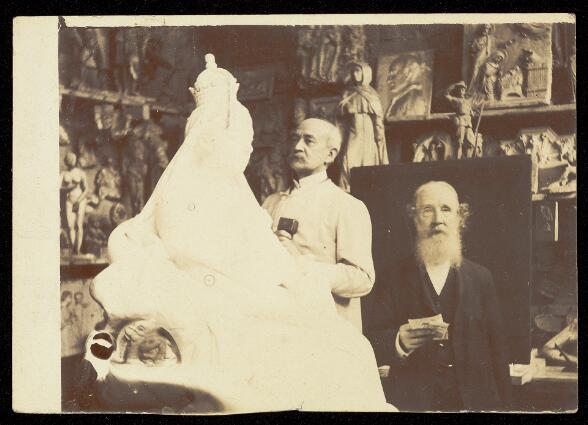
Here Tracy Wilcockson, Conservator for the project discusses an image of York sculptor G.W. Milburn and links with other archives in our holdings.


**************************************************

I have had the pleasure of seeing many interesting documents pass through the studio as part of the Retreat Digitisation project and as a conservator it is not often that my interest in the image or text overshadows that of the physical makeup or condition of an item. But during my work on part of the Retreat archive, I was intrigued and excited to come across this.


Reference: RET/1/8/6/7/8

In the modestly sized silver based print on a paper support, I recognised a familiar face. Not of the York sculptor G.W. Milburn, as this was the first photograph I had seen of the famous sculptor, or of the patient Frederick Pryor Balkwill, whose records I had yet to assess and conserve. It was the statue of Queen Victoria that first caught my attention, having passed by this actual statue many times while walking in West Bank Park, Acomb, York, and knowing its sculptor to be G. W. Milburn.


The image shows the eminent sculptor working on the Queen Victoria commission in his studio, whilst his friend Frederick Pryor Balkwill looks on. The work was originally commissioned and sited in the Guildhall, but was moved to a number of locations before its final installation in West Bank Park.


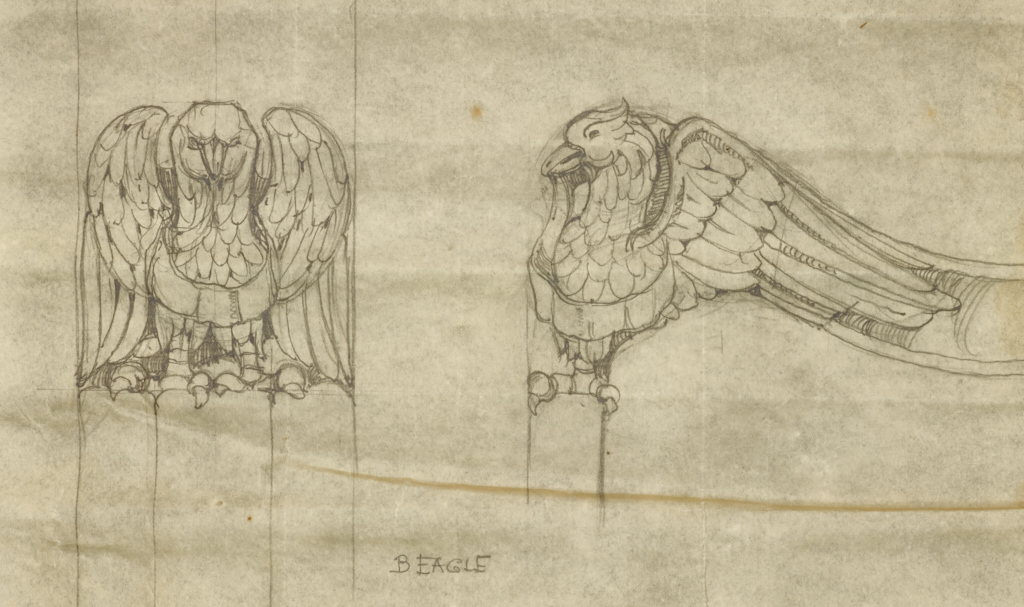
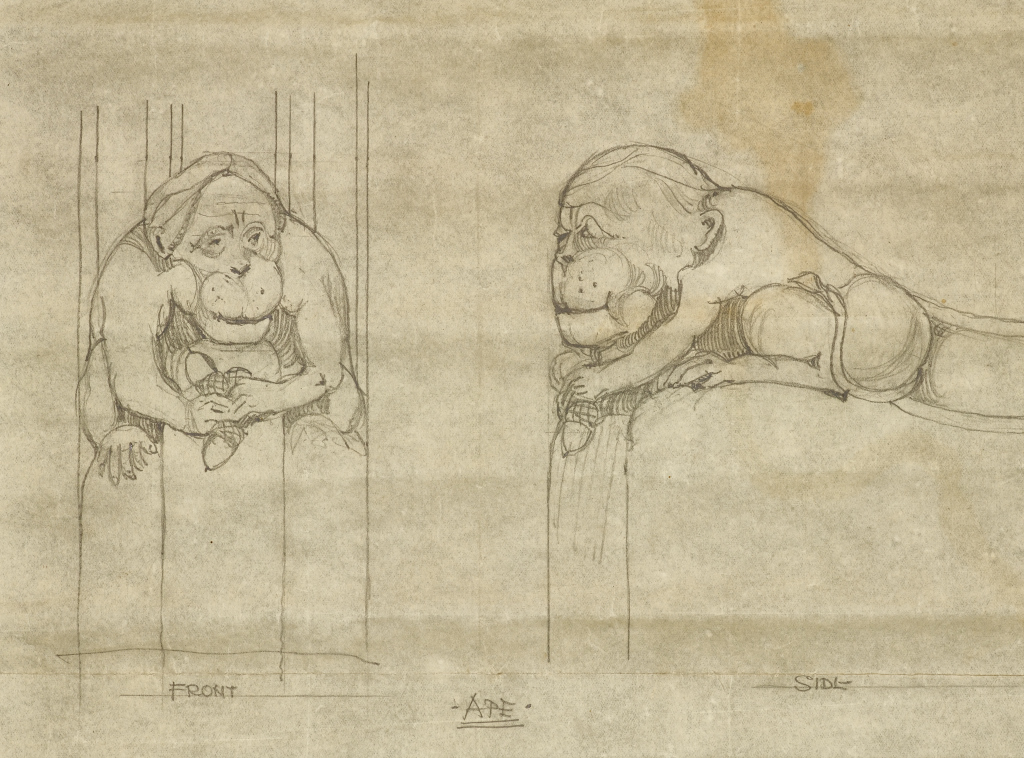
I had a keen and personal interest in Milburn as prior to seeing this photograph, I had been fortunate to view Milburn’s Day book in a private collection, which documented many commissions for carvings in buildings throughout Yorkshire of architectural or ecclesiastical significance. Within this intriguing and fragile volume I had observed many of Milburn’s commissions but was delighted to recognise both concept drawings and photographs of final pieces from plans in the Atkinson Brierley Architectural Archive held at the Borthwick and recently conserved by our conservation volunteers, linking Milburn to another of our holdings. These carvings from Sherburn Church (possibly -in-Elmet), are just one occasion that we have speculated that Milburn’s work appears.
Reference: ATKB/6/98


Reference: ATKB/6/98


There is also evidence of his York firm in the 1930 additions and alterations to Harewood House (correspondence file ATKB/8/155) and estimates from his firm for the Canon Guy Memorial Stone in Fulford (correspondence file ATKB/8/156/7).


This is just a short example of where a single item within the Retreat Archive can provide unexpected avenues of personal interest and connection beyond the expected parameters of a mental health archive. The Retreat archive might not have been the first place (or even the tenth place) a researcher might look for an elusive picture of Milburn, but it displays quite eloquently the breadth of material now available and searchable for free online thanks to the Wellcome Trust funded project and how further research leading from the Retreat archive is supported by the wider holdings of the Borthwick.


More information about the Wellcome Library funded project to digitise the Retreat archive can be found on the project pages of our website. Digital surrogates from the Retreat archive project are available via the Wellcome Library.

Friday, 29 May 2015

Who came to see the Retreat? A look through the Retreat Visitors’ Books

Queen Victoria and the Duke of Wellington didn’t visit the Retreat!
The monarch would never have signed herself “Queen Victoria” in 1856, and the signature of the Iron Duke in 1821 fails to match up with authenticated examples. Mischievous or deluded patients from the democratic Retreat “family” were probably responsible for these entries.
Queen Victoria’s name appears in the visitor’s book RET 1/4/4/2 but we don’t think it is a genuine signature
But many well-known people, from all over the country and from abroad, really did come to see the Retreat in its early days and they signed their names in the Retreat General Visitors’ Books: three volumes covering the years 1798-1822 (RET 1/4/4/1), 1822-1835 (RET 1/4/4/2) and 1837-1861 (RET 1/4/4/3).
Genuine royal visitors included the Grand Duke Nicholas, brother to the Emperor Alexander of Russia, who visited with a party of Russian notables on 12 December 1816. Important Russian visitors seem to have been a feature of the Retreat’s early years: in August 1814, the Emperor’s physician came, as did a Russian princess, and in July 1818 Grand Duke Michael, another brother of the Emperor, arrived with his suite.
On 25 August 1822, “Augustus Frederick, Kensington Palace”, signed his name in the Visitors’ Book. This was Prince Augustus Frederick, Duke of Sussex (1773-1843), the sixth son of George III. The Duke was very interested in the arts and sciences, was involved in many charities, and had progressive political views, being a supporter of the abolition of the slave trade and of Catholic emancipation.


Augustus Frederick’s signature
Such an interest in reform characterised many Retreat visitors. The Utopian idealist Robert Owen, who developed the socially enlightened and pioneering model village of New Lanark (like the Retreat, this was a place of pilgrimage for all who were interested in progressive social ideas) visited the Retreat on 6 May 1815, remarking that “on visiting houses of this kind his feelings had been harrowed up but at this house he was not so affected”. Another well-known social reformer, who visited the Retreat several times, was the Quaker prison reformer Elizabeth Fry.

The three Retreat General Visitors’ Books have long been well-known to Retreat historians, and they repay close study. Yet there has been no thorough analysis of them to examine the appeal of the Retreat and to tease out the meaning of its fame among different social groupings. There is not even a complete index of the visitors’ names. But clearly, visitors flocked as a result of the publicity generated by Samuel Tuke’s Description of the Retreat, (1813). As William Brereton Grime, a visitor from Manchester, remarked on 4 July 1816, he “was confirmed in the good opinion he had formed of it by reading Mr Tuke’s book”. The model care offered by the Retreat not surprisingly attracted those who were also involved in the management of the insane.  Thomas Maynard Knight from Finsbury Square, London, for example, came on 16 and 17 April 1817 “on purpose to gain information respecting treatment etc being about immediately to open a house called The London Retreat for the reception of about 12 Persons mentally disordered”.
Looking through the names of visitors, they clearly fall into a number of often overlapping categories: the famous visitors, who came largely in the earliest years when the Retreat was such a novelty; doctors from Britain, Europe and  the USA, coming to see the Retreat regime for themselves; Quakers, coming to see the Retreat of which they must have heard so much (and perhaps because a family or friend was a patient); ordinary people, often whole families or larger parties, visiting the Retreat because it was famous (sometimes one can clearly see local people bringing their guests to see the Retreat because it was one of the tourist sights of York), and some visitors who defy these categorisations, such as the seven Seneca Red Indian warriors, who signed the visitors book on 8 May 1818 with their names in pictures: Long Horns, Beaver, Black Squirrel, etc. They had been brought to England to be toured around theatres, and they were then appearing at the York Theatre Royal. In this case, it was not the Retreat that was being shown off but the visitors themselves who were the object of interest: a number of local Quakers came up to the Retreat to meet them.
So what names in the visitors’ books have caught my eye?
Amelia Opie (1769-1853) visited on 9 December 1834. She was a novelist, poet, radical and philanthropist, the wife of the painter John Opie and the friend of the writer and feminist Mary Wollstonecraft. She had become a Quaker in 1825 and must have been interested to see the famous Quaker Retreat.
Ignatius Bonomi (1787-1870) visited on 14 September 1815. He was a Durham based architect, who gained a considerable architectural practice in the north east of England. He is sometimes called “the first railway architect”, because in 1824 he designed the first railway bridge, over the River Skerne at Darlington, for the Stockton and Darlington Railway. Bonomi later had a family connection with York: his sister Mary Anne married Dr George Goldie (1784-1853), who became York’s premier physician and was also a very frequent visitor to the Retreat, often bringing guests with him.
Having studied nineteenth century doctors for my doctoral thesis, I was interested to see some old friends visiting the Retreat. On 9 September 1819 the young, recently qualified, Manchester surgeons Thomas Fawdington and John Boutflower visited the Retreat together: at that time they were junior resident doctors at the Manchester Infirmary, which was given as their address. They went on to have successful careers in Manchester and Salford respectively, and were both active as teachers in the Manchester medical schools. In June 1819, Joseph Atkinson Ransome, Honorary Surgeon to the Manchester Royal Infirmary, came to the Retreat, and in September 1822 Edward Carbutt MD, Honorary Physician to the Manchester Royal Infirmary, was a visitor. Both of these doctors were Quakers. It is not known what other connections, if any, Carbutt had with the Retreat, but in the Retreat archive (RET 8/8/2) is a copy of a handbill which was issued by Carbutt in 1815 to support his cause during a dispute he was then having with a doctor competitor for the post of physician to the Manchester Infirmary.
As my son now lives in Copenhagen, I was interested to see two Copenhagen doctors signing the visitors’ books. Dr Franz Gothard Howitz of Copenhagen came on 9 August 1818 and Dr Carl Otto, came on 9 April 1822. These men were successively Professors of Forensic Medicine at the University of Copenhagen, and Otto also succeeded Howitz as physician to the Copenhagen prison. Howitz had argued that many of the criminals in the prison were in fact mentally disordered and could thus not be responsible for their crimes. Both he and, to an even greater extent, Dr Otto, were phrenologists (phrenologists believed that the size and shape of the skull indicated mental faculties and character traits). A closer reading of the Retreat visitors’ books shows that other phrenologists visited the Retreat. On 17 March 1817, for example,“B. Donkin  London, Craniologist, Disciple of Dr Spurzheim” came. Johann Spurzheim (1776-1832), a German physician, is famous as one of the chief proponents of phrenology. And in fact he himself had visited the Retreat only two months earlier, on 30 January 1817; recorded in the visitors’ book as “Dr Spursheim (Craniologist)”.

This is one of a series of blog posts published as material from the Retreat archive is digitised and made available online. More information about the Wellcome Library funded project to digitise the Retreat archive can be found on the project pages of our website. Digital surrogates from the Retreat archive project so far are available via the Wellcome Library.
Kath Webb
Borthwick Institute
May 2015