Showing posts with label patients. Show all posts

Wednesday, 25 January 2017

Spotlight on the Retreat archives: A Window on the 19th Century Pharmacist

This is the first in a series of blog posts celebrating the Retreat digitisation project as it nears completion. Over the last two and half years, staff at the Borthwick have been working through the Retreat archive, updating the catalogue, preparing the documents for digitisation, carrying out conservation treatments where appropriate and photographing each item page by page. This has been a huge task. Over 600,000 images have been created so far and the focus has been on handling each item with care and capturing a high quality image in the most time efficient and effective way we could. Of course there have been many items that have caught our eye along the way. In this series of blog posts project staff pick out some of the interesting items that they have encountered. First Jane Rowling, one of our digitisation assistants introduces the Papers Relating to Alfred Jones from 1880 (RET 6/19/1/85A). 
**************************************************


 As a Victorian, where could you turn to find information on curing a nosebleed, making medicines for dogs, entertaining your children, restoring your hair, polishing soldiers’ buttons, concocting salad dressings, soothing a black eye, extracting teeth, and building a cheap aquarium? Your first port of call would probably have been your local pharmacist. One volume in the Archives of The Retreat offers a fascinating insight into the world of the Victorian pharmacist, and his customers. This volume, Medical and Domestic Formulae by a Pharmaceutical Chemist, is a notebook handwritten by a Retreat patient, Alfred Jones, and dedicated to the Medical Superintendent Dr Baker.

RET/6/19/1/85A


 Mr Jones clearly felt an affinity with Dr Baker, inscribing the first page of of his book with the words “Experientia Docet” - meaning ‘experience teaches’ - and:

‘Poets are born - not made And so are true Physicians.’ 

 These lines express a sense of a shared calling and a certain kind of equality between patient and doctor. The book also serves to show the pride a Pharmaceutical Chemist might take in his work and status in the late nineteenth century.


 Until 1842, chemists and druggists did not have to have a formal qualification. Anyone with sufficient funds could set up a shop and sell potentially lethal concoctions of drugs. Accidents with mis sold or wrongly made-up medicines gave the profession a bad name, leading to the formation of a group of pharmacists who wanted to protect their trade. Jacob Bell, the son of a Quaker pharmacist, quickly emerged as the spokesman for this group. Their greatest successes were the granting of the Royal Charter of Incorporation to the Pharmaceutical Society of Great Britain in 1843, and the 1868 Pharmacy Act, which meant that anyone making up medicines had to have taken the Society’s examination, and had to be registered with the Society. For pharmacists like Alfred Jones, registration with the Society was a mark of status as a trusted individual within a local community, and as a privileged member of a wider medical community which would also include the Medical Superintendent of a Mental Hospital like The Retreat. Thus he writes that his book contains:

 ‘Tried and Reliable Remedies & Family Recipes Etc. in Chemistry Pharmacy & Domestic Medicine & Veterinary Practise by a Registered Chemist by Examinations (classical & technical) of the Pharmaceutical Society of Great Britain’ 

 Alfred Jones’ notebook gives us an overview of the kinds of products people required from a pharmacist in the later nineteenth century, and how dangerous some of them might have been! A ‘Carmmative for Infants’ included a large dose of laudanum, while a ‘Mixture for Excited Brain’ (recommended for children as well as adults) contained bromide and chloral hydrate, a sedative. Just as unappealing is an ‘Indigestion Mixture’ containing dilute nitro hydrochloric acid - a substance which can be highly corrosive if not sufficiently diluted.


Another page recommends “Chloroform just short of anasthesia [sic] is best treatment of Hydrophobia” in cases of diseases such as rabies. This would be another risky procedure, but probably safer than the alternative, which was to perform a tracheotomy. The Victorian pharmacist walked a fine line indeed!

Some of the less harmful recipes in the book give us an insight into the realities of life beyond the pharmacist’s shop, for example:

 ‘The Herb called Solomon’s Seal is a reputed cure for Black Eye Geber saith: “It removeth any black or blew spots which occurreth to any woman on falling on her hastie husband’s fists.”


 In the nineteenth century, the local pharmacist would also provide cures and tonics for animals, reflecting a world in which working animals were a much greater part of the general public’s everyday lives than they are today. Alfred Jones offers recipes for a ‘Cleansing Drink for Newly Calved Cow,’ consisting of juniper berries, sulphur, aniseed, ginger, cumin seeds, Glaubers salt (sodium sulphate - used as a laxative in crystal form), and Epsom salts. He notes that, ‘some add 1/2 pt Linseed Oil. A different page gives ‘Alterative and Restorative Powder for Horses’ and ‘Cough Balls for Horses,’ reminding us of the ubiquity of the horse for transport at this time.


The recipes also show a lighter side of life, however. For example, this idea for a children’s entertainment:

‘Magic Designs on a White Sheet Stretch a sheet & draw a design such as the Prince Wales’s Feathers &c with a piece of Chalk & dust thereon lightly a penny packet of Aniline dye Red, Blue, or Any Colour. This is invisible at a distance but on spraying Methylated Spirit onto the sheet with a spray apparatus - it is instantly developed to the amusement of the youngsters.’


The pharmacist also held a wealth of knowledge about food and drink, for which ingredients could be supplied. Alfred Jones offered recipes for ‘Sea Side Sauce’, ‘American Cock Tail Bitters’, Doncaster Butter Scotch, Ginger Wine, ‘Currie Powder’ and Salad Dressing, as well as various jams and marmalades. In this book, some of these recipes sit rather incongruously beside much less appetising concoctions, for example ‘Currie Powder’ (nutmeg, turmeric, “cummin seed,” cayenne, coriander, black pepper, ginger and mustard) is followed by ‘Cement for Glass, China &c’ and ‘Insoluble Liquid Glue.”


This volume, handwritten by a Retreat patient, is just one of the thousands of documents in the hospital’s archive which can tell us about life outside the walls of the Retreat, as well as within. While there are some unusual additions (a poem entitled ‘Lines addressed to a Kitten’ tucked into a page describing furniture polish and cold cream, for example), this book is a fascinating insight into the world of the Victorian pharmacist, and just one of the documents in the Retreat’s archives which brings a lost world to life.

More information about the Wellcome Library funded project to digitise the Retreat archive can be found on the project pages of our website. Digital surrogates from the Retreat archive project are available via the Wellcome Library.

Friday, 10 October 2014

The York Lunatic Asylum Scandal

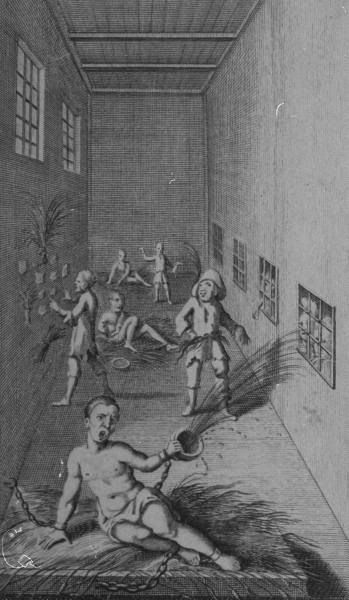
The York Lunatic Asylum opened in 1777, at a time when little was understood about mental illness. Without organised institutional care available, families were left to deal with the mentally ill at home as well as they could. It was usual to chain lunatics to the walls and to leave them naked (it was not thought possible for mentally ill people to feel cold) and alone. Madness turned people into animals.
                                                
Although there were grand ideals when it was first conceived of providing 'relief to those unhappy sufferers who are the objects of terror and compassion to all around them', York Lunatic Asylum soon fell onto a darker path. In 1790 a Quaker woman called Hannah Mills died at the York Asylum. No Friends had been allowed to see her during her six-week residence, to support her faith or to see the conditions in which she was being held. This led William Tuke to encourage the foundation of the Retreat in York, an institution built upon the Quaker idea that everyone should be treated kindly, and as an equal.

William Tuke (1732-1822)

Concerns about the York Asylum continued to grow. After William Vickers was badly treated by the staff at the asylum, a Justice of the Peace for the West Riding called Godfrey Higgins interested himself in the case. Vickers had been released from the hospital bruised, lousy, dirty and so weak he could hardly stand. Other poorly-treated patients were discovered: Reverend Schorey who had been kicked down the stairs by his keeper, and Martha Kidd whose hip was dislocated during her stay. A meeting was called to examine Higgins' accusations and nearly 40 local gentlemen (including members of the Tuke family and a number of their friends) took advantage of an old rule and paid £20 in order to qualify as governors of the asylum and effect change.

Investigations discovered that the number of patients at the Asylum had been growing, but poor financial management meant that the institution was struggling and conditions for the patients were poor. This should have caused a higher death rate but the figures published in the Asylum's annual reports did not reflect this. Closer examination of the steward's books made it clear that deaths had been concealed. In addition, it was discovered that the physicians at the Asylum had misappropriated significant sums of money from the institution. Before further assessments could be made, a fire began which destroyed one wing of the asylum and all of its early records. Four patients died. Rumours said it had been set by the steward deliberately to conceal the truth but this was never proven. Dr Best was never charged for his fraud but was forced to resign due to ill health.
 
Affluent patients at the Asylum were generally well treated. It was the poor who suffered. On a surprise inspection in March 1814, Godfrey Higgins insisted that the staff opened locked doors near the kitchen. When the key could not be found he threatened to break open the doors with a poker. Finally he gained entrance and found 'a number of secret cells in a state of filth, horrible beyond description', full of female patients, 'the most miserable objects I ever beheld'. Elsewhere, 'you might see more than 100 poor creatures shut up together, unattended and uninspected by anyone'.

 In August 1814 at the governors' annual court, new rules were made and the officers of the asylum were all dismissed. The staff were replaced with help from the Retreat Hospital.

In the aftermath, there was a full parliamentary enquiry to which Godfrey Higgins, Samuel Tuke and others contributed. The report was published in 1815 and can be read for free via GoogleBooks

Alexandra Medcalf, Archives Assistant

----------------------------------------------------------------------------------------------------------------------------

You can read more about the Retreat here and more about the Tuke family here here and here

Friday, 8 August 2014

George Isaac Sidebottom: Spot the Cat

Small oil painting, coloured, from Retreat Archives c.1890-1900 by George Isaac Sidebottom

Like most archives, although most of our holdings are manuscripts on parchment or paper, bound into volumes and loose leaf, we do have other objects in our strong-rooms. 

This painting shows people in the grounds of the Retreat, York, in the late nineteenth century. The Retreat was, and is, a psychiatric hospital run by the Society of Friends. It was established in the late eighteenth century and pioneered moral treatment for the mentally ill. The hospital saw its patients as no less human because of their illness, and emphasised that they should be cared for just like other people. This certainly does not sound unreasonable today but at the time it was extraordinary - standard Georgian treatments for mental patients included chaining to walls, leaving them naked in bare cells and sound beatings.

By the time of this painting, moral treatment was standard and you can see here that the patients were occupied with a variety of sports and activities including golf, cricket, tennis, croquet and football. Some figures in the background are riding bicycles. A slightly surreal element is provided by a patient lying under the tree in a bed. Painting was another pass-time. We know this because the artist who painted this picture was a Retreat patient at the time.

George Isaac Sidebottom was resident at the Retreat from 1894 until 1912. He had been a merchant in the north-west of England and was a non-conformist. He suffered from moral and religious delusions and had been ill, and in care, for some years before his admission. A letter from the transferring doctor called him "a very good fellow indeed it would be hard to find a more agreeable man. He can paint watercolours very decently, sings a little... and can accompany himself fairly well." In his case-notes, George is described as occupying himself in painting, reading, walking (including walking into town) and singing. He even played the piano, and there is correspondence to show that he was allowed to acquire a piano for his room.

He had a keen interest in games at the Retreat, and played cards, billiards, chess, croquet, cricket, hockey and tennis; he even skated in January 1895. He attended the Retreat's 'entertainments' and 'amusements' (which vary from picnics to dances to amateur dramatics) and had holidays in Scarborough at the Retreat's branch house.

References to paintings are made throughout although unfortunately this particular painting was not mentioned specifically. In January 1896 he 'painted a scene for the Lady's party at the beginning of the month' and in October that year 'he occupied himself with painting in oils and gives great attention to his work'. In December 1900 he was 'busy on a scene for the Xmas party'. Towards the end of his life, George painted 'peculiar' caricature portraits, which gave him much satisfaction. He continued painting virtually up to his death at the Retreat in early 1912.

This painting provides us an interesting glimpse of life inside a Victorian mental hospital from the patient's point of view which is all too rare among psychiatric archives. But, since this post is in honour of World Cat Day I also have to ask... Can you spot the cat? Comment below when you spot him (and no peeking until you do!)

Written by Alexandra Medcalf.