Showing posts with label University of York. Show all posts

Friday, 7 May 2021

Using press cuttings to understand the early history of the University of York

 By Victoria Taylor


Picture this: the year is 2546, and the University of York as it was in 1966 – and as we know it today, in 2021 – has long since ceased to exist. 


Only the ruins of the campus remain, with the lone surviving documentary evidence concerning the University’s origins to be found in the form of contemporaneous press headlines that have somehow survived the ravages of time. Perilously, you work to pull together broken pieces of a narrative, and your conclusions laid out are thus:
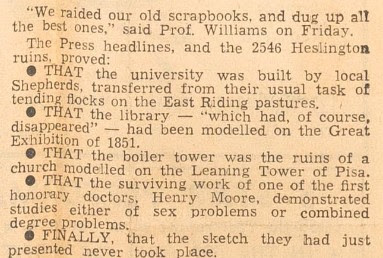

Article imagining the University's story based only on press headlines
UOY/PC/1/13/12, Yorkshire Gazette (October 1966)

Ironically, and rather meta-textually, I stumbled across this press cutting from the Yorkshire Gazette discussing how headlines might be used to help piece together history during my very own foray into press cuttings concerning the origins and early history of the University of York which I have been undertaking as part of my Public History MA placement at the Borthwick. Thankfully, the archive that I was working with contained both articles and headlines, allowing me to discover slightly more about the early days of York! 

Whilst some of 1960s humour might be lost on us today, the satirical sketch – which was performed by some of York’s staff and students as part of an historical exercise after the appointment of York’s very first honorary doctorates in 1966 – highlights the importance and limits of archival holdings, and one way in which a specific kind of archive – namely press cuttings – might be used to help us understand and remember the past, distant or not. 

Although excavation of York’s hypothetical ruins would reveal a certain amount of information relating to buildings’ dating and development, only so much would be able to be garnered about the people – and ideas – behind them. For this information, it is into the archives that we must – as the brave researchers of 2546 will do in the future – head. For it is in archives that we find stories from the past. 


* * * * * *


York’s early years: stories from the press cuttings


The prospect of a university in York was a hot topic from the late 1940s onwards; consequently, there are thousands of cuttings detailing various aspects regarding the development of the University. From the early days of the summer schools, when the hope of a University was nothing but a distant glimmer on the horizon, to the graduation of the very first cohort in 1966, the press reported on a multitude of subjects. It would be impossible to adequately summarise the vast scope of the holdings, but I will take a moment to highlight the versatility of the contents by picking out some of my favourite cuttings and the stories they reveal.


The enduring popularity of family history

Today, if one wishes to research their family then they can hop onto one of the many ancestry sites that have popped up over the recent years and trawl over a variety of records (from archives!) that have been digitised or request them through the post. In the past, the onus was on archival institutions to deal with such requests for genealogical information, and the Borthwick Institute – officially opened at St Anthony’s Hall in 1953 – was one such institution that was inundated with requests.
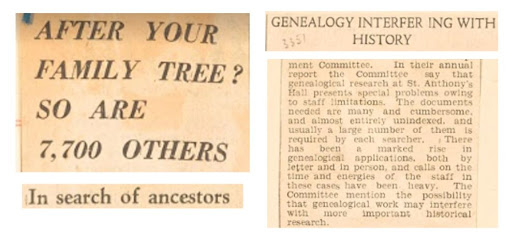
Headlines on popularity of family history
UOY/PC/1/13/30, UOY/PC/1/2/58: Northern Echo (June 1966), 
Yorkshire Post, Northern Guardian (November 1953)

Several cuttings in the archive are concerned with genealogical requests at the Borthwick, which – indicative of the 60s' opinion that family history was a less worthy historical research pursuit – apparently impeded the ‘proper’ historical research being undertaken at the Borthwick due to the sheer number of them. Requests came from far and wide, including America, and led to, quite possibly, my favourite piece of wordplay throughout the entire archive:

“…it may not be possible to see the historical wood for family trees.”

 A diverse student population

Picture of George Crofts and students outside Heslington Hall
UOY/PC/1/7/103, Northern Echo (October 1963)
If you were asked to guess at the relationship between the man and women in the adjacent picture, with the only context given that it depicted people linked to the University of York, a variety of conclusions could be reached. The most obvious answer, perhaps, would suggest that this was a lecturer talking to students. This explanation would certainly fit comfortably with traditional perceptions of what academics and students looked like. However, this was not the case. Every person in the photograph is a student: indeed, this is a group of students from the very first undergraduate cohort to pass through the gates of Heslington Hall in 1963. 

George Crofts – pictured seated – was 64 years old when he enrolled at the University of York to study Economics: he was, unsurprisingly, the oldest undergraduate. A World War I veteran and a pharmaceutical chemist, Crofts – following his retirement – moved from Newcastle to York to take up his place at the University and was successfully awarded his degree in Economics with Economic and Social History in 1966. 

Crofts was not the only mature student to enrol in 1963. Mary, a mother of four from the City of York, joined in her thirties to study Economic and Politics because she saw no reason for women her age being confined to making tea or knitting. Like Crofts, she was one of the first graduates of the University and set a fine example to her daughters. Anyone, seemingly, was welcome to study at York provided they had the qualifications: there was no conventional image of a ‘York student’ to be upheld. 
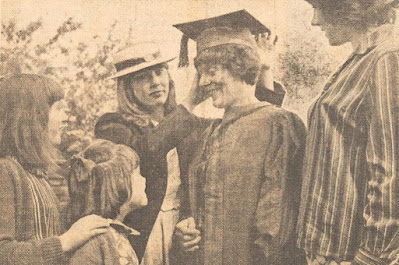
Picture of woman graduating in 1966
UOY/PC/1/13/37, Yorkshire Evening Press (July 1966)

Not only were mature students welcome, but so, too, were overseas students. Even in the earliest days of the Architecture and Archival summer schools, there had been a focus on establishing York as an internationally renowned place of study. In 1953, York was one of various cities cooperating with the British Council to host a yearly course in the spring entitled ‘Life in an Historic City’, which offered overseas students studying in UK universities the chance to experience the machinations of local government and life in British cities: a course which ran regularly in the following years. International students were commonplace in York, and it is unsurprising that there was talk of York becoming a ‘School of Britain’ at one point when it seemed as if the university dream was dead in the water. 

International students on York's architectural summer schools, 1940s-1950s Summer
UOY/PC/1/1/24, 160, Northern Echo (August 1949), Yorkshire Gazette (August 1952).
(L) Michael Onafowokan of Nigeria, studying architecture at Glasgow University, undertakes measured drawing at York Castle in 1949 as part of a York Summer School on architecture. (R) Students from the UK, Malaysia and Sudan sketching and measuring features at the Treasurer's House, 1952.


Overseas students on courses in York visit the York Press
UOY/PC/1/3/66, Yorkshire Evening Press (April 1966).


The first cohort of students in 1963 was not lacking in international students but, unsurprisingly, they were in the minority. Students arrived in York from India, Kenya, the USA, Nigeria, Hong Kong, Iraq, Sudan, France, and Germany, to name but some of the countries. A name that may be known to those already familiar with the University’s early history might be Pradip Nayak, a student from Kenya studying Economics and Politics, who was elected the first president of the Students’ Representative Council in 1964. Nayak was actively involved in student politics, with the Yorkshire Post describing him as “a leading light of the student movement”.

Following its official establishment, it did not take long for York to actively seek to develop its international links. In 1964, links were established with, what was then Northern Rhodesia, Zambia; in the 1964/1965 academic year, York – in association with the Ariel Foundation – hosted several African students studying Economics. The Zambian contingents of this group even celebrated their country’s independence at King’s Manor a day early so that they could travel to London the following day to take part in official celebrations.

Students celebrate Zambian independence
UOY/PC/1/9/99, Yorkshire Post (23 October 1964)

Student activism


Universities in the 1960s were well-renowned for their student activism, and, despite York’s climate being tamer than some of the more radical establishments, York students proved to be just as committed to their causes.

In 1964, for example, students from the University of York and St John’s College joined together to protest the life sentences that had been handed down to South African anti-apartheid activists by holding an all-night vigil in King’s Square.
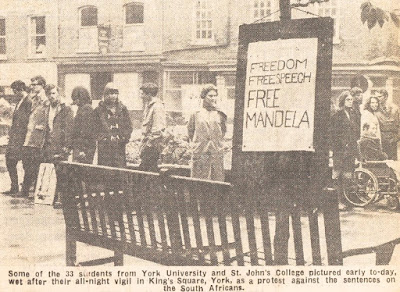
Student protest: Mandela vigil
UOY/PC/1/9/21, Yorkshire Evening Press (June 1964)

York students also took to the streets in the winter of 1965 to condemn Rhodesia’s Universal Declaration of Independence (much to the chagrin of some York residents who were out to see Father Christmas). 

Protest against Rhodesian UDI
UOY/PC/1/11/155, [unattributed cutting] (November 1965).

The Vietnam War was also a point of focus throughout the early years: in 1965 York’s Debate Society passed a motion condemning American aggression in Vietnam demonstrations were planned, and signatures were collected for a petition to be sent to the Prime Minister that urged the government to encourage a peaceful resolution to the conflict. In 1966, some York students got into hot water with the British Legion for giving out white poppies for others to wear on Armistice Day in recognition of the impact of the Vietnam War.

Indeed, so fed up with the image of the protesting student in mid-1965, two York students protested the protests that had been taking place, positing contrary opinions on several subjects that had other University of York students up in arms!

It was not all protests, however. Students were often behind fundraising attempts. The York University Movement for Racial Equality worked in tandem with Keighley International Friendship Council in 1965 – as well as the Linguistics and Education departments at York – to help teach English to immigrants in Keighley. The Movement launched an appeal – which was successful – for £1,000 that was to pay for the upkeep of a rented social centre that would enable the scheme to develop. 

Students help immigrants in Keighley
UOY/PC/1/11/150, Telegraph and Argus (November 1965)

'Sporting’ endeavours


Forget the annual ‘Wars of the Roses’ competition with Lancaster University: the hottest sporting action to be found in the archives concerns the University of Hull’s challenge of a Winnie the Pooh contest in 1966. Posted on University of York’s noticeboards, Hull students challenged York students to a game of Poohsticks and Pooh hums – for those uninitiated, Poohsticks is a game that involves two sticks, a body of flowing water, and a bridge (what better campus than York’s for such a competition with its largest plastic-bottomed lake in Europe and bridges, one might ask; one with faster running water, one might answer), and Pooh hums were to be songs that would be judged on their “Poohishness”. 

Sadly, I could find no articles discussing whether any courageous York students took up this most daring of challenges – should the University of Hull, or any students of the time, be able to clarify any information, I would gladly welcome it. [1] 

* * * * * *

Limitations and lacunae: memory and forgetting in the archives

 
Whilst there are many and myriad benefits from examining the archive to gain an understanding of the University of York’s early history, it is also necessary to recognise the archive’s limitations. The 1966 sketch acknowledged that, in the distant future of 2546, there would be no evidence of the sketch having taken place, and this observation highlights the fact that archives, no matter how varied their contents, cannot record everything, which can have a significant impact on what and who is remembered. 

The art of selection


In fact, archives contain only brief slivers of a vast, expansive past. For the researchers of the future to be aware that the sketch had taken place, an account of the sketch would have to have been documented in a newspaper headline. This would require: a journalist to decide the moment was worth documenting in the first instance; the volume’s compiler to decide that the cutting was worth including; an archivist to decide to keep the volume in an archive; a useful finding aid to be created to search through the surviving cuttings; and it would require this archive to be cared for to survive into the future (whether this survival would be in paper or digital form is a question for another day). For survival, selection is imperative at every point. 

Selection highlights just how easy it is for an event, a person, a group of people, to be consigned to the cutting-room floor: to be forgotten even in the quest for memory. The necessity of selection has, in the past, created lacunae in archives, and it is frequently the least powerful in society that suffer from this lack of documentation and lack of representation in the archives. Thankfully, action has been taken – is being taken – to redress this wrong: whether in state archives, or in more local, community archives, efforts are underway to preserve the histories of the most marginalised groups on their own terms.

Selection at work in the press cuttings archive


In terms of where selection fits into the archive that I have been working with, it is not necessarily a case of archival selection that delimits the contents – in fact, the collection process seems to have been rather indiscriminate, with the only criteria necessitating that articles must mention the University in some capacity – but rather the nature of the archive itself. It is an archive of press cuttings and press cuttings alone, which ultimately means that its contents reflect the interests of the press throughout the 1950s and 1960s. 

Stories included in the press cuttings can vary from the mundane to the scandalous, but there is little doubt that they do not – indeed could not – report on every minute happening concerning the University. Selectivity at work once again. Moreover, the articles often tease at information that they cannot further elucidate on. A case in point: a 1966 Yorkshire Evening Press article discussed an Eboracum article written by a first-year student concerned with the relationship between overseas and home students and the existence of unofficial segregation. The cutting acknowledges the existence of this tension but does nothing more to explore the matter: there are no interviews with international students documenting their experience at the time, for example. 


UOY/PC/1/12/89, Yorkshire Evening Press (March 1966)


Combating selectivity


How do archives avoid complacency and recognise the gaps in the historical record? I already mentioned the efforts that have been taken elsewhere in archives to combat the impact that such selectivity can have, and similar principles might be applied here. The early years of the University of York’s history are still within living memory, and this means that steps can be taken to counter archival gaps, helping to guarantee that the archival record will be more inclusive and representative of everyone involved in the University of York’s history. 

In other words, let us hope that the exploration of a press cuttings archive can be used to start conversations about the early years of the University of York as opposed to finishing them, creating a comprehensive and inclusive archive that might survive into 2546 and even beyond. 


[1] Do you know if York accepted the challenge? Do you have a photographic record of the events or an original 1966 Hum or rhyme? If so, please contact the Borthwick and let us know!  

Tuesday, 13 September 2016

Yorkshire Wildlife Trust and Operation Cleft Stick


Yorkshire Naturalists’ Trust Annual Report 1970.
YWT/A118/1/1
Since April, I have been steadily working through the Yorkshire Wildlife Trust’s fascinating and extensive archive. I have now surveyed over half of the records that have been deposited here at the Borthwick Institute - about 84 boxes, or 570 files! - and along the way have rediscovered items that give interesting insights into the history of the Trust. I'm going to release some of these snippets as blog posts, and some of them - like this one - will also be published in Yorkshire Wildlife Trust's magazine.

One of the first things I came across during my survey of the archive was a volume of press cuttings from 1971. The entry that immediately drew my eye was a handwritten note that read ‘Due to a postal strike, most of the annual reports were delivered by hand in this year. To mark the occasion, our own stamp was produced by the computer in the Biology Department at York University.’ This intrigued me for several reasons - least of all trying to imagine a Biology department with just a single computer!

The strike mentioned was Britain’s first national postal strike, and it was to run for
Stamp from press cuttings, 1971. YWT/A114/2/2
seven weeks from 20th January to 7th March 1971. With no postal service available, the February meeting of the Trust’s Executive Committee began to make plans for what was known as Operation Cleft Stick. Overseen by then Executive Officer, Colonel John Newman, the operation saw the delivery of 2,500 copies of the 1970 Annual Report to Trust members.

The Yorkshire Evening Press described the ‘hectic week’ of filling envelopes and transporting them across Yorkshire and beyond to be delivered by Trust volunteers. The report was an important one, marking both the Silver Jubilee of the Trust and the end of European Conservation Year, and including updates on the ongoing threat to Askham Bog from the construction of York’s outer ring road.

As well as capturing an example of how the Trust responded to the impact of national events, this snippet from the archive also represents just one example of a longstanding history of collaboration between the University and the Trust, which continues to this day. 

Lydia Dean, Project Archivist

Thursday, 27 November 2014

Slow and Steady Wins the Pace


The renowned ecclesiastical architects Pace and Sims were prolific. Both were involved in a wide range of projects, from restoring Castle Howard, to designing memorials at churches and cathedrals, and constructing imposing new buildings such as Keele University chapel. During our work experience project, we unfortunately did not see any of the plans for the new builds. However, we were lucky enough to get the opportunity to catalogue renovations and extensions, which showed their subtle skill in combining modernism with medievalism. Indeed, Durham University’s Palace Green library bears witness to this. Another aspect revealed through the archives is the careful, methodical way in which they worked; it often took many years for projects to be completed for they were known for working at a slow pace. In fact, George earned the nickname ‘Snail’s Pace’ for this very reason! 

The firm became one of the Europe’s most productive ecclesiastical architecture practices in Europe, with over 700 churches and cathedrals being built, extended, and updated by Pace and Sims. This is certainly reflected in the Borthwick’s collection. Whilst they did work for larger and more famous churches such as Armagh and Newcastle cathedral, the majority of their work focussed upon the parish church, like St Mary’s, Beverley, St Giles’, Copmanthorpe, and St Mary’s, Northchurch. 

St Mary's Northchurch Church Elevation
St Mary’s, Northchurch has an ancient history; the church claims to be one of the oldest in Hertfordshire. It is believed that a Saxon church was on the site and some Saxon stonework can still be seen in the west and south walls. The majority of the building is related to the 13-15th century, which matches the parish church expansion pattern seen nationally, as well as some Victorian additions (a vestry, a porch and a new north aisle). Sims was involved in quite a radical alteration of the interior of the church: the choir stalls and organ were moved from the north transept to the west end of the church. This significantly altered worship as it affected the acoustics and the procession. However, the changes did not end here as a new nave altar was built underneath the crossing. The Victorian interior was thus heavily impacted upon by Sim’s efforts. The simple but robust style effortlessly blends into the sensitive Victorian-cum-Medieval décor. 

Copmanthorpe Church in York has a similarly extensive history with its Roman and Saxon roots. It began life as a Norman single cell church but slowly expanded over time; its plain outside does not continue inside as the elegant beamed roof adds a touch of symmetrical sophistication. St Giles’ church required some more modern features and hence, Sims was called upon. He designed a new vestry and kitchen. Whilst searching through the archive we discovered extensive sketches and photographs of what the interior was to look like as well as being treated to a photograph of the finished product. 

St Mary's Beverley floor plan 1985
 In Beverley stands the beautiful church of St Mary’s, called by Sir Tatton Sykes in the 19th century, “Lovely St Mary’s, unequalled in England and almost without rival on the continent of Europe!” It has undergone numerous building phases. Indeed, in the medieval period building work was almost continuous. This is reflected in a plan, from 1895, catalogued by us whilst on the placement, which dates each section of the church. Both Pace and Sims worked on the Beverley church but the archive contains plans from Leslie Moore and John Bilern too. Therefore, we were able to see the metamorphosis of the interior and exterior over a period of 100 years. The new roof for the south chapel in its rich blue effortlessly works alongside the stained glass and other decorated ceilings. 

The Pace and Sims archive therefore allows the transformation of churches to be investigated, illluminated, and inspected. By just briefly analysing three parish churches, it is possible to notice how much of an impact, whether subtle or sublime, both architects made upon the ecclesiastical fabric of England.  

This post was written by students from the University of York on a work experience placement.

You can read more about the experience of earlier students on the work experience programme and the Pace and Sims Archive at Keeping Pace and Keeping up the Pace (and Sims) at the Borthwick. 

Thursday, 17 July 2014

Conservation and The Science of Light

A data logger hidden behind an exhibit
The Conservation Department has recently been involved in the installation of two new exhibitions: ‘The Architecture of War Memorials’, which can be found on the third floor of the Raymond Burton Library, and ‘The Pity of War’, which is on display along the ground floor main corridor in the Harry Fairhurst. We decided that this would be a good opportunity to set up some environmental monitoring, so that we could investigate the environmental conditions within the display cases for the duration of an exhibition. We positioned data loggers in various cases to record temperature and relative humidity, hiding the loggers under exhibits and behind stands. We also agreed that we would conduct some light monitoring for the exhibition areas.

Data Logger hidden behind an exhibit

It is difficult to be discreet about our light monitoring – the blue wool sample cards that we have positioned in the cases need to be in direct light to give an honest indication of light exposure in the cases. You should be able to spot two sample cards in each exhibition.

Blue Wool Sample Card

The principles behind the blue wool scale were originally developed for the textile industry in the early eighteenth century. French chemist Dufay was appointed to be Inspector of Dyeworks in 1729, and instructed to develop regulations to control the operations of the dyers.[1] He carried out systematic comparative testing on dyes, by exposing test materials alongside standard samples of graded fastness. Although there have been various developments in the materials, this method of using dyes of known light-fastness is still widely used today.

The blue wool scale tests for light fastness. The sample card we use today is made up of eight swatches of blue wool, which are dyed so that each consecutive dyestuff has an increased resistance to fading when they are exposed to light. 

Blue wool scale card in exhibition case

Standard 2 takes twice as much exposure to fade to the same level as standard 1, and standard 3 takes twice as much exposure to fade as standard 2 and so on up to standard 8. The sample cards are used in a variety of industries that need to test their products for light-fastness. This could include testing the dyes in clothes, the colour in wallpaper or watercolour paints used by artists. A standard test will expose the blue wool card to light alongside a sample of the dye. Half of the blue wool sample is covered (as you can see in the sample in our exhibition cases) and half of the dye sample is also covered. After a pre-determined amount of light exposure both the blue wool sample and the dye sample are uncovered and compared, and the dye will be awarded the standard on the blue wool scale that has faded the closest amount.

Conservators monitor light exposure so that we can limit damage to the materials that we care for. Light is energy, and energy is damaging to organic materials. I read a comparison of light and heat damage recently that I thought very expressive. Garry Thomson suggested that we imagine organic molecules as people on a commuter train.[2] People are jostled, but this causes minimal physical damage, just as a steady, cool temperature causes minimal chemical damage to our archives. If the temperature on the train is raised, this jostling can get out of hand, and this is when chemical reactions to our molecules also become increasingly likely.

The Electromagnetic Spectrum

Now, Thomson associates light energy with projectiles fired at the commuters by a riot control squad. The damage that the projectiles cause is dependent on the type of projectile: a ping-pong ball or a pebble might only cause minimal damage, whereas a rocket or a hand grenade would cause considerably more. Light travels in waves, with the shortest wave-lengths in the visible spectrum at the violet end, and the longest at the red end. Ultraviolet (UV) light lies beyond the visible at the violet end, and infrared (IR) at the red end. The shorter the wavelength, the more energy delivered; and the more energy delivered, the greater the damage. As a result the violet waves of light are more dangerous than the longer red waves; and the UV waves are the most dangerous of them all, equivalent to the hand grenades thrown by the riot control squad. During my research, I was amazed to discover that to get a supply of useable energy from heat comparable to the energy delivered by light in the UV range one would have to heat up to 200°C.[3] This demonstrates how powerful light energy can be.

In our exhibition cases we are not testing individual specimens, but have chosen to use the samples to give us an overall indication of light exposure over a fixed period of time. We also take light measurements with a handheld monitor in our exhibition areas, which give us ‘lux’ and UV values. These tell us how much visible light and how much ultraviolet light can be detected. To reduce light exposure in our Borthwick exhibition area there are blinds on the windows. A shaft of light that once escaped from between the blinds was measured to be 1767 lux, whereas the next highest reading from the cases next to the windows with the blinds down has been 582 lux. Direct sunlight can be very intense, and the blinds significantly reduce this exposure.


The glass of windows and exhibition cases also reduce the amount of light that reaches our archives. UV light is reduced, and only between 80 and 90% of visible light is transmitted.[4] As UV is the most damaging type of light, we aim to reduce this as much as possible, and so we also use UV filtered glass for our exhibition cases. The graphs shown here relate to the display cases in the Harry Fairhurst, and demonstrate how much visible light is blocked by the glass as well as how much UV light is filtered by the glass.


We calculate light exposure by multiplying the time by the intensity of exposure. We aim to limit the ‘light hours’ that our archives receive by restricting the length of time we have them on exhibition. Some more light sensitive materials, such as photographs or watercolours, are given even shorter exhibition periods, and are frequently substituted with surrogate images. We also alternate between exhibitions of original items with those full of surrogate material, so that we can continue to raise awareness of the collections we hold at the Borthwick without putting any items at risk from regular display.

 Although our exposure calculations are necessary, we are excited to see the results of our blue wool samples at the end of these exhibitions. Our calculations convey some numerical sense of light exposure, but the sample cards will be a significant visual indication of deterioration.


References


Forrester, Stanley. ‘The fast and the fugitive: light fastness testing of dyed textiles up to the 1870s’, Journal of the Society of Dyers and Colourists, 91 (July, 1975), 217-223.

 Guthrie, J., N. Tayan and L. Wilson, ‘A novel approach to light-fastness testing’, Journal of the Society of Dyers and Colourists, 111 (July/August, 1995), 220-222.

 Pugh, Samantha and James Guthrie. ‘The development of light fastness testing and light fastness standards’, Review of Progress in Coloration and Related Topics, 31 (2001), 42-56.

 Thomson, Garry. The Museum Environment, Second Edition, London: Butterworth-Heinemann, 1986

With thanks to Tracy Wilcockson for the photographs and light monitoring statistics.

-----------------------------------------------------------------------------------------------------------

This post was written by Catherine Dand, a Conservator at the Borthwick Institute


[1] Forrester, 218
[2] Thomson, 3
[3] Thomson, 190
[4] Thomson, 5

Friday, 9 May 2014

Keeping Pace: Dr Jones and the Raiders of the Lost Archive

In your day-to-day life you've probably walked past one of George Pace's buildings before and not realised it. Pace (1915-1975) was a York-based architect who is famous for his contributions to modernist ecclesiastical architecture. Perhaps his strict religious upbringing was the reason behind his career. Upon the death of his associate, Ronald Sims, the Pace and Sims documentation was gifted to the Borthwick. Today, more than 250 rolls of plans, drawings and correspondence lie uncatalogued in storage: it was our job to begin this exciting quest.

As work experience students from the University of York - under the guidance of Dr. Amanda Jones - we immediately got our teeth stuck in (not literally!). Armagh Cathedral was the first building we unrolled. Seventy-seven architectural drawings took us on a virtual tour of the Royal Irish Fusiliers Chapel. The Dean of York personally recommended Pace for this project; this is the foundation of Pace's illustrious career. Some of the most interesting drawings from this roll related to the war memorial design. We saw many designed for such memorials; it served as a powerful and poignant reminder of the lasting impact of the World Wars.


Drawing of detail from Armagh Cathedral memorialDrawing of war memorial for Armagh Cathedral


Another part of our project was to help conserve some of the Atkinson Brierley archives. This involved cleaning the documents using specialised tools. Alex was swept away by, "the cleaning experience. I couldn't believe the amount of dirt that has accumulated on the sdocuments!" Through this, we learnt how important conservation is for the preservation of these valuable documents. We enjoyed working with the conservation staff and current volunteers and through their help and knowledge, we gained a new set of skills in basic conservation.
Cleaning Atkinson Brierley drawings
This was Guy's favourite part," I am currently working on a Masters dissertation on Brierley so the chance to contribute to the preservation of these wonderful documents was really rather special."


In three days, we managed to catalogue 347 documents. This process was one in which the past was unrolled before our very eyes. From memorials to dossals, radiator covers to electrical installations, and candlesticks to altars, we saw the extensive work and skill behind being an architect. Joy particular enjoyed the data collecting. "It is wonderful to think that my work is contributing to the preservation of 'the past in the present for the future'. Through the database, these documents can now be brought to light again and truly appreciated."
Caitlin data-inputting for the Pace project
"I built on my communication and team skills through the data inputting. Also, the project gave me the chance to further my palaeographical skills. This week has been really fun and insightful." Caitlin.

Work experience students study a plan
"Analysing the documents was very interesting. I normally study 19th century architecture, so getting the chance to see 20th century work was fascinating." Rebecca.

Joy holding a roll of drawings
This is how Joy rolls.
What made the experience truly worthwhile is the fact we have made a lasting contribution to the archives. Before we began this placement, we did not truly appreciate the important work of archivists and the volume of information stored. A career in archives is one that should be respected as archivists are making a remarkable effort to preserve our heritage. In fact, we are all interested in pursuing a job in this field. Aoife found that, "all the staff were friendly and helpful, and their career advice was really useful."

For read about the work of former work experience students, look at the posts on the Tuke project last year, here, here and here. 

Our work experience students
"A fun and fascinating week with a great group of people." Mark  

Monday, 24 February 2014

Judging a Book By Its Cover


Nowadays many books are produced with a ‘perfect’ binding where the pages are stuck to the spine and invariably split open as soon as any pressure is applied. They are still the common book shape we are all familiar with but they are very different to books printed before 1801. Until the early nineteenth century bindings were all made by hand so each one is unique.

Books were produced by printing on a large sheet of paper and then folding, cutting and sewing the sheets to make the familiar book shape.  The size of the book depends on how many folds are made, so for a quarto the page is folded four times and for an octavo eight times, and so on. The text block that has now been created needs something to protect it and keep it clean and the best and most efficient way of doing this is to provide a rigid board front and back covered with a material such as leather.  You end up with a space that can be decorated in any way you want.
Sewing structure of a binding

This picture shows a book which has lost its spine showing the sewing structure. You can see the different gatherings of pages laid next to each other. The large thick cord is what is holding the boards on and providing a stable mount for the pages to be sewn onto.

There are many different sorts of bindings and fine bindings actually only represent a tiny proportion of those surviving, but their beauty and craftsmanship mean that they never fail to delight. There have been many wonderful binders through the ages some known only through their distinctive work such as the ‘Centre Rectangle Binder’, or the ‘Small Carnation Binder’ but there are other names that we can identify.

This is an early binding designed by Dante Gabriel Rossetti. It was for a book of his sister Christina’s poems.  

Rossetti was a poet, painter, and  illustrator among many other talents. His work with its clean pure lines influenced the generation that came after him including artists such as William Morris. Rossetti’s art was also characterised by his love of all things medieval and this binding is a good example of that.  The book is bound in smooth green cloth and has then been gilded, the design pressed into the surface with hot tools with gold leaf between the tool and the leather. The design wraps round the spine so is best seen when the book is open. The lines coming out from the spine top and bottom suggest ornate hinges and the small gold circles could represent the nail heads that would have held book clasps or furniture on a medieval binding. The design was developed over several months in 1865-1866. Rossetti had also done the design for Christina’s first book of poetry, Goblin Market, and this is similar in style with the small gold circles, although the lines for that book were straight not gently curved as in this binding.
 
The second named binding is from the beginning of the 20th century.
 
Sangorski & Sutcliffe were early 20th century bookbinders famous for using precious stones and metals in their extravagant bindings. One of their most famous creations was on a copy of the Omar Khayyam and was known as the Great Omar. It was a beautiful binding featuring golden peacocks with jewelled tails but sadly Great Omar went down with the Titanic and has never been recovered. A second copy was made but was then destroyed during the Blitz in World War Two. Undaunted, a third copy was produced and, to date, this resides safely in the British Library.
 
Although, at first sight, this seems one of their less ornate bindings, the design, fashioned by inlaying different coloured leathers, creates a real sense of movement among the rose stems.

Sangorski and Sutcliffe binding for The Hind and The Panther by Dryden

The binding is not contemporary with the book which was published in 1697. It is a poem by John Dryden called The Hind and the Panther and was written after his conversion to Roman Catholicism. The poem is an allegory with the hind representing the Catholic Church and the panther the Church of England.

It is interesting to speculate as to why this style of binding was chosen for the book. The tortuous thorny rose stems ending in the tight red rosebuds might be a metaphor for the struggle Dryden had to undergo, hiding his true religious beliefs until he was able to openly convert under James II. The use of roses as a symbol of achievement and completion is well established. After having battled with the long thorny stems, the toiler is rewarded with the beauty and the fragrance of the flowers. The rosebud represents beauty and purity and the rose leaves denote hope.  However the binding was put on over 200 years after the book's first publication so perhaps the owner just liked the design!
These and many other examples of fine binding can be found in the display cases along the Harry Fairhurst corridor in the University of York library.  The exhibition will be in place until the end of April 2014. For more information please contact Sarah Griffin, Special Collections Librarian at sarah.griffin@york.ac.uk
------------------------------------------------------------------------------------------------------------------
This post was written by Sarah Griffin, Special Collections Librarian at the University of York.
 
Don't miss Sarah's free talk on the Special Collections of the University of York, "A Journey Through the Pages" on Thursday 6th March 6.30pm (drinks and canapés from 6.00pm), in LFA 204/205
 
To register for tickets go to http://bit.ly/journeythroughthepages