Showing posts with label work experience. Show all posts

Thursday, 27 November 2014

Slow and Steady Wins the Pace


The renowned ecclesiastical architects Pace and Sims were prolific. Both were involved in a wide range of projects, from restoring Castle Howard, to designing memorials at churches and cathedrals, and constructing imposing new buildings such as Keele University chapel. During our work experience project, we unfortunately did not see any of the plans for the new builds. However, we were lucky enough to get the opportunity to catalogue renovations and extensions, which showed their subtle skill in combining modernism with medievalism. Indeed, Durham University’s Palace Green library bears witness to this. Another aspect revealed through the archives is the careful, methodical way in which they worked; it often took many years for projects to be completed for they were known for working at a slow pace. In fact, George earned the nickname ‘Snail’s Pace’ for this very reason! 

The firm became one of the Europe’s most productive ecclesiastical architecture practices in Europe, with over 700 churches and cathedrals being built, extended, and updated by Pace and Sims. This is certainly reflected in the Borthwick’s collection. Whilst they did work for larger and more famous churches such as Armagh and Newcastle cathedral, the majority of their work focussed upon the parish church, like St Mary’s, Beverley, St Giles’, Copmanthorpe, and St Mary’s, Northchurch. 

St Mary's Northchurch Church Elevation
St Mary’s, Northchurch has an ancient history; the church claims to be one of the oldest in Hertfordshire. It is believed that a Saxon church was on the site and some Saxon stonework can still be seen in the west and south walls. The majority of the building is related to the 13-15th century, which matches the parish church expansion pattern seen nationally, as well as some Victorian additions (a vestry, a porch and a new north aisle). Sims was involved in quite a radical alteration of the interior of the church: the choir stalls and organ were moved from the north transept to the west end of the church. This significantly altered worship as it affected the acoustics and the procession. However, the changes did not end here as a new nave altar was built underneath the crossing. The Victorian interior was thus heavily impacted upon by Sim’s efforts. The simple but robust style effortlessly blends into the sensitive Victorian-cum-Medieval décor. 

Copmanthorpe Church in York has a similarly extensive history with its Roman and Saxon roots. It began life as a Norman single cell church but slowly expanded over time; its plain outside does not continue inside as the elegant beamed roof adds a touch of symmetrical sophistication. St Giles’ church required some more modern features and hence, Sims was called upon. He designed a new vestry and kitchen. Whilst searching through the archive we discovered extensive sketches and photographs of what the interior was to look like as well as being treated to a photograph of the finished product. 

St Mary's Beverley floor plan 1985
 In Beverley stands the beautiful church of St Mary’s, called by Sir Tatton Sykes in the 19th century, “Lovely St Mary’s, unequalled in England and almost without rival on the continent of Europe!” It has undergone numerous building phases. Indeed, in the medieval period building work was almost continuous. This is reflected in a plan, from 1895, catalogued by us whilst on the placement, which dates each section of the church. Both Pace and Sims worked on the Beverley church but the archive contains plans from Leslie Moore and John Bilern too. Therefore, we were able to see the metamorphosis of the interior and exterior over a period of 100 years. The new roof for the south chapel in its rich blue effortlessly works alongside the stained glass and other decorated ceilings. 

The Pace and Sims archive therefore allows the transformation of churches to be investigated, illluminated, and inspected. By just briefly analysing three parish churches, it is possible to notice how much of an impact, whether subtle or sublime, both architects made upon the ecclesiastical fabric of England.  

This post was written by students from the University of York on a work experience placement.

You can read more about the experience of earlier students on the work experience programme and the Pace and Sims Archive at Keeping Pace and Keeping up the Pace (and Sims) at the Borthwick

Friday, 24 October 2014

Keeping Up the Pace (and Sims) at the Borthwick

Death and Dairies at Castle Howard
 
Our week began with a brief introduction and tour of the Borthwick Institutes archives and stores. The collection is massive and the works are housed in strong rooms which we were certain could survive the apocalypse! The collection varies from maps and photographs to books, wills, church registers and architectural plans which is what we focused on for the week. The Pace and Sims collection includes plans and sketches to English landmarks like Castle Howard. The works we were assigned are relatively contemporary, primarily dating between the 1960s and the 1980s with our most recent plan dating to 1999. The plans include designs for everything from entire buildings to notice boards and toilets. We even came across a full size sketch of a pillar in the Castle Howard Mausoleum which, at nine meters, stretched the length of the large Lifelong Learning Room!

Loooong drawing of pillar at Castle Howard Mausoleum


 The sketch was not very detailed and we believe this was because the architect may have been attempting to get a better idea of the height of the column.

The collection also included sketches of the Mausoleum on the grounds, originally designed by Nicholas Hawksmoor. These photos are copies of the original plans by Hawksmoor. These were interesting in that they included a stamp and address of where they were kept as well as, presumably, a signature from the person who kept or collected these plans. With these copies we were able to see the differences and similarities between older and more modern plans. Here, we observed likenesses in handwriting between eighteenth-century architects and twentieth-century architects. Most interesting was the stamp from National Buildings Record Office in Swindon. This was interesting as we discovered that the office in Swindon housed records and archives from various collections that were thought to be at risk from bombing during the Second World War. 


Memorials and Mysteries at Newcastle Cathedral

Amongst mountains of architectural plans emerged designs in a language which we could not decipher.Danish! These were plans for the organization of text for Danish memorials at St.Nicholas Cathedral in Newcastle at which Ronald Sims was Cathedral Architect for a time. In researching, we discovered that the memorials are still displayed at the cathedral in recognition of the Danish merchant navy which made Newcastle its home port during World War II (see http://www.danskekirke-newcastle.co.uk/kirke/uk/window-uk.htm for more information).  We found these plans to be poignant as we were not expecting to handle documents for World War II memorials, especially to those outside of England.

The plans for Newcastle Cathedral also included sketches for a stolen noticeboard which was replaced in 1999. It was interesting to watch the progression of designs from the original board to the creation of a new board. This included many revisions which allowed us to experience the evolution of something that is seemingly insignificant.

 A Canadian in England!

In the first roll of plans from Clifton Campville Church we found plans for memorials and various inscriptions for the Confederation Centre of the Arts in Prince Edward Island. We have tried to make a connection between Prince Edward Island, Canada and Clifton Church in Staffordshire (a tiny parish in English midlands) but have not been able to find its relevance. This was particularly significant for one member of our team as she is a Canadian. It was fun to come across something that was tied to Canadian heritage and history within mounds of rolls of English architecture.

Detail of the Canadian inscription


This week has been particularly useful and full of surprises. Not only were we given the opportunity to handle and catalogue archival materials but also learned how to clean these sketches (rolls from the Atkinson Brierley drawings). We were given the opportunity to view and handle doodles, names and scribbles within the margins of these plans giving us insight into the personality of the architect and the day-to-day management of a major architectural firm.

One of our volunteers in action!


This post was written by students from the University of York on a work experience placement. 

You can read more about the experience of earlier students on the work experience programme at Keeping Pace

Friday, 9 May 2014

Keeping Pace: Dr Jones and the Raiders of the Lost Archive

In your day-to-day life you've probably walked past one of George Pace's buildings before and not realised it. Pace (1915-1975) was a York-based architect who is famous for his contributions to modernist ecclesiastical architecture. Perhaps his strict religious upbringing was the reason behind his career. Upon the death of his associate, Ronald Sims, the Pace and Sims documentation was gifted to the Borthwick. Today, more than 250 rolls of plans, drawings and correspondence lie uncatalogued in storage: it was our job to begin this exciting quest.

As work experience students from the University of York - under the guidance of Dr. Amanda Jones - we immediately got our teeth stuck in (not literally!). Armagh Cathedral was the first building we unrolled. Seventy-seven architectural drawings took us on a virtual tour of the Royal Irish Fusiliers Chapel. The Dean of York personally recommended Pace for this project; this is the foundation of Pace's illustrious career. Some of the most interesting drawings from this roll related to the war memorial design. We saw many designed for such memorials; it served as a powerful and poignant reminder of the lasting impact of the World Wars.


Drawing of detail from Armagh Cathedral memorialDrawing of war memorial for Armagh Cathedral


Another part of our project was to help conserve some of the Atkinson Brierley archives. This involved cleaning the documents using specialised tools. Alex was swept away by, "the cleaning experience. I couldn't believe the amount of dirt that has accumulated on the sdocuments!" Through this, we learnt how important conservation is for the preservation of these valuable documents. We enjoyed working with the conservation staff and current volunteers and through their help and knowledge, we gained a new set of skills in basic conservation.
Cleaning Atkinson Brierley drawings
This was Guy's favourite part," I am currently working on a Masters dissertation on Brierley so the chance to contribute to the preservation of these wonderful documents was really rather special."


In three days, we managed to catalogue 347 documents. This process was one in which the past was unrolled before our very eyes. From memorials to dossals, radiator covers to electrical installations, and candlesticks to altars, we saw the extensive work and skill behind being an architect. Joy particular enjoyed the data collecting. "It is wonderful to think that my work is contributing to the preservation of 'the past in the present for the future'. Through the database, these documents can now be brought to light again and truly appreciated."
Caitlin data-inputting for the Pace project
"I built on my communication and team skills through the data inputting. Also, the project gave me the chance to further my palaeographical skills. This week has been really fun and insightful." Caitlin.

Work experience students study a plan
"Analysing the documents was very interesting. I normally study 19th century architecture, so getting the chance to see 20th century work was fascinating." Rebecca.

Joy holding a roll of drawings
This is how Joy rolls.
What made the experience truly worthwhile is the fact we have made a lasting contribution to the archives. Before we began this placement, we did not truly appreciate the important work of archivists and the volume of information stored. A career in archives is one that should be respected as archivists are making a remarkable effort to preserve our heritage. In fact, we are all interested in pursuing a job in this field. Aoife found that, "all the staff were friendly and helpful, and their career advice was really useful."

For read about the work of former work experience students, look at the posts on the Tuke project last year, here, here and here

Our work experience students
"A fun and fascinating week with a great group of people." Mark  

Thursday, 22 August 2013

'Everyone must make sacrifices, even golfers' - Heslington Hall during WW2

One of the most significant periods in Heslington Hall’s history is its occupation by RAF Bomber Command No.4 group  from 1940 until 1947. Whilst attempting to reimagine life in the Hall and the village during these tense years of British history, Donald Ward’s Heslington Memories have become our discoveries. And whilst recounting life in the village in these notoriously dark times for the British, writing always with a comfortingly upbeat undertone he sheds some light on Heslington’s ‘War Years’. The anecdotes we have had the fortune of reading show the way servicemen and women, villagers, in Heslington and no doubt villages and towns up and down the country refused to let the tragedies of war weigh too heavily on their outlook, and life went on.

Heslington Hall was thankfully never hit by any bombs during the war, the nearest place that was hit was a house called Spring Villa; we hear that although thankfully there were no fatalities the watchdog had to be put down, and ward remarks ‘I bet it was a Christmas they never forgot, as all the windows were broken and the house was covered in soot’.

Heslington village, undated

Ward was too young at the time to join the RAF himself, but he was still active in village work .He recalls one particular night on fire duty from which we can envisage the tensions and anxiety that would befall a village, especially one with a Bomber Command headquarters through the long nights. The pair were patrolling in front of the Hall when his partner ‘a nervous man’ jumped into him and let out a terrific scream, shouting ‘It got me!!’ .Far from capture by Nazi invaders he had, in Dad’s Army fashion, walked into the head of a horse.

Ward came across other troubles while undertaking another job of transferring the cattle. A problem similarly and frequently encountered by his father who would often receive angry messages from RAF bases requesting him ‘to remove his cows from the runway’, since planes were able neither to take off nor land. After Donald had successfully and without trouble guided his cattle to the golf course, they immediately and frantically broke into a gallop right across the fairways. This was much to the outrage of ‘all associated with golf’ but in these difficult times for everyone they were quite rightly told that ‘There’s a war on and everyone must make sacrifices, even golfers’.

Before the RAF took over during the war the house had been occupied by the 4th Lord and Lady Deramore and Ward describes one particularly amusing scene during a shooting trip. The shoot, at Langwith woods, had stopped for lunch and the Lord Deramore, having taken a walk, noticed that the lavatory of one of only three residents of Langwith, an old lady, had fallen down. She answered his concerned enquiries with a description of a somewhat less effective set up involving a plank of wood between two trees. Deramore was understandably upset by this and on his return home sent his joiner to build her a new lavatory. Upon his return to Langwith he asked how she was finding her new lavatory to which she replied that it was too good to use, so she was keeping her hens in it!

This post was written by Hugo Laffey, one of our student interns.
For more on the work of our student interns see Heslington Hall - Country Life and Archiving Ayckbourn

Thursday, 18 July 2013

The Tuke Work Experience Project, Part 3: Views of York

We are finishing off the series of Tuke work experience blog posts with an entry from Alex and Martha who looked at some views of York, and the Tuke house.

We start with some views of York from Alex:

One of the most interesting items I have had the opportunity of handling this past week has been a collection of 10 photographs of the City of York c.1860. Seeing photos of instantly recognizable sites dated over 150 years ago is absorbing. The collection of photographs had been selected to be included in the memoir of Samuel Tuke, 1784-1857. It is of great interest that these particular images were chosen to best represent York and Samuel Tuke’s life, suggesting they were just as important to the local area then as they are now.  Samuel was heavily involved in The Retreat, a mental health hospital in York that still survives today, just 5 minutes from The Borthwick Archives. The Retreat was established by Samuel’s grandfather William Tuke, and the Borthwick holds most of their records.

Collection - Tuke 79TUKE/2/2/6/3/6


Above we can see a photograph of Micklegate Bar, a photograph of a print of Ouse Bridge, a photograph of 8 figures in front of Ackworth School, a photograph of the south side of York Minster, a photograph of a print of Walmgate Bar, a photograph of Lindley Murray's house in Holdgate, a photograph of a print of Chichester Cross, a photograph of the tomb of Archbishop de Gray in York Minster, a photograph of a sketch of the Shambles in York, and a carte de visite photograph of Samuel Tuke.

Martha found some photographs of the Tuke's house in Lawrence Street:

Whilst going through the Tuke archives one of the most fascinating things I discovered was in the photography collection. The pictures show where the Tukes used to live in York, and the family’s house was located on Lawrence Street. It is a shame that the house has not been preserved, as it is now surrounded by a busy road, and the beautiful gardens attached to the house have since been filled with an industrial estate. It is sad to think that the many people, who pass the house every day, are unaware of the rich history that it holds.
The pictures show the house and garden in there former glory taken in the 1850s, and we can see members of the Tuke family in the pictures. 

Tuke 85 -  photograph of the front of the Tuke's house in Lawrence Street, 1850s Reference TUKE/2/4/1/19/1.


Tuke 85- Esther Tuke in the Tuke's garden at Lawrence Street, ?1850s Reference TUKE/2/4/1/19/3


To read more about our student volunteers' work with the Tuke archive, please see Growing Up Tuke and Who Do You Think You Are Kidding, Mr Bonaparte?

Friday, 21 June 2013

The Tuke Work Experience Project, Part 2: Who do you think you are kidding, Mr. Bonaparte?

This week we continue our Tuke themed blog posts with a look at some of the poetry found in the collection, written by one of our work experience students, Rebecca.

You can catch up by reading Part I here.


Studying personal documents from the early nineteenth century, I inevitably found myself looking out for glimpses of major political events; the Napoleonic Wars in particular. I found there to be surprisingly little. I suppose it’s one of those ‘topical silences’ – letters are going to be about the personal and the everyday, not the grand and international. It’s not like I ever wrote about the Iraq war in my letters of the last decade. But I have to say that a selection of comedic poems was not somewhere I expected to find my first reference to Bonaparte (TUKE/2/1/13/1/3). It makes sense though, and it’s a really fun read. The kind of tongue-in-cheek mockery and teasing bravado reminds me of the theme song to Dad’s Army; who do you think you are kidding, Mr. Bonaparte?


TUKE/2/1/13/1/3
Answer to the Enigmas in a note to Bonaparte

I understand Bonaparte, you still think to come
To frighten Old England with the beat of your drum
But take my advice, & never come near us,
For if you land here you’ll have reason to fear us,
If you ever mix with us, to eat up our bread,
We will lull you to sleep with a potion of Lead
We need stop neither Harrows nor ploughs to find men,
Should we meet in the field you’ll find fifty for ten,
For our Bricklayers lads & our wool-combers Boys,
With our guns can play better than yours with Toys
Yes our very Thimbling tribe can all with great skill,
Use their daggers for their daggers as swords a henchman to kill,
Believe me friend Bonney you’ll be left in the Lurch
Whenever you try to demolish our Church;
At the end of your life you will find I speak truth,
And wish for the Solitude you passed in your youth,
So Huzza to old England if ‘ere you dare come,
For we fear neither you nor the beat of your Drum
All the bells in our steeples shall merrily ring
And our young men & maidens will joyfully sing,
The fame of brave Britons to you is not new,
So we’ll use no more ink but to bid you adieu.


Rebecca found other interesting poetry snippets in the collection, like these written by Favilla Copsie:

TUKE/1/35/1/8/8
The poem (left) was written by Favilla Copsie (née Scott), probably in 1807, and is mentioned in letters from her sister Mary Maria Tuke (née Scott) (TUKE/1/6/1/6/24) and her son James Favil Copsie (TUKE/1/37/1/9/7, TUKE/1/37/1/9/8). Favilla evidently enjoyed writing poetry, and we have a selection of her other poems, which often take the form of everyday correspondence. They’re wonderful to read;


‘my dearest James I use this Ink // to let you see on you I think… first I must thank you for your thimble // which make my needle run quite nimble’


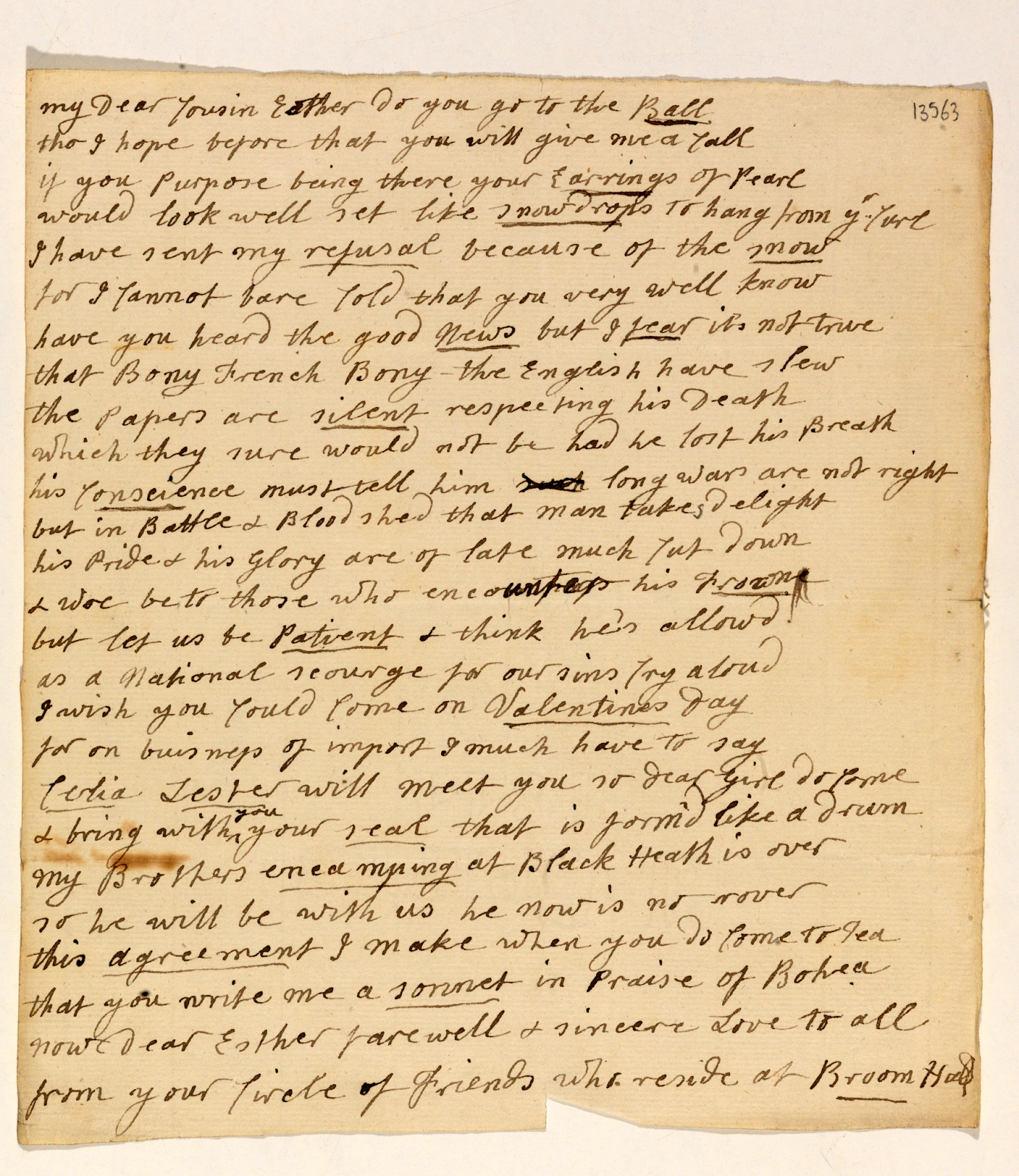
TUKE/1/35/1/3/3


‘my Dear Cousin Esther do you go to the Ball // tho I hope before that you will give me a Call’


Little gems like this which seem at once so alien and so familiar made the week’s work experience really absorbing.


To read more about our student volunteers' work with the Tuke archive, please see Growing Up Tuke and Views of York.

Friday, 14 June 2013

The Tuke Work Experience project. Part I: Growing up with the Tukes

Between April 15th and April 19th, the Borthwick enlisted the help of a team of Work Experience students to help us work through the large collection of Tuke material that we hold. Part of their remit was to pull out interesting documents form the collection to form a series of blog posts.

This week we look at contributions from Sara, Ceri, and Stephanie.


We are a group of students currently undertaking a work experience placement at the Borthwick Institute of Archives in York. Over the past week we have been re-cataloguing the vast Tuke family archive consisting of letters, maps, photographs, silhouettes, finance and other personal items including hair.

 The Tuke family were a notable Quaker family in York, in the 18th and 19th Century. They were active in the local community, and were involved in areas such as pioneering new mental health treatment, founding a Quaker school, a tea and coffee business and other charitable work.

 The week has given us a great insight into what it would be like to work in archives. If anyone is interested in working in this area, they should be aware that opportunities are offered twice a year for York University students to work at the Borthwick for a week.


Sara found a great piece on teenage heartache...


One of the greatest joys of working through this collection was the opportunity to glimpse into the personal lives of members of the Tuke family (perhaps the archival equivalent of peering over the hedge). The Tukes’ private declarations of love, fear, and indignation make them people, rather than personages, and human, rather than historical. A prime example comes from the correspondence of William Murray Tuke (1822-1903). In 1837, he received a letter that any 15-year-old would dread: his girlfriend was breaking up with him. 
 
TUKE/1/30/2/2/1. Letter from Y.Y.Y. to L.N., William Murray Tuke. 28 Oct 1837.
 

Though Y.Y.Y. is unidentified, L.N. is a codename for the young William. ‘My dearest L.N.’, Y.Y.Y. begins, and then she gets straight to the heartbreaking point: ‘I have long thought that as we are both too young to think about such things and yet too old to be so foolish as I now think we have been for the last two or three years [. . .] I do not wish to risk my future happiness by continuing our present correspondence’. Once you see past her handwriting and eloquence, you realize that Y.Y.Y.’s concerns are both modern and strikingly teenaged: ‘I love you as much as ever I did’, she says, but ‘I know your affections may perhaps be fixed upon another person much more worthy of your love than I am’.

With a bit more sleuthing, Y.Y.Y. might be identified and the nature of her relationship with ‘L.N.’ elaborated. For now, this letter remains a mysterious and poignant peek into the heart of an adolescent. In 1846, nine years later, William Murray Tuke married Emma Williams, yet he kept this letter until his death. Perhaps Y.Y.Y.’s naïve words remained with him throughout his long marriage: ‘I shall not forget you as being my first love.’


Ceri found a number of sketches and insights into the everyday life of the young Daniel Hack Tuke...
 
A sketch from TUKE/1/32/1/4/14
This week has given me the chance to follow an individual from early life all the way to a bearded old age. This was one of the great delights for me; Daniel Hack Tuke proved to be the most interesting character and my favourite Tuke of the week after reading his youthful doodle-laden letters to his older brother William Murray Tuke from c. 1841. His sketches of the family during Hebrew lessons (TUKE/1/32/1/4/14) or gathered at tea (TUKE /1/32/1/4/22) brightened up the letters with a mixture of colourful imagination but also morbid curiosity; tucked in with the

A sketch from TUKE/1/32/1/4/22
collection was a small card with a woodcutting and the details of a hanging at York castle. (TUKE/1/32/1/4/25) The letter about Daniel flying his kite was not dissimilar to how a child today would sheepishly admit to a misdeed. The quote “I have been flying my kite to day but is at present in a tree, not in our premises” (TUKE/1/32/1/4/19) partnered with the simple ink sketch provides a poignant childhood memory which was good to keep in mind when reading his later more grown-up correspondence. This collection, in particular was filled with animated anecdotes and was an entertaining insight into the whimsical childhood activities of this prominent figure of the Tuke family.


Stephanie also found some interesting childhood letters, this time from James Favil Copsie...


One of the nicest things about working with original documents is that you are continually reminded of the humans behind the stories that are eventually consolidated into historical narratives. The documents take you away from the general and encourage you to empathise and engage with individuals’ tribulations. This experience will probably be what I will remember best from my week working with the Tuke Collection, my complete immersion in the Copsie family’s lives. Seeing James Favil Copsie transition from a child first living away from home, profusely thanking his parents for the cakes and apples they sent him to an apprentice, falling off the Sunderland Pier and spending time with his friends, to becoming a business man, working in coffee and tea businesses and even considering setting up a mustard business, was fantastic. His childhood letters were by far my favourite though, especially one in which he discussed the breaking off of an engagement (see the quote below), as his childlike honesty contrasts with the more polite and ceremonial letters regarding marriage in other parts of the collection.


“I am glad to hear Miss Rodhams match is broke off. I remember having dear sister Favilla say that she said she would marry at the age of sixteen or before I did expect it would be a poor match as a person of fortune and sense would not have her who knew nothing she is not handsome nor learned nor yet very industrious. So that if any would chase her it would be only for money.” (TUKE/1/37/1/8/3)

To read more about our student volunteers' work with the Tuke archive see Who Do You Think You Are Kidding, Mr Bonaparte and Views of York