Showing posts with label sport. Show all posts

Friday, 22 June 2018

Howzat?: Cricket and the Yorkshire Historic Dictionary

A guest post by Dr George Redmonds, author of the Yorkshire Historic Dictionary 

A woodcut of three men playing stool ball, from a 1767 book 'A Little Pretty Pocket-book'
Stool-ball, 1767, from A Little Pretty Pocket-book
The game of cricket is traditionally difficult to explain, especially to foreigners, but the history of the word itself also poses problems. Even the Oxford English Dictionary has no answer, placing the words ‘Etymology uncertain’ after the entry. The first recorded reference to ‘cricket’ as a game is in the Borough Records of Guildford in 1598 – in Surrey therefore! In that year a man called John Denwick testified that he had known a certain parcell of land ... for the space of Fyfty years and more, a fact secured in his memory because hee and several of his fellowes did runne and play there at Creckett. We can presume from this that cricket was being played at the end of the reign of Henry VIII, but unfortunately it makes no contribution to our understanding of the word.

An old cricket stool, well worn.
A cricket stool
Several possible interpretations are commented on in the OED including one theory that links cricket with stool-ball, a game played especially by young women, to which there are references from before 1473. That game is still played in Sussex, where it is thought to have originated, and the relevant point for cricketers is that two stools were formerly the wickets. The fact that a low wooden stool was once called a ‘cricket’ persuaded some historians of the game that this was a vital link in the word’s meaning. The OED view on that theory is that any connection ‘is very doubtful’ since ‘cricket’ in the sense of stool ‘is itself not in evidence till a later date’, not until just before 1643. 

Excerpt from the probate inventory of George Brough, Selby, 1673
Excerpt from the inventory of George Brough, Selby, 1673,
Selby Peculiar probate
Evidence in a Yorkshire will now removes that particular objection to such a link. In 1559, when Ninian Staveley of Ripon Park died, an inventory was made of his goods, and In the Greate Chambre were 2 old chaires valued at 12s and one litill crekett stole, worth 4s. Similarly, a Selby blacksmith was in possession in 1656 of 1 letle clap table & a crekit stole. It was not invariably a compound term. In 1673, a tanner called George Brough, also from Selby, owned 2 crecketts and 5 greene chares. Of course this does not finally solve how ‘cricket’ came to be the name of the game but it certainly renews the debate about its connection with stool-ball and the south-east of England.  

--------------------------------------------------------------------------------------------------------------------------
For more from the dictionary, please follow our Twitter feed @YorksDictionary.
You can click on the 'dictionary' tag below to see other blog-posts from the project.

Edit 25/01/2019 The Yorkshire Historical Dictionary is now available online at yorkshiredictionary.york.ac.uk

Thursday, 29 January 2015

Continuity and change at the Retreat

Arranging a tour of the grounds of the Retreat for a morning in January was a bit of a risk. We were truly at the mercy of the elements! We were fortunate however to have picked a day when there was no snow or ice on the ground and nothing falling from the sky. Saying that, this was one of the coldest weeks for a while and the temperatures only just peaked at a chilly 1 degree celsius as we were shown around the extensive grounds of the hospital.

We have been lucky enough to receive funding from the Wellcome Library to digitise the archive of the Retreat (a psychiatric hospital that is situated right next to the University of York where the Borthwick is based). We are several months into this project now and are in the process of delivering the 3rd of 10 batches of digital images to Wellcome for ingest and processing before inclusion in their library catalogue.

Last week our in-house resident expert on the Retreat archive, Kath Webb took the project team around the grounds of the hospital and gave us a talk on its buildings, history and on some of the key figures involved with shaping the institution since it was opened in 1796.

It really is a fascinating place and has a key position not only in the history of mental health care, but in Quaker history and the history of York. It was great to see the full extents of the grounds, and hear how the land and its buildings have evolved and developed over time. Lots has changed but there was also a surprising level of continuity. Landscape features and plantings that are visible on early plans and images of the Retreat and are now being re-established. Some of the ‘newer’ additions to the archive held at the Borthwick Institute are a set of large 20th century plans of the Retreat grounds, showing planting and marking positions of trees, and allied to these there are some Retreat ‘tree books’ noting trees and plantings - a rich source of information for the modern gardeners.


A cricket match in progress in the Retreat grounds in the early 20th century (reference RET 1/8/4/16/2)
 We were taken to the sports fields at the back of the Retreat and later in the day were shown old black and white photographs of the staff cricket and hockey teams that played there. We went into the burial ground where local Quakers and Retreat residents had been buried. Very simple headstones stood in rows, but recognisable names from the archives were all around us.

The project team are used to the cold (working as they do in an archive where we try and maintain temperatures that will cause the least stress to the documents within our care) however by the end of the tour we were starting to lose feeling in our fingers and toes and were glad to get back to the office and get the kettle on. It was great to have some time out to understand and appreciate the character of the Retreat and put the work we are all doing on this project into context.

The Wellcome Library will be releasing the digital surrogates that we create on a rolling schedule as we deliver them. We are excited to be able to announce that the first small batch is already available via the Wellcome Library Catalogue.


The women’s staff hockey team in 1902 in the grounds of the Retreat (reference RET 1/8/4/15/1)


We are working through the Retreat archive in the order it appears within our catalogue so the first small test batch falls within the general administrative section and consists primarily of minute books from directors meetings from 1792 to 1928.

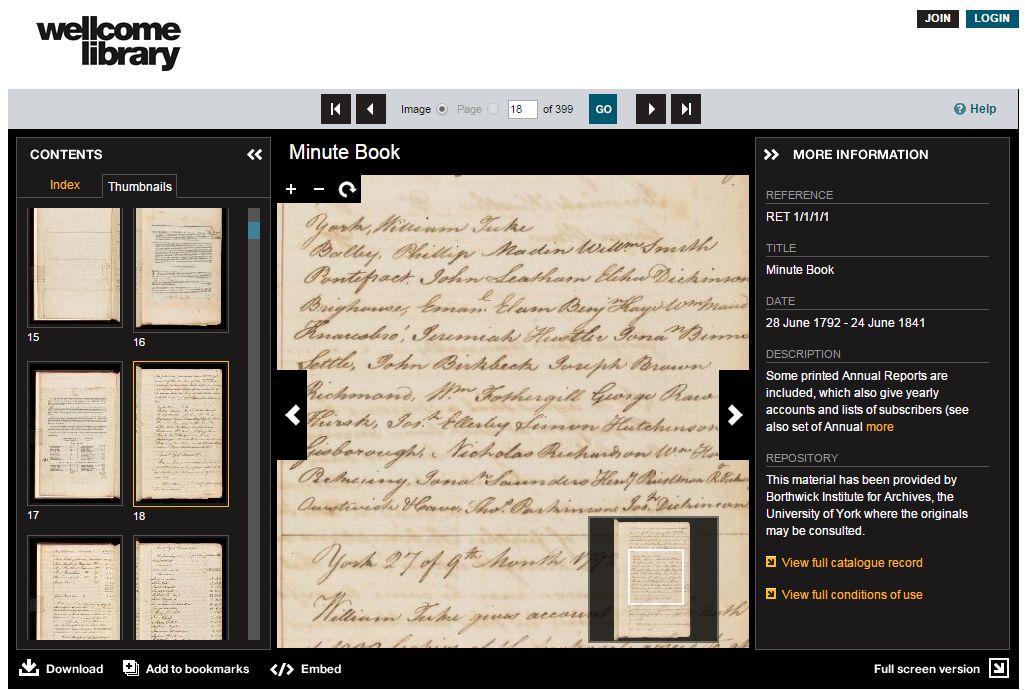
See for example the first item within the catalogue (archival reference RET 1/1/1/1), a minute book from 28 June 1792 to 24 June 1841. On the Wellcome Library catalogue we can see both the catalogue description of the item and the digital surrogates produced by our digitisation team and displayed within a viewer that allows you to move to the page of interest, zoom into the text and pan around the document.


wellcomedigitallibraryRET_1_1_1_1.jpg


This is just a taster of what is to come. We hope to highlight other interesting items from the archive as the project progresses so watch this space.


Jenny Mitcham, Digital Archivist, Borthwick Institute

Friday, 8 August 2014

George Isaac Sidebottom: Spot the Cat

Small oil painting, coloured, from Retreat Archives c.1890-1900 by George Isaac Sidebottom

Like most archives, although most of our holdings are manuscripts on parchment or paper, bound into volumes and loose leaf, we do have other objects in our strong-rooms. 

This painting shows people in the grounds of the Retreat, York, in the late nineteenth century. The Retreat was, and is, a psychiatric hospital run by the Society of Friends. It was established in the late eighteenth century and pioneered moral treatment for the mentally ill. The hospital saw its patients as no less human because of their illness, and emphasised that they should be cared for just like other people. This certainly does not sound unreasonable today but at the time it was extraordinary - standard Georgian treatments for mental patients included chaining to walls, leaving them naked in bare cells and sound beatings.

By the time of this painting, moral treatment was standard and you can see here that the patients were occupied with a variety of sports and activities including golf, cricket, tennis, croquet and football. Some figures in the background are riding bicycles. A slightly surreal element is provided by a patient lying under the tree in a bed. Painting was another pass-time. We know this because the artist who painted this picture was a Retreat patient at the time.

George Isaac Sidebottom was resident at the Retreat from 1894 until 1912. He had been a merchant in the north-west of England and was a non-conformist. He suffered from moral and religious delusions and had been ill, and in care, for some years before his admission. A letter from the transferring doctor called him "a very good fellow indeed it would be hard to find a more agreeable man. He can paint watercolours very decently, sings a little... and can accompany himself fairly well." In his case-notes, George is described as occupying himself in painting, reading, walking (including walking into town) and singing. He even played the piano, and there is correspondence to show that he was allowed to acquire a piano for his room.

He had a keen interest in games at the Retreat, and played cards, billiards, chess, croquet, cricket, hockey and tennis; he even skated in January 1895. He attended the Retreat's 'entertainments' and 'amusements' (which vary from picnics to dances to amateur dramatics) and had holidays in Scarborough at the Retreat's branch house.

References to paintings are made throughout although unfortunately this particular painting was not mentioned specifically. In January 1896 he 'painted a scene for the Lady's party at the beginning of the month' and in October that year 'he occupied himself with painting in oils and gives great attention to his work'. In December 1900 he was 'busy on a scene for the Xmas party'. Towards the end of his life, George painted 'peculiar' caricature portraits, which gave him much satisfaction. He continued painting virtually up to his death at the Retreat in early 1912.

This painting provides us an interesting glimpse of life inside a Victorian mental hospital from the patient's point of view which is all too rare among psychiatric archives. But, since this post is in honour of World Cat Day I also have to ask... Can you spot the cat? Comment below when you spot him (and no peeking until you do!)

Written by Alexandra Medcalf.