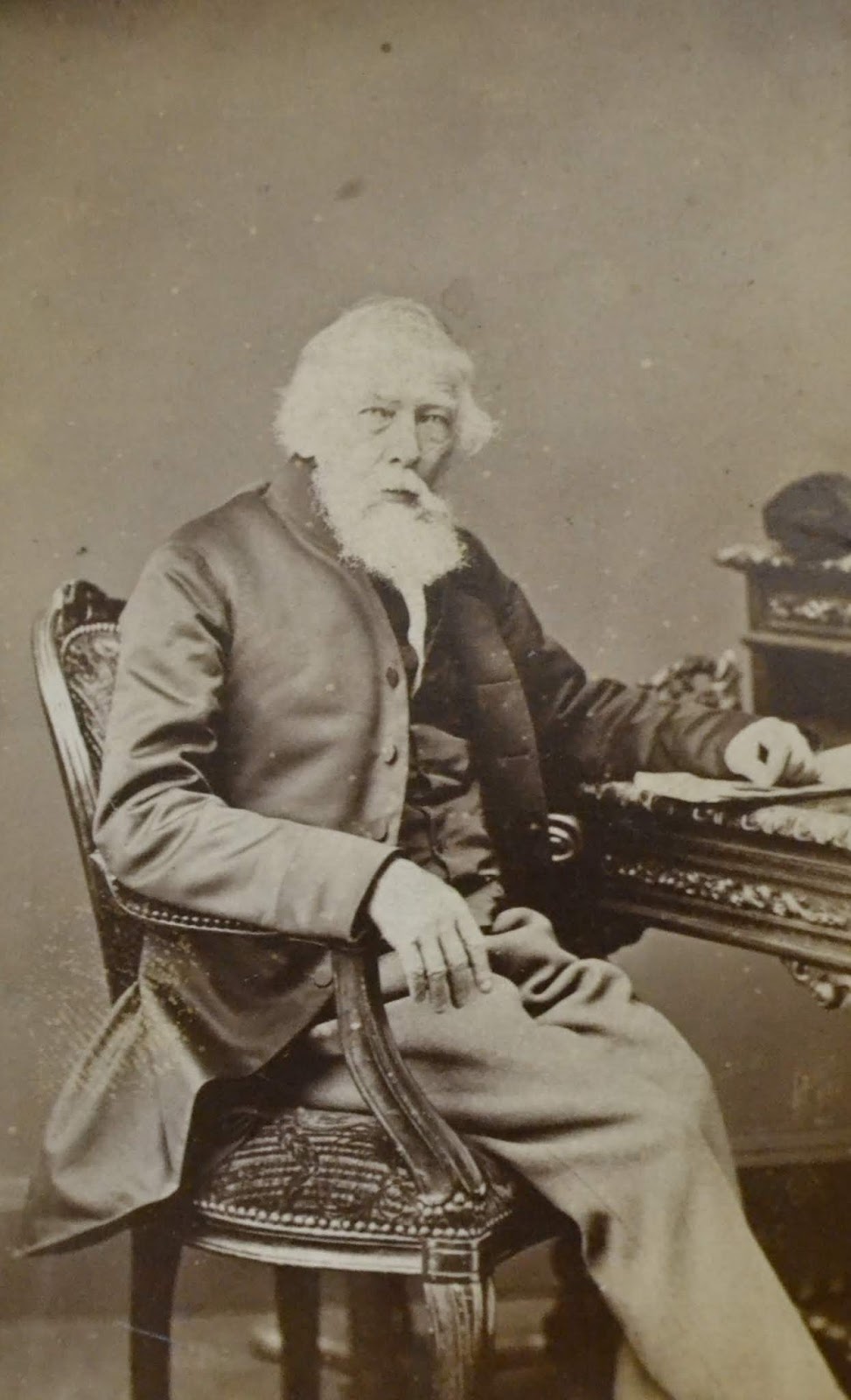
By Sarah Moses, Archive Trainee
Benjamin Seebohm (father of Joseph
Rowntree’s first wife Julia Seebohm) was born in Friedenthal, near Bad Pyrmont,
Germany, on 20 February 1798. He came into contact with English-speaking
Friends (Quakers) at a young age through his parents’ invitations to English
and American Friends to visit their small group living around Minden and Bad
Pyrmont.
Benjamin’s father Ludwig had acted as
interpreter during Friends’ visits but, due to Ludwig’s illness in 1814,
Benjamin was asked to serve in his place during the visit of French-born
American Friend Stephen Grellet. He soon adopted this role once again for a
group of English Friends, including Sarah Hustler of Bradford. Benjamin was
asked to interpret during their visits elsewhere in Europe, and was then
requested to accompany them back to England. He soon became part of the Hustler
household in Bradford, moving into their family business as a wool
merchant.
 |
| The young Benjamin Seebohm |
In 1831 Benjamin married Esther
Wheeler, a granddaughter of prominent York Quaker William Tuke. Benjamin and
Esther had four children who survived to adulthood: Henry (born in 1832),
Frederic (born in 1833), Benjamin (born in 1839) and Julia (born in 1841).
Benjamin’s gift for ministry was
acknowledged in the early 1820s, and he visited many parts of Great Britain,
Ireland and North America to speak at Meetings, often staying away from home
for many months at a time. One visit in particular had a significant impact on
Benjamin and his family: his visit to North America from October 1846 to July
1851.
Many of Benjamin’s experiences during
this visit (and Esther’s unhappiness during his absence) are recorded in
‘Private Memoirs of B. and E. Seebohm’ - a volume of recollections, memoranda
and correspondence edited by their sons and published in 1872.
Concerning Benjamin’s departure for
America, the boys wrote:
‘In 1846 the news was broken to us at
school that our father was going, probably for some years, to America. During
the summer holidays he took our mother and two of us a tour in Germany, to take
leave of his relations at Friedensthal, Minden, and Hamburg. […] When in
October the time of departure came, we were summoned home from school. Never
shall we forget his solemn and touching farewell sermon at meeting on the last
Sunday morning; the sorrowful evening, when it was so hard to all to be
cheerful; the next morning, when the carriage came to bear him away; the long
embrace between him and our mother; the wave of his handkerchief, as he drove
out of sight; and how we, the mother and weeping children, were left alone with
a sense of blank which was to last for years. What the sacrifice was to our
mother in thus sparing him for years from her side, no one can tell. The worst
was, that though our father had spared no pains to secure, as far [as] it could
be, that she should be free from anxiety, and had left his affairs in as small
a compass as circumstances would admit, yet during his absence one anxiety came
after another, and she, as so often had been the case before, had to breast it
alone’ (pp.47-48).
In one of the first letters sent to her
husband during his voyage, Esther described her sense of loss, while admitting
the necessity of Benjamin’s travel to North America to aid the Quaker ministry
there. ‘My mind has generally been favoured with quietness since thou left,
though I have felt very low these last few days, and perhaps shall more and
more realise the loss of my dearest earthly treasure; and yet I desire to
regard it less as a loss than a loan to Him who in His great kindness
put me in possession of it’ (p.178).
Benjamin reached land on 5 November
1846, arriving in Halifax, Nova Scotia. His travels took him all over North
America but he spent much of his time in Philadelphia. As mentioned above, these
journeys are vividly described in ‘Private Memoirs of B. and E. Seebohm’.
 |
| Julia Seebohm, aged 6 |
On 14 April 1849, halfway through his
visit, Benjamin wrote to his eight-year-old daughter Julia to tell her about
his recent travels around Union Springs, Albany and New York. (He wrote many
letters to his children during this time but this is the only one in our
Victorian Correspondence files. See below for a full transcript of this letter
- RFAM/JS/VC/1/1.) Beginning his journey in Union Springs on Cayuga Lake,
Benjamin soon arrived in Auburn, where he visited the prison - home to more
than 500 convicts and namesake of the ‘Auburn system’, in which silence was
enforced at all times.
He then travelled onwards to Albany,
where he was introduced to the Governor of New York, Hamilton Fish, and ‘an
Indian Chief of the Cayuga tribe’. Benjamin describes this man as being ‘fine
looking’ and ‘dressed a little like an Indian’ but he appears to have enjoyed
their meeting and encourages Julia to ask ‘Grandfather Robson’ - presumably
Thomas Robson, the father of her uncle Isaac Robson, who was married to Julia’s
maternal aunt, Sarah Wheeler - about ‘these poor people who formerly inhabited
the land now occupied by the whites’. Benjamin left Albany aboard a steamer
named ‘The Isaac Newton’ and, on arriving in New York, visited an old friend
and attended two Quaker Meetings before travelling to Philadelphia for the
Yearly Meeting.
Benjamin finally left North America at
the beginning of July 1851 but memories of his visit remained in the minds of
Friends he had met. Our Victorian Correspondence files contain two letters
written by Margaret C Kimber of Philadelphia to Benjamin’s daughter Julia in
the early 1860s. (Full transcripts of both letters are included below -
RFAM/JS/VC/27/1 and RFAM/JS/VC/27/2.)
 |
| Julia Seebohm |
In her first letter, dated 2 December
1860, Margaret updates Julia on various Friends, Quaker Meetings and missionary
visits. However, she also mentions the changing political climate in America,
stating that the ‘great “republican” victory in the last Presidential election
[...] has thrown our southern states into a tumult’ and increased the
probability of ‘a northern and southern confederacy, in which event, our
Baltimore friends fear Maryland will go with the south’. Despite ‘almost
everyone [being] apprehensive as to what may be in store for us’, Margaret
takes comfort in knowing that ‘our country is at the disposal of none of the
conflicting parties, but that her future is controlled by a merciful and all
wise Providence who [...] will bring that which seemeth to Him good’.
On a lighter note, Margaret’s mother
appears to have taken great delight in telling American shopkeepers about the
‘better articles she saw in the shops in England’ during her travels there;
whereas Englishman William Lean declared that American bookstores were ‘more
complete, extensive and well-arranged than he had seen them at home’.
 |
| Julia Seebohm and Joseph Rowntree |
Three years later, Margaret wrote again
to Julia, who had now become both a wife and a mother following her marriage to
Joseph Rowntree and the birth of their daughter Lillie. Little did Margaret
know as she wrote this letter, sent from Haverford on 12 August 1863, that her
‘dear Julia’ would be dead - most likely of meningitis - little more than a
month later.
As with her previous letter, Margaret
recounts the activities of her family and other Friends, including her own
involvement with the First Day School system, which she describes as ‘a great
privilege as well as a great responsibility’. She then updates Julia on the political
situation in America and the ‘drafting for the war’. A visit from some Friends
from North Carolina both saddened and strengthened Margaret and those around
her. One visitor in particular related the experiences of his two brothers in
Kingston, ‘who were kept without food or water for four days & four nights,
but who wrote to their friends that they did not suffer, for they had bread
from Heaven to eat, and their Master himself was with them by night and day’.
Margaret was unwavering in her support for the President, Abraham Lincoln, and
declares her ‘respect and love’ for him ‘with this honest homely ways, his
unambitious purity of motive, and his full faith in Providence’.
Finally, Margaret writes about her
interest in ‘the colored people’, stating ‘it is grand to see a nation emerging
from slavery’. She continues by mentioning the officers of the ‘colored
regiments’, whom she views as ‘men of great moral as well [as] of physical
courage’, and trusts that the ‘wicked politicians [who] for their own purposes
are trying to incite the foreign population against them [...] will not be
allowed to do any permanent harm’.
As for Benjamin Seebohm, his feelings
during the American Civil War are recorded in the ‘Private Memoirs of B. and E.
Seebohm’:
‘During the period of the American War
his feelings of sympathy with his many American friends were warmly excited.
The daily newspaper was always lying on his table, and frequently the memoranda
of his own American journeys. He kept up a correspondence with some of his
Philadelphia friends in particular. His political feelings went ardently and
throughout with the North, much as he sorrowed over the war itself. He was
deeply grieved at the hasty and unwise words of some leading English
politicians upon the triumphs of the South, and never lost his faith that the
right would prevail, and Slavery come to an end. True as were his sympathies
for the American people, his love of his “Friends” in the United States was
equally constant, and seldom did anything give him greater enjoyment than the
visits he received from those who from time to time visited this country’
(pp.57-58).
 |
| Benjamin Seebohm |
In the years following his visit to
America, Benjamin wrote several volumes, including ‘Memoirs of the life and gospel
labours of Stephen Grellet’ - whom he had met in Germany so many years before -
and ‘Memoirs of William Forster’, and worked as editor of the ‘Annual Monitor’
(a list of the deaths of British Quakers) between 1855 and 1878. He continued
to travel to speak at Meetings until 1870 and, following a bronchial
affliction, he died on 2 June 1871, and his body was interred in the Friends’
burial ground in Hitchin, Hertfordshire.
------
Transcript
of RFAM/VC/JS/1/1 from Benjamin Seebohm to his daughter Julia Seebohm
My darling Julia
Tho’ I write thee a pretty long letter
by the last steamer, and have not time to say much now, I must just tell thee
that we have got back again to the fine city of Philadelphia, where we have
many kind friends who are glad to see us. We left Union Springs, on Cayuga
Lake, last second day morning & went to a nice town called Auburn to take
the rails for Albany, but before we set off from there we paid a visit to a
large prison near the town, where more than 500 convicts are confined - as a
punishment for various crimes which they have been found guilty of. They are
not allowed to speak to one another, but are employed in making a great variety
of things for sale, such as carpets, wigs[?], tools, machinery, saddles etc
etc. They have a minister of the Gospel and two school masters to instruct them
& try to make them better and I was glad to hear that many of them are
quite reformed, and have become Christians. When we had paid our visit to the
prison we took our places in the cars & arrived at Albany quite early in
the morning. We had to wait a long time for the steamboat that was to take us
to New York, & were introduced to the Governor of the State of New York
whose name is Fish. We found in his room an Indian Chief of the Cayuga tribe.
He was a fine looking man, dressed a little like an Indian. He seemed pleased
to shake hands with us & we liked to talk to him a little. I dare say
Grandfather Robson can tell thee a little more about these poor people who
formerly inhabited the land now occupied by the whites. When we were at Charles
Howland on Cayuga Lake a nice little boy about 10 years old, the son of a
friend of the name of Richard Small from England, fell into the lake and was
drowned. We attended his funeral, & had a very large Meeting - a great many
of the town people coming to it. Children ought to be very careful not to go
near the water. His poor father & mother & two sisters were very much
disturbed & we tried to comfort them.
We left Albany in a very fine steamer
called “The Isaac Newton” & we had nearly 500 passengers. When we arrived
at New York, I went to see a dear aged friend, Eliz[abe]th Coggeshall, with
whom I first came to England, many years ago, & she enquired about my dear
little Julia & his dear Mother & brothers. I had just got your letters &
would tell her a little about you all. She sent her love to dear Mamma &
aunt Sarah, & Uncle & Grandfather Robson. We were at two Meetings at
New York & then came here to attend the Yearly Meeting.
In a few days I hope to hear again from
you all. I am very glad that thou art so happy with dear Aunt Sarah, & hope
thou writes to dear dear Mamma and gets good accounts from her & thy dear
brothers. I do love thee, very much, my darling & hope thou art trying to
be very good. Give my dear love to Uncle & Aunt & Grandfather &
Henry & Joshua, and particularly to dear Henry, Fred & Benjy when thou
writes to them. Farewell my precious Julia Elizabeth. Thy affectionate father
Benj[amin] Seebohm
Philadelphia 4/14/49
------
Transcript
of RFAM/VC/JS/27/1 from Margaret C Kimber to Julia Seebohm
Philadelphia
12 mo. 2nd 1860
My dear Julia,
As I was sitting alone this evening,
mother brought me to read a letter lately received from thy dear father, with a
nice note enclosed from thy mother. It was most pleasant to hear from you and I
felt tempted to write a few lines to thee, without having anything on my mind
but a little chat! Thou will like to know Eliza Barclay and party are
spending a pleasant week with us in Filbert St. E. P. Gurney is making her home
at John M Whitall’s opposite, and we see much of her. They are quite interested
in our city, its society, institutions etc and it is a great pleasure to us
all, to have their company. John Henry is full of life and spirits, and having
purchased a little American pistol to take home, which he was kind enough to
exhibit and explain to my boys, has become in their eyes a hero of the first
magnitude.
Our weather has been at times extremely
cold for the early winter, and we were quite satisfied to leave the country on
the 18th of last month, although on many accounts we regretted the change. The
quiet of the country we had thoroughly enjoyed, and the uninterrupted evenings
were seasons of much [home] endearment for parents & children. I do not
know whether the distinction between country and town socially, is so broadly
marked with you as it is with us. You are so much more thickly settled,
that perhaps there are few places where there is not society, and your towns
are so much larger, that there may be retirement in the crowd. We have this
winter a large Bible class, it meets here weekly. Since coming from England my
father takes great interest in it, and in the First day school, of which he is
now considered superintendent. We are very glad to have him, as before we were
feeling rather young and inexperienced.
Samuel Shipley & Anna sometimes
come in from the country to meet us. Thy father will like to know that Samuel [Kettle]
and my uncle Tho[ma]s Wiston have just returned from a visit to Muncy. They
have been among families of friends in that mountainous country, and although
Sam[uel] Kettle was taken quite ill in a very remote & inaccessible place,
(with the nearest doctor, thirty miles distant, and the snow deep on the roads)
he was favoured to recover, and accomplish his labors to the satisfaction of
his friends.
Francis King has been spending a day or
two here. He is in much trouble at the political aspect of things. If thou
takes any interest in American affairs, thou may have noticed our great
“republican” victory in the last Presidential election. This has thrown our
southern states into a tumult, and filled them with foreboding as to the
destiny of their peculiar institution.
There is now much threatening, and an
increasing probability of a secession, and the formation of a northern &
southern confederacy, in which event, our Baltimore friends fear Maryland will
go with the south. They think they scarcely could live there, in such event as
this, and yet they are not ready to think of leaving their homes. Business men
everywhere are dull and almost everyone is apprehensive as to what may be in
store for us. It is a great comfort however to reflect that our country is at
the disposal of none of the conflicting parties, but that her future is
controlled by a merciful and all wise Providence who out of all this seeming
chaos of human opinions and actions, will bring that which seemeth to Him good.
We were very glad to hear of the safe
arrival at home of your Prince of Wales. The voyage was a long one, but as it
has proved safe, a touch of sea life would do very well. I am often amused at
my dear papa. He looked upon the journey to England as something very
formidable, but now it is over, he thinks he should not at all mind taking
another trip. Even mother who was so timid, seems now to think nothing of the
dangers of the sea. They talk much about England, and we have many little
things in daily use to remind us of their travels. I tell mother she will quite
displease our American shop keepers, by telling them how much better articles
she saw in the shops in England. W[illia]m Lean however, who is with J. H.
Backhouse, was liking our book stores very much the other day, and thought them
more complete, extensive & well arranged than he had seen them at home.
I am glad to hear the labour of the
Annual monitor was concluded for the season. We scarcely think in looking at
these little returns, how much care & toil they involve. Coming so soon
after the long work of the Grellet memoirs, I hope it may not wear too much on
thy dear father’s strength.
I hope at this time you may be
enjoying, as hinted in the letter, a visit to thy brothers in the South. I think
my parents were not at Hitchin.
Dear Julia, I must conclude - do write
at some leisure time.
I must renewedly acknowledge all your
nice presents to us, the beautifully bound books, the pitcher, and the
children’s cards & toys. When I wrote before I had not seen them all, for I
was afraid to have them sent to us in the country, lest something should
happen, and they were waiting for us in town. With much love to all your
family, in which Anthony unites, thy attached friend, M. C. Kimber
Eliza Barclay desires her love to you
all, and hopes to write if she finds time. Mother says “how I wish I had urged
dear Julia to come home with us, and now she could have returned with Eliza
Barclay.” How much we should have enjoyed it, if it could have been so.
------
Transcript
of RFAM/VC/JS/27/2 from Margaret C Kimber to Julia Seebohm
Haverford
8 mo. 12th 1863.
It has been long, dear Julia, since we
have heard directly from each other, how long I can scarcely tell. Thy letter
as the last, and I have not been doing myself justice to be silent so long. I
think of you all so often and with such an unvarying feeling of interest and
affection. How I should delight again to meet your family circle, so enlarged
since we were with you. Do write and tell me of thy new home. I should so like
to hear of it. Is it not one of the compensations of leaving home to receive a
visit from our parents. I do not think we have a greater pleasure than
to have such at times. We are now boarding for a few weeks in the neighborhood
of Haverford College. Sister Mary with her family are at Germantown, a few
miles from us. My Father and Mother are at Newport for the summer, and have
with them our eldest boy, we hope to join them there before long. We have just
been reading with interest, the report of the First day School Conference at
Leeds. I noticed thy husband’s name and thy own among those who attended.
We held a much smaller Conference in
Philadelphia during our last Yearly Meeting, which we enjoyed very much. The
cause with us is still in its early beginnings. Our school at 12th St Meeting
is doing well. We have taught for three years, and find it deeply interesting.
We sometimes think the good results are more noticeable among the teachers than
among the scholars in our city, that it has proved as an anchor to some in
times of unsettlement can be said very truly. My dear husband has a class of
boys of the same age as our own, and including them; as a reward of good
conduct they take tea with us occasionally. They are all friends or professors.
My own class are young girls of nineteen or twenty. They are all birthright
members of our Society, but little more. It is a great privilege as well as a
great responsibility to have such a charge. I do not know whether thou met with
Mary Bettle when in England. We missed her very much while away. She is one of
our best and most indefatigable teachers.
We are feeling much now on account of
the drafting for the war. Many of our friends have had the lot to fall upon
them. What their fate will be we do not know, but most of them are very firm,
and some hopeful and trusting that if the trials of old are to fall to their
portion, the promises and consolations will also be fully realized.
My cousin Wiston Brown was drafted last
week. We were very much strengthened and cheered by the company of the friends
from North Carolina. They have suffered so much, have borne such a noble
testimony in the midst of the rebel army, and have been so wonderfully
preserved, that it has been deeply instructive to us all. W[illia]m Stockett
was relating to us the account of his two brothers, who were kept without food
or water for four days & four nights, but who wrote to their friends that
they did not suffer, for they had bread from Heaven to eat, and their Master himself
was with them by night and day. They are still in cruel confinement in
Kingston North Carolina. There is good hope that this state will return to the
Union at an early day, when we trust there dear friends with their families may
be relieved from their sufferings. The five young men who were with us are all
in poor health, having contracted disease and cold from long marches and
exposure. Three have gone to their friends in the west, two who are too unwell
to travel are still with us. In regard to the great revolution through which
our country is passing, our hearts are bound up with the cause of our
government and the cause of freedom. We respect and love our President with his
honest homely ways, his unambitious purity of motive, and his full faith in
Providence. We believe it is in the divine ordering that such a man at the
present crisis should be the head of our government, and we feel anxious to
support his administration to the extent our consciences will allow.
For the colored people we are deeply
interested. It is grand to see a nation emerging from slavery. Wicked
politicians for their own purposes, are trying to incite the foreign population
against them, but we trust they will not be allowed to do any permanent harm.
My cousin in command at Yorktown, Virginia, writes my Uncle Thomas Wiston to
try and find a friend to come out and take charge of 3000 freedmen within his
lines. The colored regiments are steadily fighting their way up, we cannot help
following them with interest. Their officers are men of great moral as well of
physical courage, deeply interested in what they consider the Providential mode
for the elevation of the race. The 54th Massachusetts were at Battery Wagner in
front of Charleston, has a Lieutenant Colonel, and Captain from among our best
Haverford boys (not friends) the first terribly wounded in the last assault.
I am afraid thou can not make out the
cross writing dear Julia. Will thou give our love affectionately to every
member of your family. Our special thanks to thy brother Fred for his
acceptable gift of his book. We enjoyed it very much ourselves, and have made
much use of it in lending to our friends. We have been very remiss not sooner
to have acknowledged his kindness. My husband wrote to thy dear father last
week. I hope it has reached him. Write to me soon dear Julia that I may learn
to love thy English name. With kindest regards to thy husband. I am thy
affectionate friend
Margaret C. Kimber